Not a subscriber yet?
Sign up here.
|
|
Who Owns the Generative AI Platform?
|
|
by Matt Bornstein, Guido Appenzeller, Martin Casado
|
|
| |
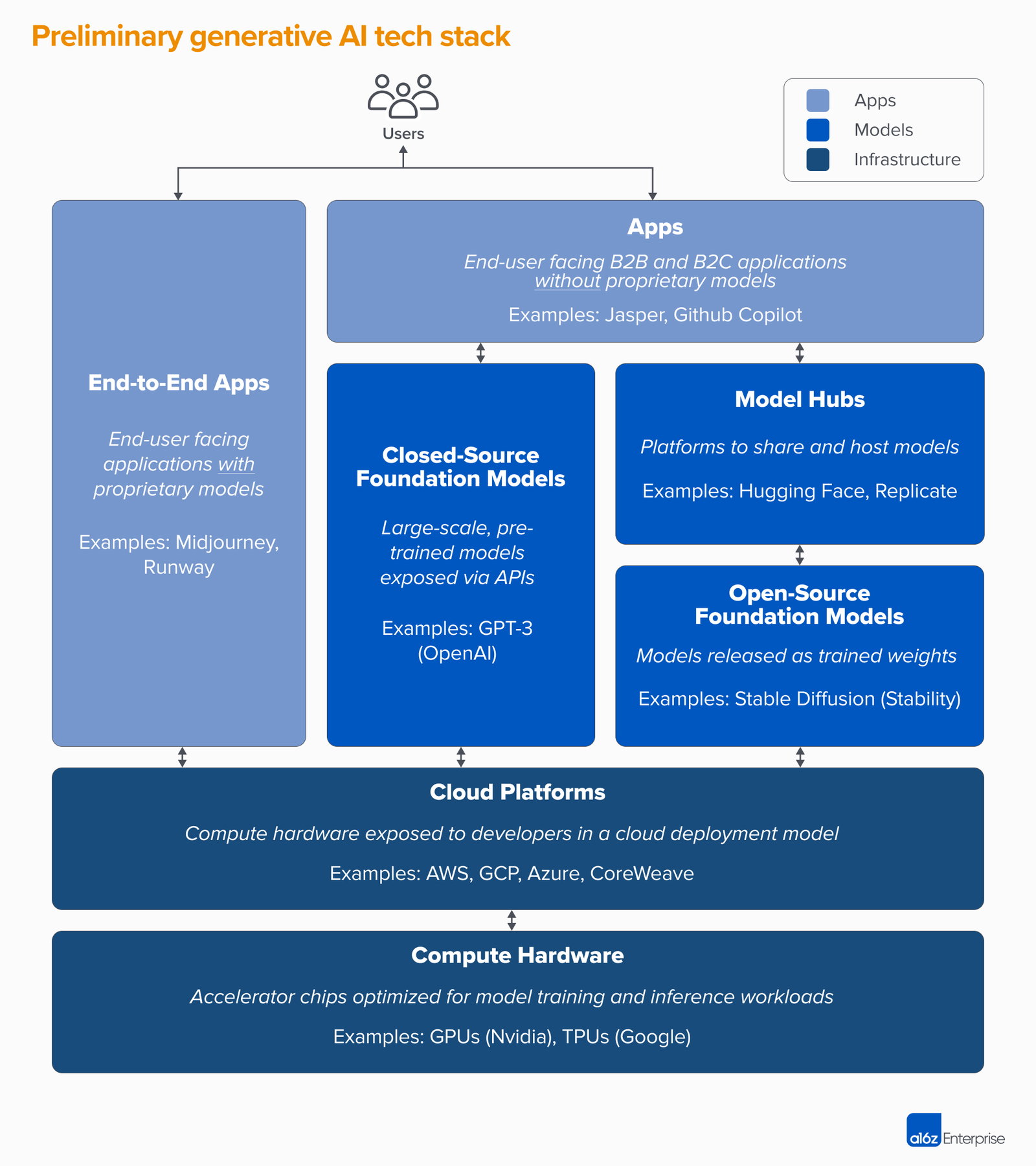
We're starting to see the early stages of a tech stack emerge in generative AI. Hundreds of startups are rushing into the market to develop foundation models, build AI-native apps, and stand up infrastructure/tooling. But which parts of the stack are truly differentiated and defensible?
|
|
| |
|
|
Temu: What It Is, and Why It Matters
|
|
|
|
| |
A little-known shopping app has quietly overtaken TikTok, YouTube, and Amazon to become the most downloaded free app in the U.S. Temu is a discovery-based shopping app that offers an interesting case study on differing go-to-market strategies between U.S. and Chinese consumer companies.
|
|
| |
|
|
Market Annealing: Getting to $10M ARR in Very Early Markets
|
|
by Martin Casado, Peter Levine
|
|
| |
Understanding how to build a company in the face of a new, immature, or non-existent market is a topic startups should obsess about. Finding product-market fit is only part of the journey. Most companies don’t find a magical product that just happens to address a key pain point in the market. Rather, they engage in a multi-year-long battle of hammering the shit out of the company and the market simultaneously, trying to get the two to hold together. Martin Casado and Peter Levine refer to this joint dance between company and market as market annealing. In this post, they share examples and frameworks from their firsthand experience building companies.
|
|
| |
|
|
The Evolution of Programming Languages
|
|
with Sam Blackshear, Noah Citron, Eddy Lazzarin, Sonal Chokshi
|
|
| |
What are the differences between smart-contracts programming and traditional programming—and where does programming for blockchains sit in the long history and evolution of programming languages overall? In the latest episode of ‘web3 with a16z,’ we overview all things programming languages, crypto, and beyond for both existing blockchain programmers and for other developers seeking to enter the space. But the discussion is also for anyone interested in the intersection of language, code, and expression.
|
|
| |
|
|
Expert AI as a Healthcare Superpower
|
|
with Vijay Pande, Marc Andreessen
|
|
| |
The last few months have seen dramatic—almost magical—applications of expert generative AI released to the public. But what does this mean for healthcare and bio? Vijay and Marc sat down for a wide-ranging discussion on AI as an additive superpower for healthcare, as well as screenplays, music, and more.
|
|
| |
|
|
The Price Isn’t Right: 3 Pricing and Packaging Pitfalls to Avoid
|
|
|
|
| |
Problems with pricing and packaging models at growth-stage companies are less obvious than at earlier stages. Monetization strategies that drove adoption early on won’t necessarily drive growth and profitability later. While every business is different, here are three telltale signs that a late-stage company’s pricing and packaging strategy isn’t working—and some approaches to getting it back on track.
|
|
| |
|
|
The Key to Selling in a Downturn—and Showing Customers Why You’re Valuable
|
|
|
|
| |
With the explosion of product-led growth over the past several years, companies bought a significant amount of software through non-traditional channels, like product teams. As the macro environment has shifted and companies try to do more with less, CFOs are consolidating their investments. Here’s how to ensure your product doesn’t get cut.
|
|
| |
|
|
Developing Frameworks for Crypto Regulation
|
|
by Miles Jennings, Brian Quintenz
|
|
| |
Two extremes clash over web3 regulation: One faction that argues for applying existing regulations wholesale to web3; and the other that argues for completely excluding web3 from existing, successful regulatory frameworks. But both produce bad policy outcomes. So how to resolve this tension? Regulate businesses, not software (the decentralized, autonomous software and underlying blockchains, smart contracts, and networks that provide the internet with new functionality). Check out part one, two, and three of our series on developing pragmatic frameworks for web3 regulation.
|
|
| |
|
|
Aligning Product and GTM Teams with Better Segmentation
|
|
by Zeya Yang, Baker Shogry
|
|
| |
Segmentation is a powerful tool for driving product success, and an effective means to align the priorities of product teams and go-to-market teams. It unifies conversations and debates around “what you’re building” and “what you’re selling.” Understanding the nuances of segmentation and how to do it well can have a huge upside, especially for B2B companies.
|
|
| |
|
|
|
|
by Joshua Lu, Andrew Chen
|
|
| |
Seidr is a games company building the next generation of midcore cross-play games.
|
|
| |
|
|
|
|
by Angela Strange, Alex Rampell
|
|
| |
Cygnvs acts as the system of record to manage pre-incident preparation and post-incident response for cybersecurity breaches.
|
|
| |
|
|
|
|
by Arianna Simpson, Andrew Chen, Robin Guo
|
|
| |
PLAI Labs is building the next generation of social gaming platforms leveraging AI and web3.
|
|
| |
|
|
|
|
by Anish Acharya, Marc Andrusko
|
|
| |
Method is an embedded, debt-focused API that allows consumers to link all their outstanding liabilities accounts and make real-time payments.
|
|
| |
|
|
|
|
by Andrew Chen, Jack Soslow
|
|
| |
Voldex acquires, improves, and builds games on the massive user-generated content platforms Roblox and Minecraft.
|
|
| |
|
|
You are receiving this newsletter since you opted in earlier; if you would like to opt out of future newsletters, you can unsubscribe immediately.
The views expressed here are those of the individual AH Capital Management, L.L.C. (“a16z”) personnel quoted and are not the views of a16z or its affiliates. Certain information contained in here has been obtained from third-party sources, including from portfolio companies of funds managed by a16z. While taken from sources believed to be reliable, a16z has not independently verified such information and makes no representations about the current or enduring accuracy of the information or its appropriateness for a given situation. In addition, this content may include third-party advertisements; a16z has not reviewed such advertisements and does not endorse any advertising content contained therein.
This content is provided for informational purposes only, and should not be relied upon as legal, business, investment, or tax advice. You should consult your own advisers as to those matters. References to any securities or digital assets are for illustrative purposes only, and do not constitute an investment recommendation or offer to provide investment advisory services. Furthermore, this content is not directed at nor intended for use by any investors or prospective investors, and may not under any circumstances be relied upon when making a decision to invest in any fund managed by a16z. (An offering to invest in an a16z fund will be made only by the private placement memorandum, subscription agreement, and other relevant documentation of any such fund and should be read in their entirety.) Any investments or portfolio companies mentioned, referred to, or described are not representative of all investments in vehicles managed by a16z, and there can be no assurance that the investments will be profitable or that other investments made in the future will have similar characteristics or results. A list of investments made by funds managed by Andreessen Horowitz (excluding investments for which the issuer has not provided permission for a16z to disclose publicly as well as unannounced investments in publicly traded digital assets) is available at https://a16z.com/investments/.
Charts and graphs provided within are for informational purposes solely and should not be relied upon when making any investment decision. Past performance is not indicative of future results. The content speaks only as of the date indicated. Any projections, estimates, forecasts, targets, prospects, and/or opinions expressed in these materials are subject to change without notice and may differ or be contrary to opinions expressed by others. Please see https://a16z.com/disclosures for additional important information.
|
|
|
|
|
Software Is eating the world
|
|
MENLO PARK OFFICE
|
|
2865 Sand Hill Road, Suite 101
Menlo Park, CA 94025
|
|
|
SAN FRANCISCO OFFICE
|
|
180 Townsend Street
San Francisco, CA 94107
|
|
|
NEW YORK OFFICE
|
|
11 Madison Avenue, 15th Floor
New York, NY 10010
|
|
|
|