Welcome back to another edition of AI, Tech & Money. This is Kendra Barnett reporting from New York.
It’s been another quiet week with a sluggish news cycle. Oh, wait! Just 15 short months after Donald Trump promised he’d be a peacetime president who didn’t “start wars,” the U.S. and Israel have kicked off a fresh and bloody conflict with Iran. It’s the first for the U.S. likely to materially rely on AI and automated technology from the outset. The U.S. military reportedly used Anthropic’s flagship Claude model in early strikes on Iran—just hours after Trump barred the AI lab from government use in response to the company’s rejection of the Pentagon’s ultimatum demanding unfettered access to its tech.
Then, OpenAI’s arrival at a deal with the Defense Department sparked outrage and calls for a ChatGPT boycott. Many consumers pronounced plans to switch to Claude. As I reported earlier this week, Anthropic wasted no time capitalizing on its rival’s poor fortune, promoting a tool that makes it easy for users to migrate to its platform and import its chat history from other LLMs.
Meanwhile, over at Elon Musk’s X, creators are being booted from the revenue-sharing program if they fail to disclose when war videos are AI-generated. Though that’s just good practice for stemming misinformation, it could have the welcome second-order effect of encouraging advertisers to spend on the platform. With its ad revenue still just half pre-Musk takeover levels, the platform has been proactively courting agency and brand marketers by promising more brand safety. This week, I got my hands on a 44-page deck that the company presented to advertisers last week on just that. The development represents a renewed push by the platform to drive ad revenues. Keep scrolling for the full scoop.
A reminder that replies to this email go directly to my inbox, so feel free to reach out with feedback or tips. If you want to spill the tea, ping me at kendra.16 on Signal.
|
|
|
If you were forwarded this newsletter, you can sign up here. |
|
|
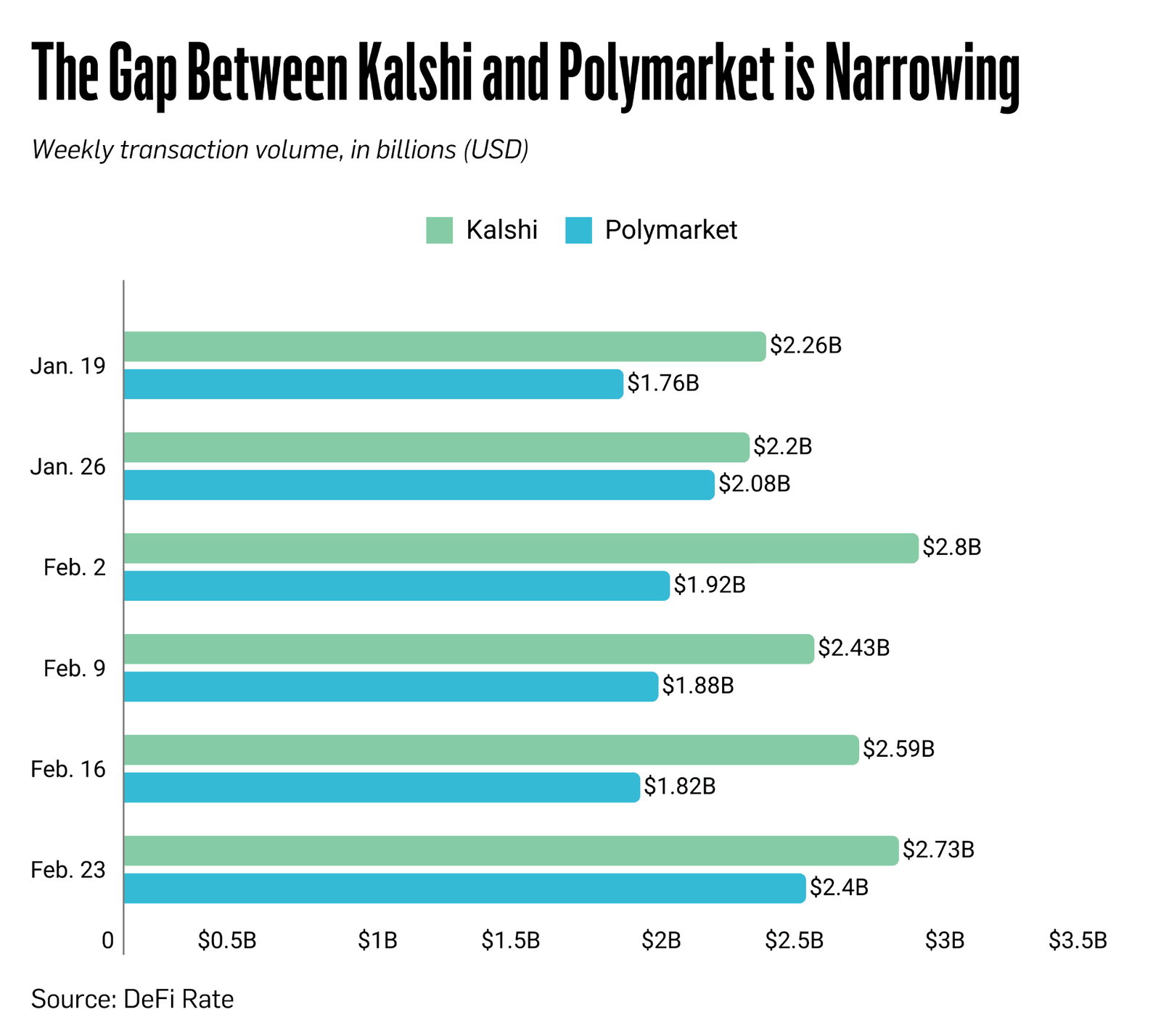
Total transaction volume across the most popular prediction markets, Polymarket and Kalshi, reached $5.8 billion during the week of Feb. 23-March 1, a more than 10% lift from the previous week, according to DeFi Rate, which aggregates data from across blockchains, platform APIs, and proprietary datasets. The surge was likely driven by interest around major events like President Trump’s State of the Union address on Feb. 24 and the U.S. and Israel’s attack on Iran beginning on Feb. 28.
At the same time, transaction data indicates that the market gap between Polymarket and Kalshi—which together act as a duopoly in the U.S., controlling the overwhelming majority of market share—may be closing.
|
|
|
X Courts Advertisers with Promises of Grok-Enabled Safety Weeks After Deepfake Fiasco |
X wants to attract investment from advertisers, so it’s wooing them with fresh promises of brand safety on its platform—which, in case you’ve been living under a rock, has seen a sustained increase in hate speech and misinformation since Elon Musk’s $44 billion takeover in 2022.
A new pitch deck, presented to advertisers last week in a webinar and obtained by ADWEEK, shows that the company is making assurances about the safety controls and transparency features that brands can use to avoid appearing next to less-than-desirable content on X.
Core to X’s renewed brand safety promises? Grok, the AI chatbot operated by X’s parent company, xAI, and integrated natively into X. The deck claimed Grok has an “average brand safety score” higher than 99.99% as determined by media quality firms IAS and DoubleVerify. It is a strange claim. While DoubleVerify has publicly assigned X a brand safety rate of 99.99%—a figure that refers not to the share of content that is safe on the platform, but to the rate of effectiveness of X’s brand safety systems—that rate has never been presented as a reflection of Grok. When asked, DoubleVerify declined to comment; IAS pointed me to a blog post that included no mention of Grok.
|
Grok, Musk’s brainchild, enjoys comparatively loose safety restrictions, evidenced by its ‘spicy mode’ for NSFW conversations and ‘Ani,’ the sexualized anime-style avatar through which users can choose to interact with the tool. To dial up the irony of pitching Grok’s brand safety capabilities to marketers who manage millions of dollars in budgets, the dust is still settling on a recent brand safety nightmare perpetuated by Grok: the dissemination of explicit, nonconsensual deepfakes of X users earlier this year.
Paired with the chatbot’s transformation into a Hitler-loving demon one day last summer and Musk’s ongoing plans to make Grok “more unhinged,” one can reasonably assume Grok is not exactly a marketer’s ideal vanguard for brand safety.
But desperate times call for desperate measures, and X is, indeed, desperate for advertiser dollars. Its ad revenues in 2025 tallied $1.25 billion, approximately half that of 2021, pre-Musk, according to Emarketer estimates.
How X, and Musk himself, are thinking about the role of advertising in the social platform’s future is yet unclear. Upon the unceremonious departure of CEO Linda Yaccarino last summer, there was some speculation that X may be moving away from advertising in a definitive shift toward an AI-powered utility model. (Of course, uncertainty around X’s commitment to an ads model has been intensifying since at least 2023, when Musk told advertisers, “Go fuck yourself,” in an onstage interview with the New York Times’ Andrew Ross Sorkin).
Eight months later, that doesn’t appear to be the case. The company has named its former head of the Americas Monique Pintarelli as its new head of global advertising, signaling a new focus on the revenue stream. Just last week, the platform opened up its aspect ratio support for videos and images, making it easier for advertisers to repurpose assets from different media environments. Plus, X’s head of product Nikita Bier told me earlier this year that Grok will be able to help brands “get a pulse on what people are saying about their product or brand.” That was evidenced in the lead-up to Super Bowl LIX last month, when X piloted BrandRanx, a Grok-based tool that analyzes millions of posts and engagement data to create a leaderboard highlighting the brands that dominated conversations around the event on social media.
Then, after the U.S. and Israel’s strikes on Iran Feb. 28—and the subsequent flurry of attacks levied by Iran across the Middle East—Bier took to X to announce that the company would begin suspending creators from its revenue-sharing program for failing to disclose when videos depicting armed conflict are AI-generated. Aside from being a sensible move to stem the spread of war-related misinformation on the platform, Bier and his colleagues would surely have known that the move would read well to advertisers. Less misinformation equals greater brand safety.
In my previous conversation with Bier, he said he envisioned a future for X that wouldn’t have to choose between an ads-based and an AI-driven business model—they could do both, he argued. Whether the approach will translate to long-term financial growth for the business remains to be seen.
For now, it’s obvious that X won’t soon give up on advertisers, who previously generated 90% of the company’s revenues. Mr. Musk can tell them to go fuck themselves, but X would almost certainly be fucked without them.
|
|
|
AI, Tech & Money covers the intersection of artificial intelligence, emerging technology, and the business forces shaping them — from groundbreaking research and infrastructure shifts to the investors, startups, and strategies driving the next wave of innovation. Each issue breaks down how new AI developments translate into real economic impact, market opportunities, and competitive advantage across industries. |
|
|
|
|