|
Welcome back to another edition of AI, Tech & Money. This is Kendra Barnett reporting from New York.
This week, I popped into the 25th annual Isaac Asimov Memorial Debate, moderated by the iconic Neil deGrasse Tyson at the American Museum of Natural History in Manhattan. In a fun tradition, both the subject and the participants are announced on the spot. This year, former Google CEO Eric Schmidt was joined by five computer scientists and scholars to pick apart all things AI, from the existential risks of achieving superintelligence to real-life impacts of AI on the labor market. As I reported exclusively, Schmidt locked horns with a former chief technology officer of the FTC and a leading AI researcher on governance and safety. It was intense and very cool to watch IRL.
But the real buzz in the industry this week has been all about Publicis and The Trade Desk. Earlier this week, the French holding company sent a memo to clients, obtained by ADWEEK, urging them to avoid transacting on the popular demand-side platform after it claimed the company failed a third-party audit of its fee structures and media and data spend. The Trade Desk denied that charge, and CEO Jeff Green has taken to LinkedIn to defend the adtech firm’s practices. But some say are pointing out the apparent irony in Publicis' finger-pointing over transparency concerns. More on that in my feature below.
Meanwhile, my boss, ADWEEK editor-in-chief Ryan Joe, chatted with Canva late last week at its AI Vision event in New York City. Since 2024, Canva has been on an acquisition spree, which is why it now has an enterprise-grade creative suite competitive with Adobe.
What struck Ryan was how bottom-up Canva’s competition strategy is. It’s making complex ad production tasks easy for non-designers on a marketing team, whereas Adobe remains a traditional, heavy-duty market stack designed for experienced creative pros.
This enables Canva’s Trojan Horse offense, where it shows enterprise procurement teams that their employees are already using individual Canva accounts—so it makes sense to unite them all via an enterprise-wide single sign-on.
Sneaky. Though the big question is whether that will be enough to help Canva displace Adobe at scale.
As always, replies to this email go straight to my inbox, so feel free to share feedback or tips. Or ping me at kendra.16 on Signal.
|
|
|
If you were forwarded this newsletter, you can sign up here. |
|
|
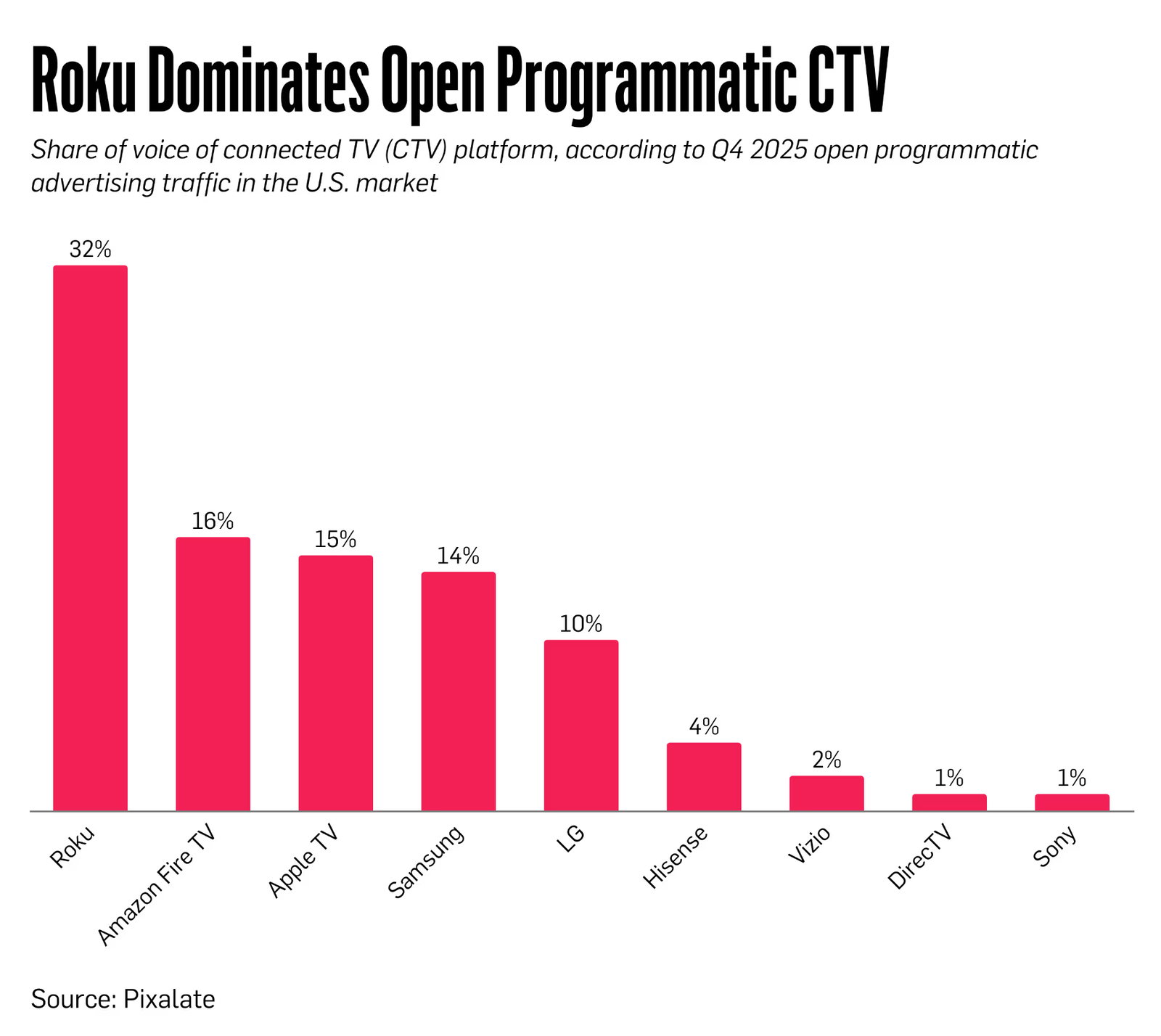
Roku’s connected TV (CTV) platform controlled 32% of the total U.S. share of open programmatic CTV advertising in the fourth quarter of 2025, per recent Pixalate data. Amazon Fire TV trailed with 16%. But the platform with the biggest quarterly jump was LG, which saw a nearly 80% spike from the previous quarter. |
|
|
|
Creative Agents That Make You Prolific |
Expand creative capacity without expanding headcount. Luma is the force multiplier for your team, executing creative work end-to-end with full context from brief to final delivery.
Request a Demo
|
|
|
Publicis Dumps The Trade Desk—Critics Cry Hypocrisy |
Three of the world’s largest advertising groups have now pulled back dramatically from The Trade Desk, the world’s most popular independent demand-side platform.
Just weeks after we reported that Dentsu and WPP exited OpenPath—The Trade Desk’s supply path for direct publisher deals—French holdco Publicis sent a memo to clients, obtained by ADWEEK, advising them to stop using The Trade Desk altogether.
Publicis claimed in the memo that The Trade Desk failed a third-party audit of its fees and media and data spend. Specifically, the company said the firm “improperly” applied its DSP fee to some tools that Publicis and its clients were automatically opted into, without providing evidence that the additional purchases had been authorized. Additionally, Publicis claimed the DSP did not turn over all the information requested by the auditor. As a result of these issues, Publicis said it could “no longer recommend The Trade Desk for our clients.”
Sources close to Dentsu and WPP also cited concerns about undisclosed fees and a lack of transparency for the decision to abandon OpenPath.
In response to Publicis’ move, The Trade Desk staunchly defended its position. In a statement shared by a company spokesperson—and later echoed in a LinkedIn post by the company’s CEO Jeff Green—the DSP claimed it did not fail the audit. The company said it was not able to fulfill the auditor’s full requests because it could not disclose data that would breach confidentiality agreements with partners and customers.
The Trade Desk’s stock tumbled around 13% on the news.
But some players are suggesting it’s ironic that Publicis would call out The Trade Desk for poor transparency.
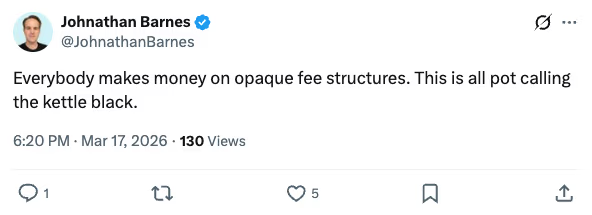
That’s because, in adland, hidden fees are often part and parcel of the deal—including when dealing with holdco agencies. Jay Friedman, the former CEO of indie agency Goodway Group, for example, claims that because clients aggressively squeeze agency fees, those fees are no longer sufficient for covering the real cost of services. As a result, many agencies can no longer rely on transparent, upfront compensation to sustain them. Instead, they have to “generate profit from hidden fees and undisclosed arrangements,” he wrote in an op-ed for ADWEEK this morning.
He’s alluding to a slew of practices from media arbitrage to bundled fees and undisclosed kickbacks from vendors. He suggested that the industry has fallen into a kind of mutual dependency loop, where everyone benefits from complexity and transparency threatens multiple revenue streams at once.
|
On the whole, Friedman wrote, “Opacity has become a business model.”
The Trade Desk’s Jeff Green said that he plans to address “the most ironic programmatic practice, principal-based buying,” next week. Green is referring to the practice of buying media upfront and then reselling it to clients at a markup (which is not one and the same as arbitrage, which would see the agency pocket the spread between what the media costs and what clients are charged).
Principal buying is a common practice in ad agencies today. After Omnicom’s $13.5 billion takeover of IPG last fall, experts predicted the principal practice at that holdco would only grow—but Publicis has long been viewed as the king of principal buying. (Though Publicis would play this down, telling ADWEEK in late 2024, that only 1% total U.S. media revenues are derived from principal media trading—still a substantial number for a $21 billion company).
So in the eyes of The Trade Desk and some others, Publicis’ withdrawn endorsement is all a bit, ‘People who live in glass houses shouldn't throw stones.’
|
|
|
AI, Tech & Money covers the intersection of artificial intelligence, emerging technology, and the business forces shaping them — from groundbreaking research and infrastructure shifts to the investors, startups, and strategies driving the next wave of innovation. Each issue breaks down how new AI developments translate into real economic impact, market opportunities, and competitive advantage across industries. |
|
|
|
|