|
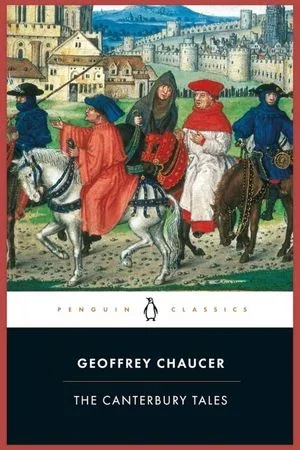
"Travellers turn up one April day at a real inn, the Tabard, in Southwark. There are thirty-one of them. A knight has come with two retainers, a Prioress with four. Six are guildsmen riding together. The guildsmen have come only from London, as has the manciple: the steward of a household of lawyers. Others have travelled from far: a scholar from Oxford, a reeve from Norfolk, a master mariner from Dartmouth.
They have not met up by arrangement. The Tabard is simply a pleasant place to stay: on the edge of London and (like an airport hotel) well placed for an early start on a journey. The journey is a pilgrimage to Canterbury, which will take about two days easy riding, for all the pilgrims have brought horses with them. But although they are mostly strangers to each other, it is sensible for them to travel together. That way, they are a strong group, protected from thieves on the road.
It is the Host, the real Harry Bailey, landlord of the inn, who welds them together from an assortment of people to a company with a common purpose: the telling of stories on the way. Chaucer’s original idea was to have each person telling two tales out and two tales back. That involved him writing 124 tales, or more if the Host took part. But only twenty-one tales were ever completed, and two others were left unfinished. Chaucer ran out of time. He lived for only about thirteen years between getting the idea for The Canterbury Tales and dying in his late fifties in 1400.
The Tales have been the subject of a vast amount of research and scrutiny. They are chiefly studied as literature, that is to say as works of art and of the imagination. My route to writing Chaucer’s England has been that of a historian. When I first encountered Chaucer at school, I was taught that he was a creator of characters, a clever observer of human pretensions and failings. In fact, I was ticked off for asking what he told us about the England of Richard II.
|
|
But literature always comes to me with a strong smell of the time that it was written. When I read Shakespeare, I feel I am in Tudor England; when Jane Austen, in the polite society of George III’s reign. So also with Chaucer. Of course, he was an original artist, conceiving characters and situations that are fictional. But he was also shaped by the time in which he lived, by its prejudices and its values.
Take the Knight, for example. He is an idealised figure, ‘very parfit’ and ‘gentle’ meaning well-bred. He is a famous crusader. In real life, some of the knightly sort were quarrelsome and untrustworthy. Some were rebels and paid for the fact with their lives. Crusaders were not very common. So the Knight is not a typical knight of his day, but who would be? How nowadays could you have a typical politician or policeman or schoolteacher? He embodies an ideal. Chaucer’s contemporaries still cherished this ideal, and they paid great respect to those who went on crusades.
Or, in another case, take the Friar. At school I was given to understand that friars were common figures in society and that Chaucer had managed to see below their disguise and show how much hypocrisy there was in their life-style. They claimed to be poor and humble. In truth they were crafty and self-seeking, preferring the company of wealthy people, especially women, to that of the poor.
What I was not told was that this view of friars arose in the thirteenth century, due to quarrels in the University of Paris. These quarrels inspired the great French writer of that age, Jean de Meun, to attack friars in what became one of the most widely read books of medieval Europe, the Roman de la Rose. English authors read the Roman and seized with delight on Jean’s sly thrusts at the friars. By Chaucer’s time, a reader expected a portrait of a friar to be a satirical one.
This turns my school lessons upside down. Arguably, Chaucer has not discovered the failings of friars and thereby started a slow disenchantment with the medieval Church that people used to say led to the Reformation. Instead, he has taken over a tradition, and his readers accept it alongside knowing friars and often giving them charity. It is like someone today watching stories about Arthur Daley and then buying a second-hand car.
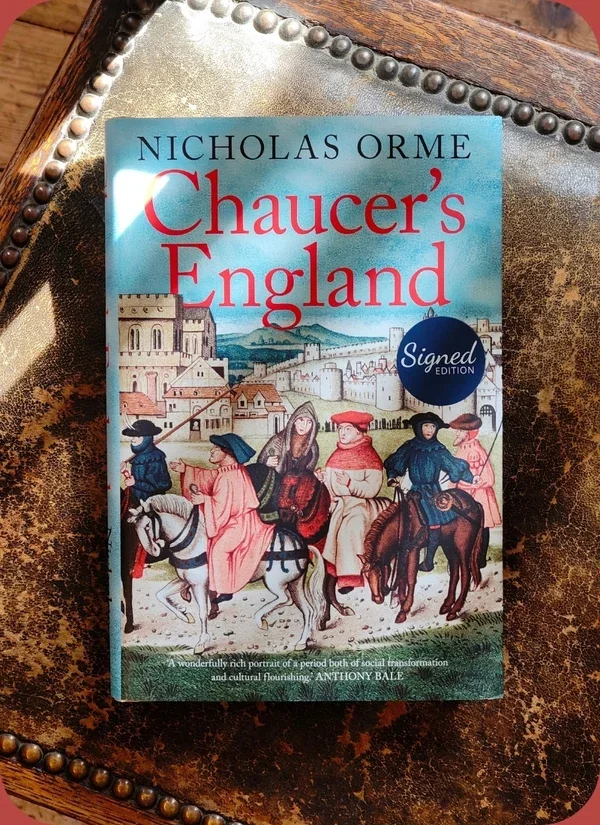
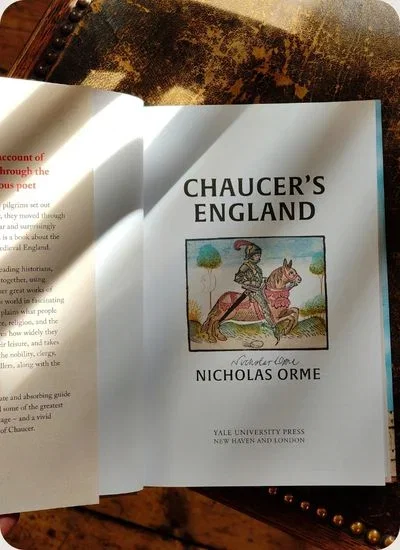
Chaucer’s England looks at all the pilgrims and considers how Chaucer’s descriptions of them were shaped by the times in which he lived, and what we can learn from the pilgrims about those times. The remarkable breadth of his work – because the tales add more to the character sketches – takes us into the whole life of fourteenth-century England.
He helps us to see what sort of country it was, how varied, how far it knew about the rest of the world. One of his tales is about Genghis Khan. He shows us how society was organised. As a former page, he knew exactly how different ranks should be graded and greeted. He introduces us to the main social groupings: the aristocracy, the clergy, townspeople, and country dwellers. He uses town and countryside in his stories. He takes us out of the fields and into the forests.
And he reminds us of something else that we forget. Most of his pilgrims are literate people. They have been to school, they keep accounts of their money, they send letters and receive them. Their children and grandchildren will be reading Chaucer himself. Altogether he is a wonderful guide to his age, a guide who sometimes has a sly grin and should not be taken seriously, but a guide who, if he had been more serious, would not be the charming companion that he is."
|