By Editors of Encyclopaedia Britannica |
|
|
Thanks for following The Pitch over the last two months! We hope you had as much fun as we did covering the 2026 FIFA World Cup and reliving the rich history of football, filled with triumphs, heartbreaks, records, and controversies.
In our final edition, we recap the tournament final and list the most memorable records of the 2026 tournament.
|
|
|
Credit: © Evrim Aydin—Anadolu/Getty Images |
Spain Triumphs over Argentina |
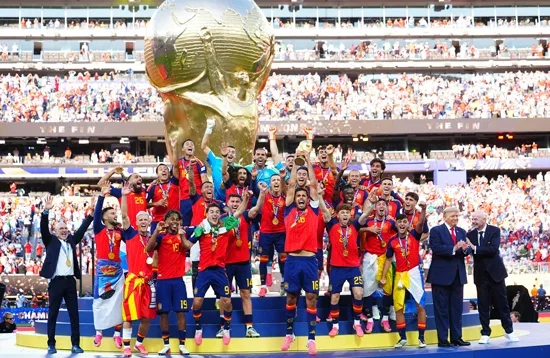
Spain won its second FIFA World Cup title, beating Lionel Messi’s Argentina 1–0 after extra time in the final of the 2026 edition. Unlike the free-flowing, high-scoring third-place playoff, in which England beat France 6–4, the final match proved much less exciting, as both teams played cautiously. Tied 0–0 after 90 minutes, the match went into extra time, with Argentina reduced to 10 men after its midfielder Enzo Fernández was sent off. Early in the second half of extra time, Spain’s Ferran Torres pounced on a cushioned header from his teammate Nico Williams and lashed the ball into the net. The 1–0 lead was enough for Spain to be crowned world champion.
The 23rd FIFA World Cup was the biggest in the tournament’s history, with 48 teams and 1,248 footballers playing more than 100 matches over 39 days. U.S. Pres. Donald Trump attended the final and, along with FIFA president Gianni Infantino, presented the trophy to the winning team. Here are some of the firsts and records that occurred during the competition.
2026 FIFA World Cup Records and Highlights
|
- France’s Kylian Mbappé (22 goals) and Argentina’s Lionel Messi (21 goals) surpassed German player Miroslav Klose’s all-time World Cup record of 16 goals.
-
Mbappé, who scored 10 goals, won the Golden Boot as the tournament’s top scorer, becoming the only player to win the award more than once. He had also won the Golden Boot in the 2022 edition.
- Spain’s Rodri claimed the Golden Ball as best player, and Unai Simón won the Golden Glove as best goalkeeper.
-
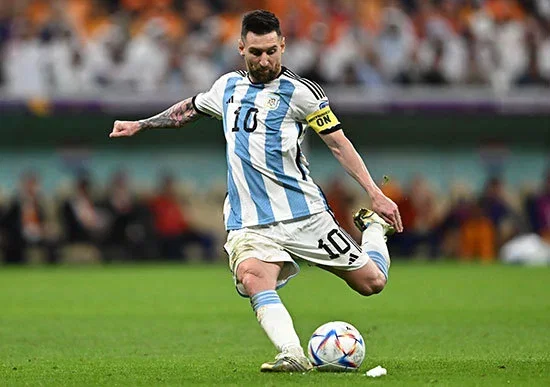
Messi set several records during the 2026 edition, including the longest scoring streak (9 matches), the most World Cup appearances (34 matches), the most assists (12), the most missed penalties (4), and the most World Cup finals as a starter (3).
- Portugal’s Cristiano Ronaldo became the first player to score in six editions of the FIFA World Cup.
-
English player Jude Bellingham made history as the only midfielder to score seven goals in a single World Cup tournament.
- The Japan vs. Tunisia group-stage fixture marked the 1,000th match in World Cup history.
- Argentina’s Enzo Fernández scored the 3,000th goal in men’s World Cup history during a round-of-16 match against Egypt.
-
England secured a third-place finish, marking its best World Cup result since it won the tournament in 1966.
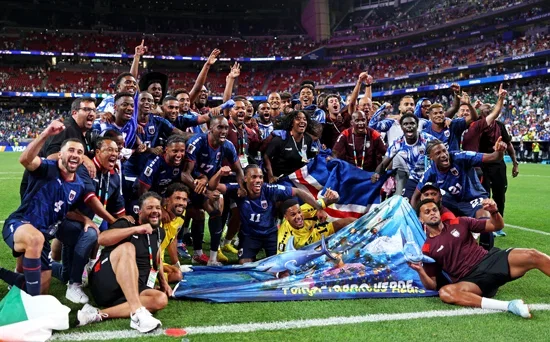
- Cabo Verde became the smallest country to reach the tournament’s knockout stage.
- Forward Erling Haaland helped deliver Norway’s best result in the tournament’s history.
-
The 2026 edition drew a record crowd of more than 6.6 million people and produced a whopping 308 goals, shattering the previous marks of 3.6 million attendees at the 1994 World Cup and 172 goals in the 2022 edition.
- Beyond the pitch, fans of different countries captivated the world with unusual celebrations and activities, such as Norwegian fans’ “Viking Row.”
|
|
|
The 2026 edition was the first one in the tournament's history to feature a Superbowl-style halftime performance. |
|
|
|
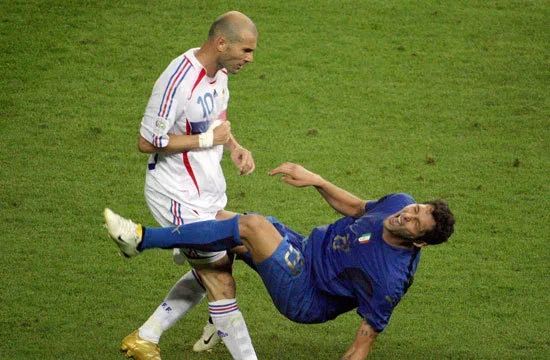
2026 FIFA World Cup: A Complete Guide |
|
|
|
|
Greatest Goals in FIFA World Cup History |
|
|
|
|
50 Greatest Men’s Football Players |
|
|
|
|
Biggest FIFA World Cup Controversies |
|
|
|
|
2026 FIFA World Cup: Best and Worst Teams |
|
|
|
Keep up with Britannica
after the tournament |
|
|
|
|
Answers to all the questions you never knew you had. |
|
|
|
|
Your daily guide to the animals that share our planet. |
|
|
|
The World Cup means more when you know what’s behind it. |
|
|
You are receiving this message because you opted in to a newsletter from
The Britannica Group.
To manage your email preferences, click here.
|
|
|
|