|
Casa de Santé
GLP-1 Digestive Health
|
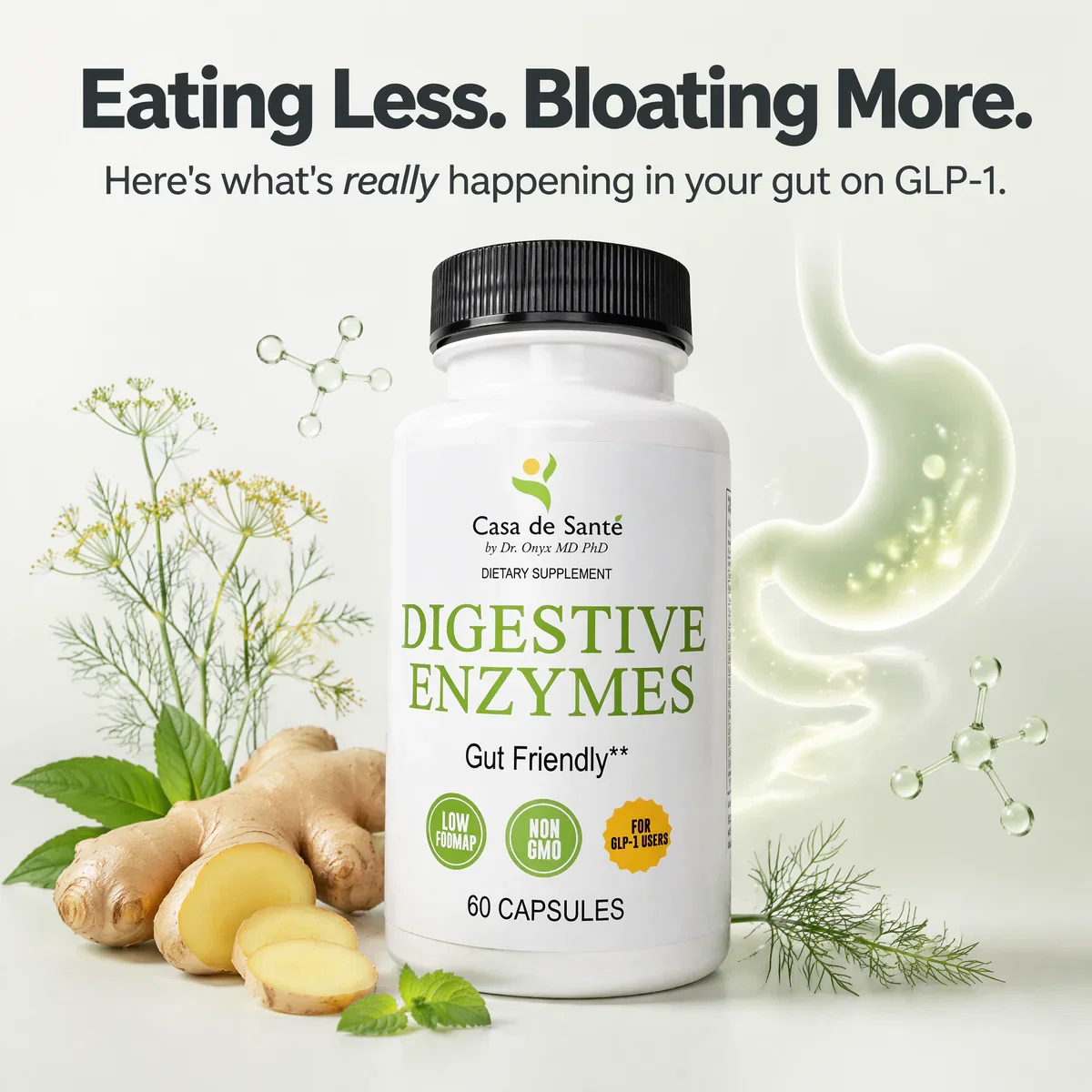
Eating Less, Bloating More?
Here's what's really happening in your gut on GLP-1 medication, and the two-step fix that's working for my patients.
|
A patient told me something last month that I now hear at least twice a week. |
"I'm eating half of what I used to. Smaller portions. Better food choices. And I'm more bloated than before I started my medication." |
|
|
She assumed it was something she ate. She tried eliminating dairy, then gluten, then raw vegetables. Nothing changed. The problem wasn't on her plate.
Your GLP-1 medication reduces your body's own digestive enzyme output. A clinical review published in BMJ Gut found that GLP-1 receptor activation decreases gastric acid secretion by 67% and lipase, your primary fat-digesting enzyme, by 36%. That means your stomach makes less acid to break down protein, and your pancreas releases fewer enzymes to process fat. Even a small meal can sit half-digested.
|
|
67%
drop in gastric acid secretion
|
|
36%
drop in lipase secretion
|
Source: clinical review, BMJ Gut
|
When Food Breaks Down Too Little, Too Late
Three things happen, and they compound with every meal:
|
|
Gas builds in your upper GI tract
Undigested carbohydrates ferment. Undigested proteins putrefy. Both produce gas.
|
|
Your small intestine works harder
Without adequate enzyme breakdown in the stomach, larger food particles arrive downstream. Absorption drops.
|
|
Bloating becomes chronic, not occasional
It's not one bad meal. It's every meal, because the enzyme deficit is constant while you're on the medication.
|
|
A separate meta-analysis of over 12,000 semaglutide users confirmed that 31% experienced GI adverse events, with bloating, nausea, and discomfort the most common complaints. |
|
Two Things That Helped My Patients |
|
Take a broad-spectrum digestive enzyme 10 minutes before eating
|
|
Not after symptoms start. Before the meal hits your stomach. The enzyme blend compensates for what your body produces less of: lipase, protease, and amylase above all. Look for a formula with at least 15 enzyme types to cover the full range of food groups.
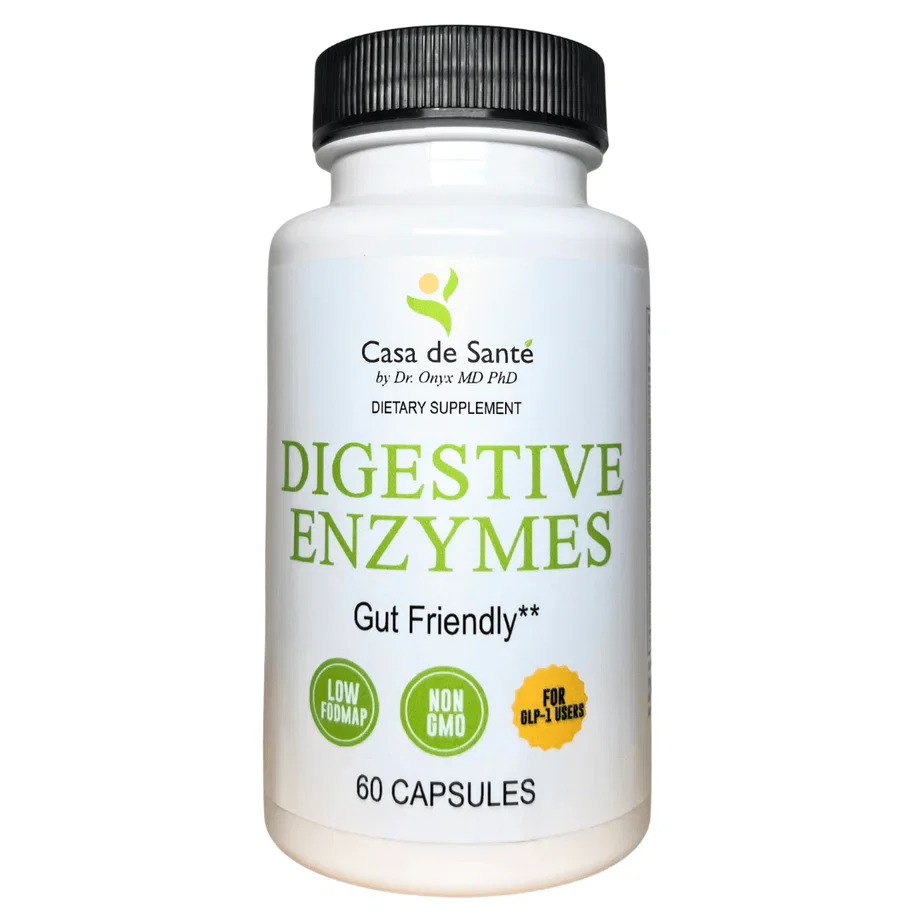
I formulated our GLP-1 Digestive Enzyme Companion for this exact situation.
|
![GLP-1 Digestive Enzyme Companion bottle]() |
|
|
|
Eat protein and fat before carbohydrates at each meal
|
|
When you lead with protein, you give your limited enzyme supply the highest-priority work first. Carbohydrates are simpler to break down and can wait. This sequencing reduces the fermentation that causes most post-meal gas.
Our FODMAP Digestive Enzymes with Pre/Pro/Postbiotics adds gut flora support alongside the enzyme blend.
|
![FODMAP Digestive Enzymes with Pre/Pro/Postbiotics bottle]() |
|
|
That patient I mentioned? She started taking enzymes before her two main meals. Within a week, the bloating dropped. Not gone. But she told me: |
"I ate lunch at my desk and forgot about my stomach for the first time in months." |
|
That's what this is about. Not perfection. Just digesting your food the way your body used to. |
|
Dr. Onikepe Adegbola, MD PhD
Founder, Casa de Santé
|
|