|
Having trouble viewing this email? Click here to read online
|

Whisked Away Weekly - Stories from Our Pantry
|
|
Subscribers save 5% with code ketchup
|
|
🍩 AISLES
🍳 RECIPES
🍎 COUNTRY
|
| |
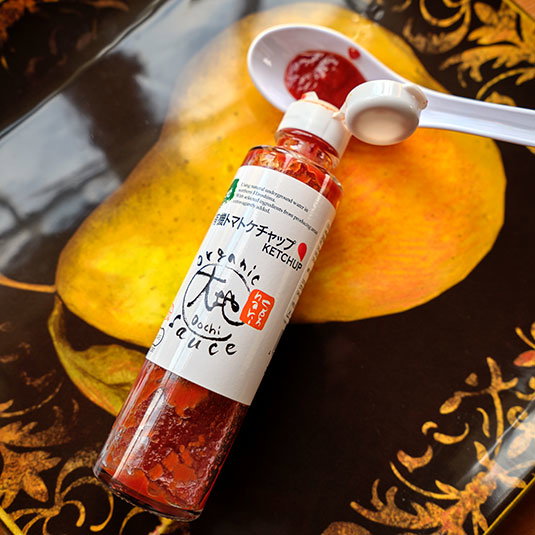
Organic Japanese Umami Ketchup
The origin of Ketchup has a long tail—the tale of rotten fish turning into a savory, flavory topping. Like all food facts, facts are squishy (and sometimes fishy)!
Chinese lore speaks in the Qimin Yaoshu ("Important Arts for the People's Welfare") a Chinese agricultural text, written in 544 CE. The following legend about the origins of fish paste appears in it: "When the Han emperor Wu-ti (140 to 88 BC) chased the barbarians to the sea shore, he smelled a potent, delicious aroma, but could not see where it came from." As the story is told, he tasted and declared it special. It was, as some have spoken about, a pile of rotting fish. Keep reading to see the path of history.
Organic Japanese Umami Ketchup
To the nose, there is more twang than tomato. Or is it the tomato that gives it the twang?
It pours smoothly, not fast, not slow, from the bottle. The combination of flavors is quite enjoyable. Not so much tomato and vinegar like we put on our hamburgers and hot dogs; this ketchup is more like a treat that is sweet and savory.
Dip your tongue in and it is alluring to your taste buds. You want more.
Taste the flavors in the middle of the mouth, and you get a nice burst. Then, as you squeeze with your tongue, the taste changes to a different experience of salt, onion, and garlic. It is quite wonderful.
Shop Here for Organic Japanese Umami Ketchup!
|
| |
|
|
| |
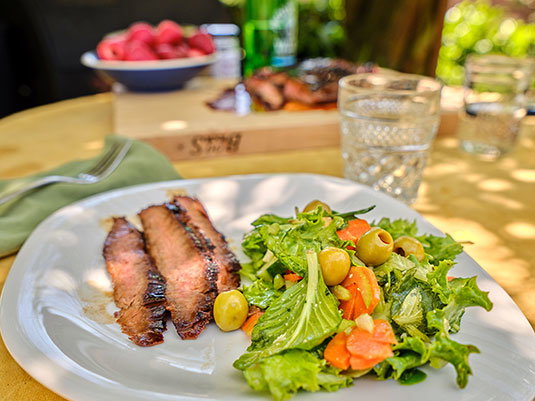
PERFECT WAY TO USE KETJAP MANIS
This is a terrific, tangy marinade for grilled meat or chicken. We love this marinated flank steak with a simple plate of rice and a green vegetable. Easy, quick to mix, the quality of the soy sauce makes all the difference. The sesame oil and the ginger are key ingredients, as well.
See the Marinated Flank Steak Recipe Here!
|
| |
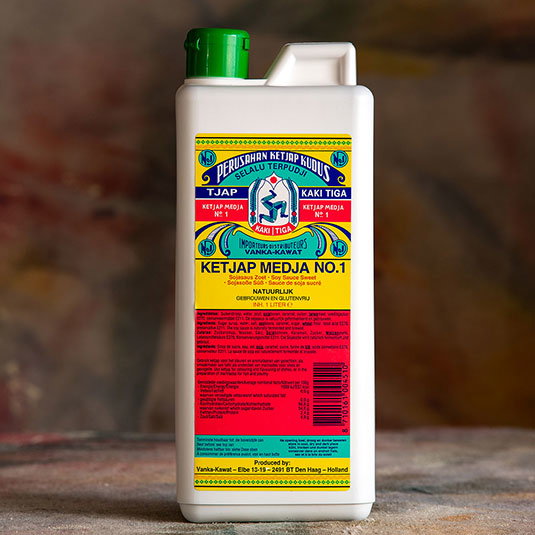
The Sweet Soy - Ketjap Manis
The word ke-chiap originally meant "fish sauce" in a dialect of Fujian province which is the humid coastal region that also gave us the word "tea." Fujianese settlers took ke-chiap with them to Indonesia, Malaysia, and the Philippines.
Fujianese traders also took the ke-chiap to Indonesia, where it became kecap/ketjap, and the word gradually generalized to encompass sweet and savory soy sauces, and sauces in general.
Today, kecap manis is a sweet soy sauce, a mixture of soy sauce, with the additions of ingredients like sugar, molasses, garlic, ginger, anise, coriander, and a bay leaf, and heated until syrupy.
Ketjap Manis - sweet soy
Thick, like dark amber, late harvest grade B or C maple syrup, this is very dark in color.
To the nose, it smells like soy sauce, less bitter, and though you can smell sweet, it doesn't smell sweet. Perhaps it does not smell refreshing or appealing. Quite frankly, it smells nothing like the taste.
To the mouth, you can take a spoonful without the fear of the salty bomb that soy sauce might instill upon you.
This is the best secret ingredient when making a marinade for a flank steak.
Pairing it along with soy sauce, fish sauce, and/or sesame oil is my favorite way.
This dark sweet soy sauce is one of the few essential pantry items I do not like to be without!
Shop Now for Ketjap Manis - Sweet Soy!
|
| |
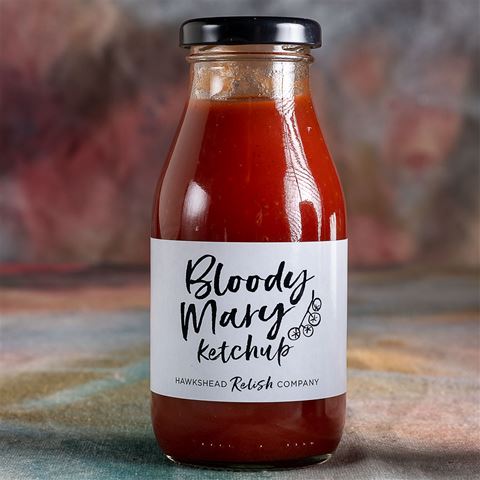
Hawkshead Bloody Mary Ketchup
When Dutch and British merchants went to Southeast Asia around 1600 (colonialism) seeking spices, textiles, and porcelain, they also began buying from Chinese merchants there, including ke-chiap.
The British in particular took a shine to the stuff as they understood that ke-chiap did wonders for making their ocean provisions (stale crackers and dried ham) more edible.
Hawkshead Bloody Mary Ketchup
This Hawkshead Bloody Mary Ketchup sends a wonderful tingle-twinge up the nostrils, it is sweet with a hint of angry, and reminds one a little of a V8. To the eye, it is thinner than a "The best things come to those who wait" ketchup, and it pours quickly in a nice bright red color.
As you taste, the lips taste nothing, the tongue tingles and the back of the throat coughs! All the flavors are mixed together and come out in a racy way. In the end your lips are tingly, the edges of your tongue are too and if you have enough spoonfuls your body starts to get hot!
It is delicious fun, and just right for the next dog in your life.
Shop Now for Hawkshead Bloody Mary Ketchup!
|
| |
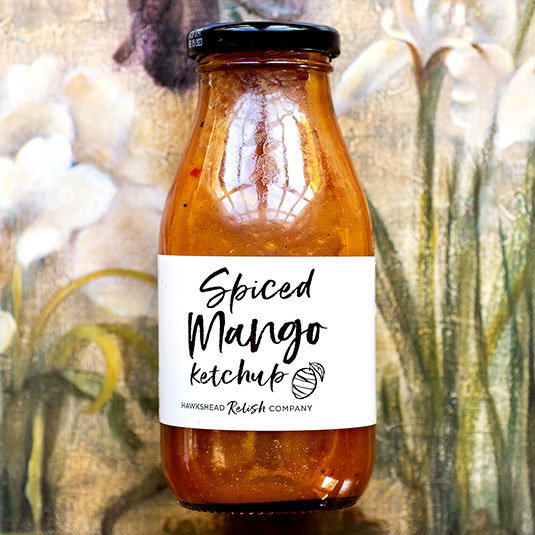
Hawkshead Relish Spiced Mango Ketchup
In England, attempts were made to recreate what was then considered a special sauce using the ingredients they had on hand. In the mid-eighteenth century, one recipe called for a pound of anchovies, mixing it with strong beer, mace, cloves, pepper, ginger, shallots, and mushrooms.
The 18th century featured recipes made from oysters, mussels, mushrooms, walnuts, lemons, celery, and even fruits like plums and peaches, all to make the "sauce".
Hawkshead Relish Spiced Mango Ketchup
Spiced Mango Ketchup is a different kind of ketchup!
One of the testers popped the top and exclaimed, "This is really good!" Mind you it was a gaggle of teenage boys who were testing, yet we think the same, this is good stuff.
Mango is the vehicle flavor melded with the flavors of India. With a touch of heat, the flavors are all mixed up in every spoonful. Every little taste is the same yet different.
What delicious fun this ketchup brings to your next bite! So good you can eat it with a spoon or use it as an excuse to break open a pack of hot dogs!
Shop Now for Hawkshead Relish Spiced Mango Ketchup!
|
| |

Savory Deliciousness!
With just a few fresh ingredients and a good soy sauce you have a simple tasty sauce to use on your meat or vegetables!
See the Basic Garlic Soy Sauce Recipe here!
|
| |
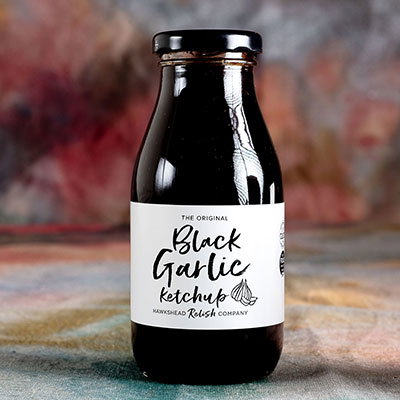
Hawkshead Black Garlic Ketchup
Then in 1812, James Mease, a Philadelphia scientist, is credited with developing the recipe, writing that the choicest catsup came from tomatoes ("love apples").
Jonas Yerkes is credited as the first American to sell it in a bottle, and by 1837 he had produced and distributed the condiment nationally.
And then a new company called Heinz introduced its famous formulation in 1876, containing tomatoes, distilled vinegar, brown sugar, salt and various spices. They also pioneered the use of glass bottles so customers could see what they were buying.
Hawkshead Black Garlic Ketchup
This very dark, gourmet ketchup is nothing like the red stuff we have used our whole lives. In fact, it does not resemble anything we have had before. Though I am thinking that the next burger I make will have this as the condiment of excellence.
To the nose, Hawkshead Black Garlic Ketchup has a big twing-y tickle from the acetic acid - balsamic vinegar. To the tip of the tongue, it is sweet. And to the mouth, it is a squeeze in the cheeks pleasure.
The flavor of this gourmet ketchup is not garlicky, at least not to the taste buds. It takes some cheek smacking to get the garlicky flavor as it's much more about the complete experience. You get a sweet twinge of goodness with hints of balsamic and caramel. This is like an enhancement of black garlic in a ready to pour form!
Shop now for Hawkshead Black Garlic Ketchup here!
|
| |
What's Happening in the Store
Did you know the store often has more?
Come, taste and check it out! Pick your favorite and meet friends new and old who all love food. We love it when you hang out!
May 2026 Store Hours
Monday - Saturday 10am-5pm
ChefShop Retail Shop, 1425 Elliott Ave West, Seattle
|
| |
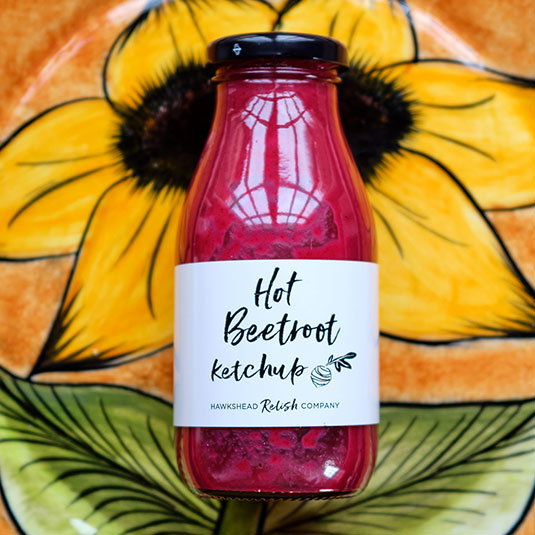
Hawkshead Relish Hot Beetroot Ketchup
Chinese ke-tsiap, a pickled fish sauce, which made its way to Malaysia as kechap and became ketjap in Indonesia. As early as 1690, Europeans brought it back home and began calling it catchup. The term ketchup actually first appeared in print in 1682, slightly before catchup, and was further popularized in 1711 in a book called An Account of Trade in India. Catsup has possessed extra cachet since at least 1730, when satirist Jonathan Swift included it in a list of dodgy foreign indulgences. So all three names (ketchup, catchup, and catsup) were a British coining.
Henry John Heinz first brought his product to market as "Heinz Tomato Catsup," but changed the spelling early on to distinguish it from competitors. In Britain, ketchup overtook catsup as the most frequently used name around 1850, but in the U.S., catsup held on to its dominance until the 1980s. Del Monte was the last major holdout as it did not switch from "catsup" to "ketchup" until 1988, after it became clear that ketchup was the spelling of choice for American consumers.
From rotting fish brine on the Fujianese coast, to Indonesian kecap manis, to British anchovy-beer concoctions, to a Philadelphia scientist's tomato experiment, to Heinz's red bottle now found on tables in nearly every country on earth. And now, in the Philippines. a former American colony, people now make ketchup with local bananas and add it to fish sauce, bringing the whole flavor full circle.
Hawkshead Relish Hot Beetroot Ketchup
The first thing you will see is a vibrant brilliant red that angles towards the purple.
To the nose, it is more acid than beet, but there is definitely a good beat.
The most fun to this hot beetroot ketchup is the texture. Little bits add to the composition of the feel to the mouth. The texture in the bite to me is special. When you take a bite, the small bits are just right.
If you squeeze the bite, along with the beet bits you get a sweetness, like a relish. The finish has the hot, though not hot like hot is, instead, it is a twinge of spicy at the back of the throat and has this wonderful overall flavor rolling around the mouth.
Think perfect for gefilte fish, roast beef or spaghetti squash.
Shop for Hawkshead Relish Hot Beetroot Ketchup here!
|
| |

Easy to make!
Gather the ingredients, whisk together and soak your meat or veggies! Easy!
See the BBQ Marinade Recipe Here!
|
| |
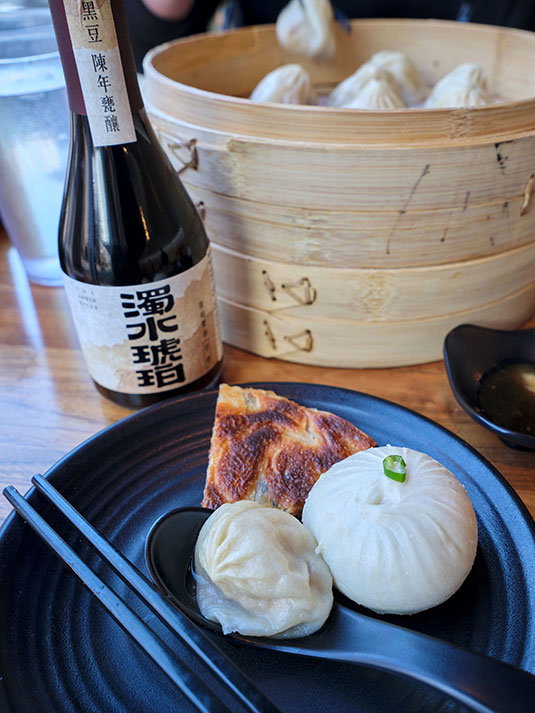
My Favorite right now
To the nose, the flavor of the smell is distinctly different than the shoyu's of Japan. This soy sauce is gentler, not as round or filling in the nostril, it feels thinner or perhaps the descriptor is lighter than shoyu.
The Amber River Soy is clear, complex, where the flavor rolls through the mouth and then rises in the back and then leaves a salty tongue. More pointy in its presentation. It lingers longer in a nice way. And when it leaves, it does so with almost no trace. And that is nice.
The creation of this Amber River Soy Sauce is made from black soybeans, unlike the yellow soybeans used in many other parts of Asia.
The black soybeans grown in the south of Taiwan are known for their rich black color and sweet and nutty flavor. They have a mellower taste compared to the yellow variety, and are rich in protein content and a richer concentration of certain antioxidants and phytonutrients due to their dark outer shell, compared to other soybean varieties. This protein gives the Amber River Soy Sauce its exemplary savory feel.
The process of making this traditional Taiwanese soy sauce is an intricate one. At its core, it consists of just a few ingredients: local black soybeans, sea salt, water, and sugar. But the magic lies in the meticulous methods of fermentation (8 days instead of 2) and aging in earthenware pots in the sun, which can take up to a year or more.
The now fermented beans are heated over wood fires to halt the fermentation process. The use of wood over more modern fuels such as gas, takes more time, and keeps the the traditional handmade brewing technique unique.
This results in a soy sauce that is complex in flavor, with a depth not found in the mass-produced soy sauces.
Shop now for Amber River Soy Sauce!
|
| |
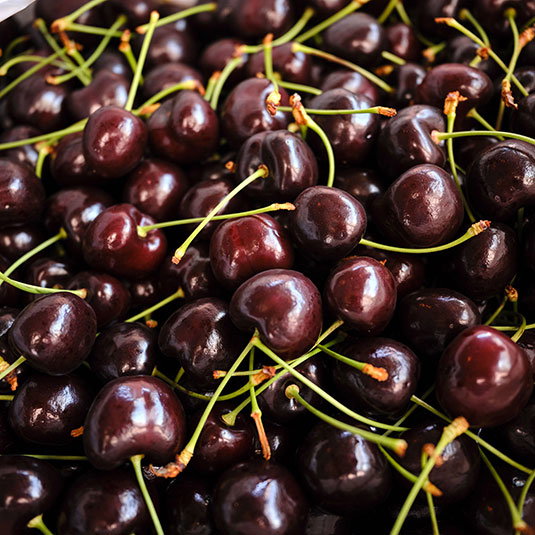
Pre-order before the first Harvest
The Black Pearl Cherry is a sweet cherry (Prunus avium), the same group as the Bing, Rainier, and Sweetheart. It is emphatically a dark cherry, not a blush variety. Its skin ripens to a deep burgundy-black which is one of the darkest of any commercially grown sweet cherry, and consistent with the high anthocyanin levels associated with very dark sweet cherries.
The Black Pearl sits closer to the Bing end of the flavor spectrum than anything else, but pushes further into dark fruit territory than even the Bing manages. Its sugar content often reaches around 20 Brix under good growing conditions, placing it in the same general sweetness range of a Bing, but what distinguishes it is intensity and depth.
The near-black skin signals the high anthocyanin load that gives the fruit its wine-like, dark berry complexity with notes of blackberry and dark plum layered beneath the cherry. Where the Bing is classically bold and the Rainier is honeyed and delicate, the Black Pearl is a wonderful dark expression of sweet cherry flavor.
Distinctive Characteristics
Color: Among the darkest cherries in commercial production. Deep burgundy-black skin, red flesh—the darkest of the Pearl Series siblings, whose flesh Cornell describes as red compared to the orange-red flesh of Ebony and Burgundy Pearl.
Firmness: One of its standout commercial traits. Exceptional firmness with a distinguishable snap that holds up through shipping and storage making for a meaningful advantage over more delicate varieties.
Crack resistance: Specifically bred for it. The Black Pearl tolerates rain during harvest far better than the Bing, which makes it particularly attractive in the Pacific Northwest where weather during the harvest window can be unpredictable.
Early ripening: Comes in approximately 10 days before Bing placing it in the same early window as the Early Robin, with the Black Pearl running a few days to a week later depending on the year. This early timing opens the dark cherry season before the Bing.
Tree: Vigorous, upright, canker resistant, and a heavy producer though that heavy set can limit individual fruit size if crop load is not carefully managed through pruning.
Brix
The Black Pearl is consistently documented at approximately 20 Brix reflecting a sugar-dominant soluble solids concentration that places it in the same sweetness range as a well-grown Bing.
The Black Pearl boasts a flavor profile that feels richer and more concentrated because its high anthocyanin and phenolic content is perhaps the creator of layers of complexity that pure sugar measurement cannot capture. A 20 Brix Black Pearl tastes more intense than a 20 Brix Bing, for the same reason a dark red wine tastes more complex than a lighter one at the same alcohol level. At least that is what we speculate....
Pre-Order Cherries!
|
| |
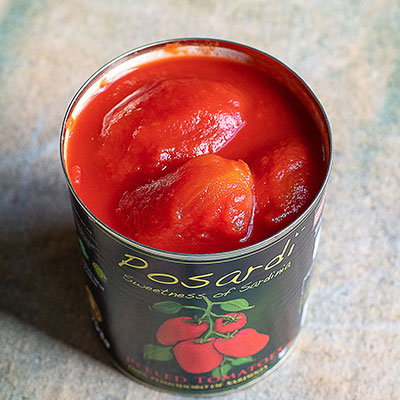
TIME FOR TOMATOES
Tomatoes are just coming into season! Perfect for salads and just plain tomato with a nice tomato vinegar!
And time to make a little pasta sauce with canned tomatoes! Or baked beans!
We love these. The tomatoes are whole and nestled beautifully inside the can. The taste is pure tomato, the way a canned tomato should be, with no added elements, allowing you to be in control of how they're flavored.
The Posardi Sardinian whole peeled tomatoes are consistently sweeter tomatoes, with a richer, fuller color, and nice soft ends. These whole canned tomatoes work just as they should, adding to a dish without being too strong. Perfect.
They have just three ingredients: tomatoes, tomato juice (juice from processing), and citric acid. No salt added, Non-GMO, Gluten-Free, BPA-Free, Pesticide-Free. 100% Pomodori Sardi Tomatoes from Sardinia. Like all great ingredients, there is a difference from one brand to the next!
These are truly exceptional tomatoes.
Shop now for Posardi Sardinian Whole Tomatoes - Canned here!
|
| |
|
|
| |
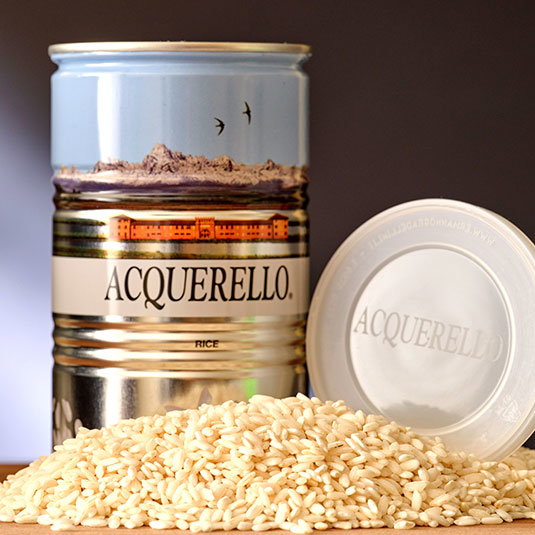
SPECIAL PRICING
Italy grows some of the finest rice in the world. From black rice to white and the varieties in-between, the flavor and the resulting dish can be the best on the planet.
Acquerello il Riso Carnaroli has been around in our food world forever. One of the first of the slow food movement foods, Acquerello il Riso Carnaroli was awarded the Snail of Approval in 1986. Taking a year to produce, the rice undergoes the steps of aging, refining in a special process and enriching with its own germ. The result is tastier, richer and healthier. (Their words and we agree.)
The rice is in a vacuum sealed can and this might be the most important feature of this delicious rice, at a minimum ensuring the flavor profile the maker has intended.
Shop now for Acquerello Aged Carnaroli Rice - aged 1 year!
|
| |
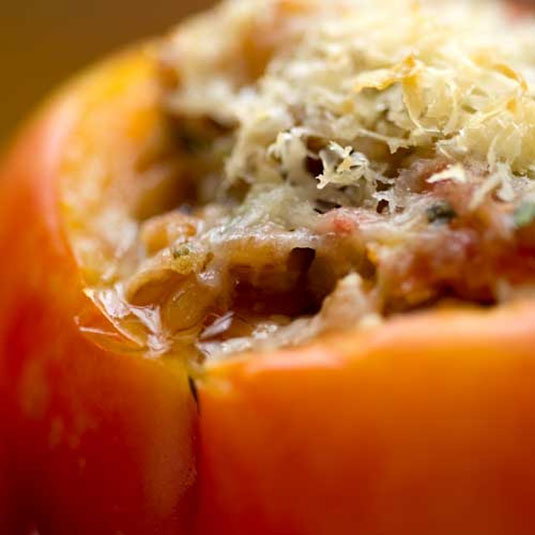
ONE FUN DISH
Instead of using the classic Arborio rice, we switched to emmer. Emmer has a different bite than rice, so the end result is a nicely toothsome side dish with a bit more flavor. Perfect.
See the Emmer Stuffed Heirloom Tomatoes Recipe here!
|
| |
|
|
“
Shared by a Reader
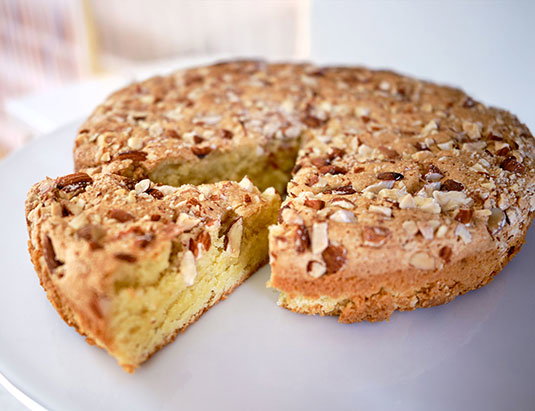
We spend a lot of time, holidays and birthdays trying to find a cake that is gluten free and drama free, and this is a cake to look forward too!
— Ann E., ChefShop Reader
See the Almond Flour Yuzu Cake recipe here!
|
| |
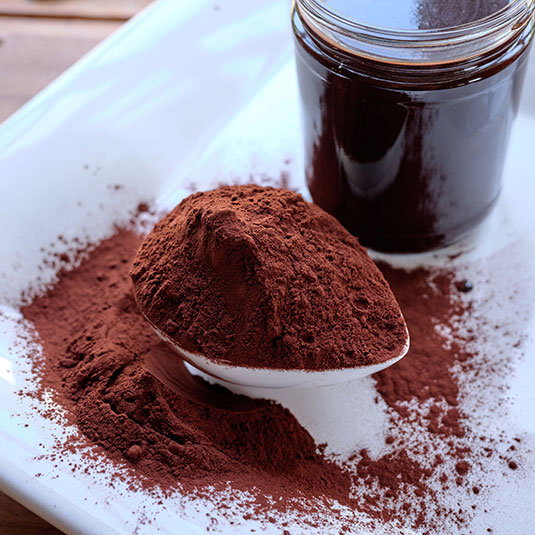
Richer, Darker and Full of Chocolate Flavor
Professional pastry chefs are using ChefShop Grande Brut because it does several things well at once: deep flavor, smooth texture, rich color, easy blending, low acidity, and real versatility across applications. It is a many-trick cocoa powder.
We stock it now because after working with it ourselves, we found it spectacular! It makes a giant difference!
ChefShop Grande Brut contains 22% to 24% cocoa butter. That is significantly higher than most cocoa powders on the market, and it is one of the main reasons we chose it. That extra cocoa butter is not a minor detail. It changes how the cocoa tastes, how it blends, and what your finished desserts actually feel like.
Most people focus on cocoa percentage (and with cocoa powder it is always 100% as it has no sugar) and overlook fat content entirely. It is the balance between cocoa mass and cocoa butter that matters. Cocoa butter is the natural fat in the cacao bean, and it shapes everything about how cocoa performs in a recipe.
Shop now for ChefShop Grande Brut Cocoa Powder here!
Shop now for our Classic ChefShop Cocoa Powder here!
|
| |
|
SHARE THE LOVE
Give the Gift of Love Through Food
Gift Certificates available for any amount you choose.
Get Gift Certificate →
|

|
|
| |
This Week's Recipes
|
See What You Missed in Previous Newsletters
|
|
|
ChefShop.com
1425 Elliott Ave W
Seattle, WA 98119
206-286-9988
You're receiving this email because you purchased from us or subscribed. We respect your privacy and will never share your email address.
Unsubscribe from this list. |
Privacy Policy |
Terms
|
|


