Back during my second year as a professional speaker, I walked into a keynote thinking I was prepared.
The client was good. The room was ready. I'd reviewed my deck the night before, run through the major points in my head on the drive over.
Twenty minutes in, I felt it. Not panic — something quieter and worse. The awareness that I was improvising where I should have been relying. That I was performing instead of delivering. That the reps I thought I'd done in my head weren't the same as the reps I should have put in on my feet.
The talk wasn't bad.
But I knew the difference between a talk that goes well because you got lucky in the room and one that goes well because you deliberately built it before you arrived.
That night, I made a change.
Every keynote now gets multiple full run-throughs - alone (or in front of my dogs), out loud, on my feet, as if the room is full. Not a mental review. A rehearsal. In my house, a hotel hallway, backstage, wherever I can find space. No one watches. No feedback loop. Just me and the work.
The shift changed how I feel when I walk into a room.
The calm isn't confidence in my ability. It's confidence in the specific preparation I put in beforehand. I'm not hoping I'm ready. I know I am - because I was already in that moment alone before anyone was watching.
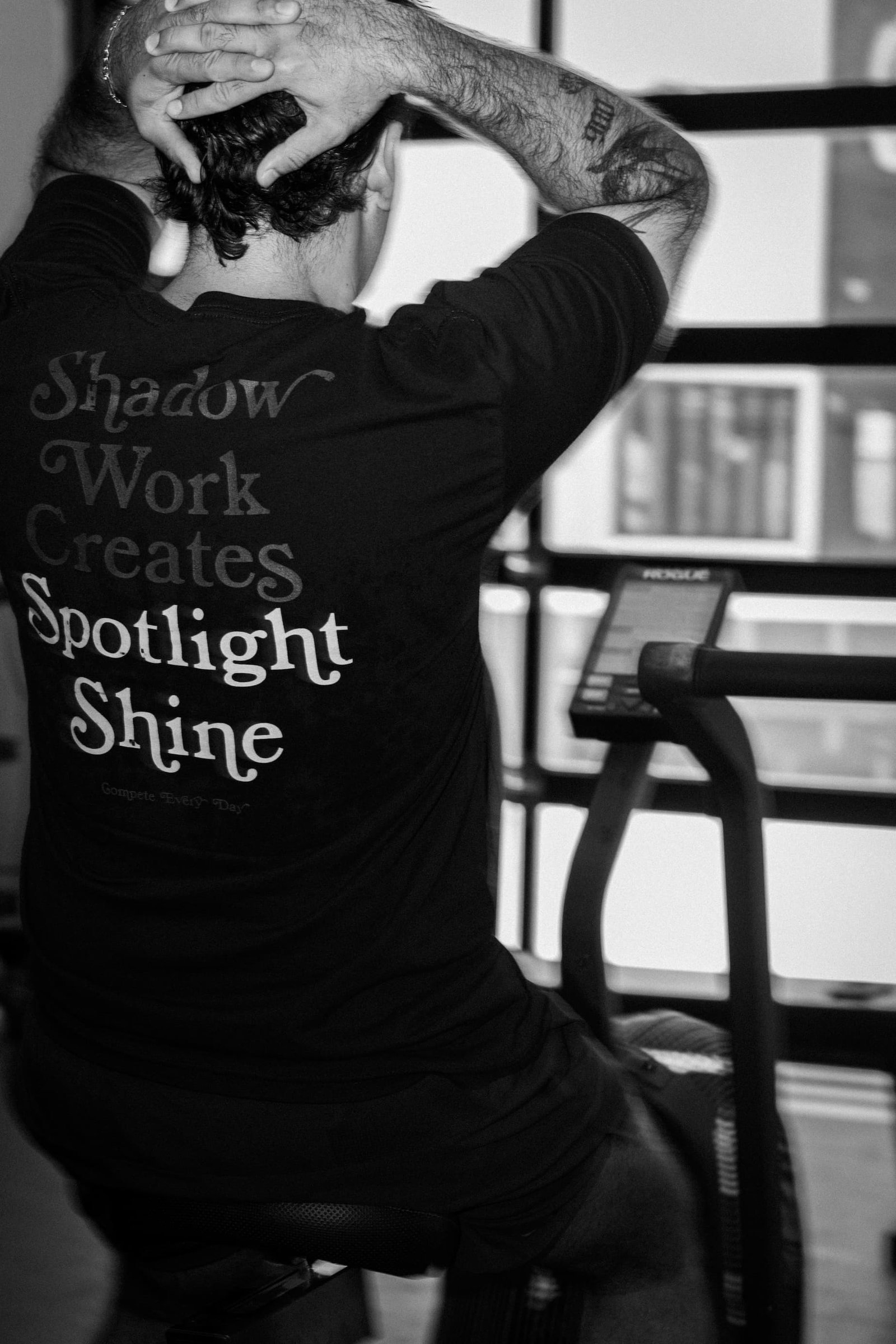
That's what shadow work actually produces. The spotlight can't give you that feeling. Only preparation can.
Anders Ericsson spent decades studying elite performers — surgeons, musicians, chess masters, athletes — and the separator wasn't talent. It was the quality and consistency of deliberate practice: reps done alone, at the edge of your ability, without immediate feedback or applause.
The principle is as old as performance itself.
You don't rise to the moment. You rely on what you built in the shadows.
The July shirt is built around that standard.
Every time I see it, I ask myself: Did I do the shadow work today? Did I put in the private rep that I can't fake my way around when the pressure shows up?