The truth about due dates
By Cradlewise Staff
|
|
When you’re pregnant, your due date quickly becomes the date. It's the one everyone asks about. Doctor visits, work plans, childcare, everything seems to point to that day.
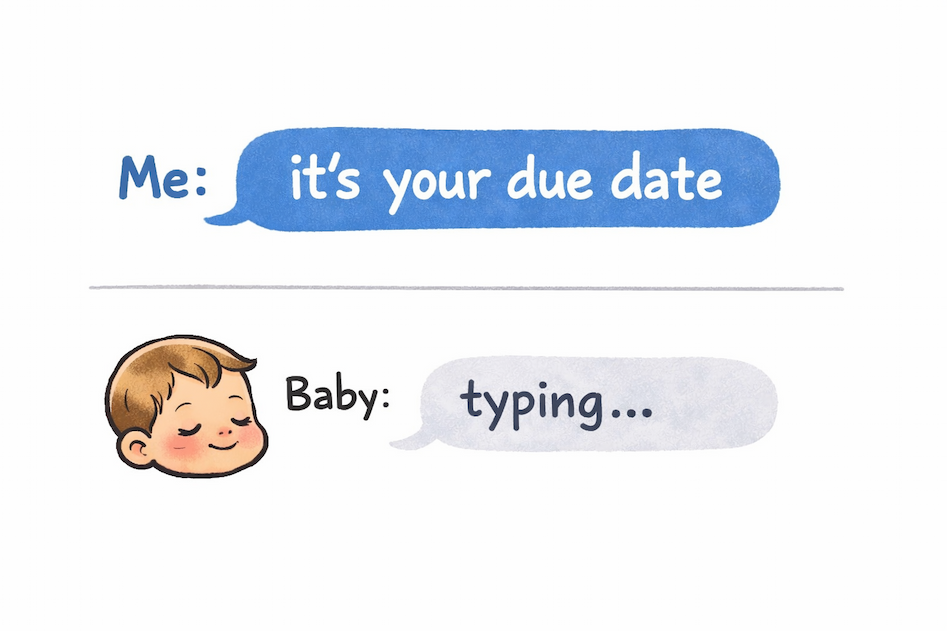
It starts to feel like your baby has RSVP’d too. Like once that date arrives, they will too. But that’s not how it usually works. Most babies don’t arrive on their due date. Many come earlier, many come later. So, where does this date come from? How accurate is it? Let’s get to the real story!
|
|
How your due date is calculated
|
|
Your due date is an estimate of when your baby might be born. It's based on 40 weeks from the first day of your last period, not the day you conceived or ovulated. Just the first day of your last period. Doctors use a formula called Naegele’s rule. It's been around a long time. To calculate it, they take the first day of your last period, add seven days, then subtract three months. that gives a due date.
For example, if your last period started on June 10, you add seven days to June 17. then you count back three months. That puts your due date around March 17.
|
|
This formula goes back to the 1800s. A doctor named Carl Naegele created it using records from about 100 pregnant women. Those records were collected even earlier, in the 1700s. Slowly, it became the standard and is still used today.
|
|
Why are due dates often off?
|
|
The formula assumes a perfect 28-day cycle and ovulation on day 14. Most people don’t have cycles like that. Some cycles are shorter. some are longer. Ovulation doesn’t always happen on the same day each month. When your cycle doesn’t match those assumptions, your due date can be off by days or even a week or more. The formula treats every body the same, but bodies aren’t the same.
|
|
A more accurate way to estimate...
|
|
According to American College of Obstetricians & Gynecologists (ACOG), Early ultrasounds are usually more accurate than using your period alone. The best time for this is between 11 and 14 weeks. Early in pregnancy, babies grow at about the same rate, so measuring them gives a better idea of how far along you are.
If your ultrasound date doesn’t match your period-based date, doctors usually trust the ultrasound. Even then, it’s still an estimate. Early ultrasounds can be off by a few days. Later ultrasounds are less helpful for dating. By the third trimester, they’re measuring size and comparing it to an average baby. If your baby is naturally bigger or smaller, the estimate can be off. That's why doctors rarely change due dates later in pregnancy unless the difference is big.
|
|
What affects your due date?
|
|
Your due date is just a guess. Some things make it less accurate.
- First baby or not. First babies usually take longer. Many first-time moms go past 40 weeks. Later babies often come closer to the due date or even early.
- Twins or more. Multiples usually come early. Twins around 37 weeks. Triplets around 33 weeks. Your due date might say 40 weeks but the doctor expects them sooner.
- Your age. If you are 35 or older you might go past your due date a little more often.
- Your cycle. If your period is longer than 28 days you probably ovulated later. That can change your due date by a few days.
- Family history. If your mom or sister had long pregnancies you might too. Same for shorter ones.
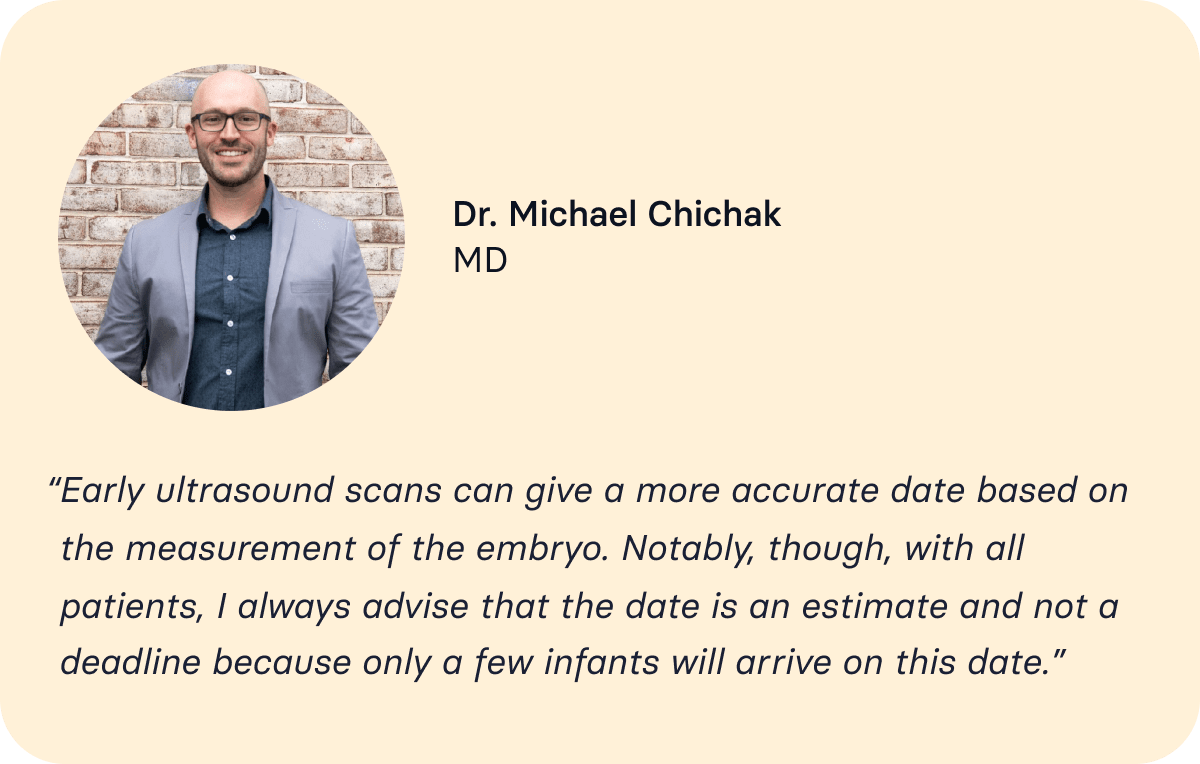
"Several reasons might affect the accuracy of the due date in reality such as irregular menstrual cycles or cases of late ovulation and conditions such as gestational diabetes in pregnancy. Also, first pregnancies are likely longer than the rest. The determined date of delivery itself is not likely modified in the early pregnancy stages rather determined by a combination of natural and personal factors". - Dr. Michael Chichak, MD
|
|
So, when do most babies arrive?
|
|
According to ACOG (the American College of Obstetricians and Gynecologists), Most babies come between 38 and 41 weeks. The average pregnancy is 40 weeks but that is just the average.
Anything from 37 to 42 weeks is full term. So even if your due date is 40 weeks your baby could come at 38 or 41 weeks and it is normal.
|
|
Common myths about due dates
|
|
Myth- Spicy food will start labor
Spicy food will not start labor. You might get heartburn but it won’t make contractions start.
Myth- You can predict based on how you're carrying
How you carry does not tell when your baby will come or if it is a boy or girl. It has more to do with your body type, muscle tone, and baby's position than when they'll arrive or what they are.
Myth- If you go past your due date, something's wrong
Going past your due date is normal. Most doctors do not even talk about induction until 41 or 42 weeks. Your baby is not late.
|
|
Your baby's arrival: TBD ❤️
|
|
Your due date is a placeholder. Your baby will show up when they show up, probably somewhere in the ballpark of that date, maybe not. Pack your bag by 36 weeks. Keep your plans loose. And when that date passes without a baby, don't panic. Most first babies are fashionably late anyway. So take a breath. Your baby's coming. Just not necessarily when the calendar says they should.
|
|
Once your little one arrives, quality sleep becomes precious. That's where Cradlewise comes in. Using SmartSoothe technology and built-in sensors, the crib learns your baby’s sleep patterns and detects early wake cues - giving parents back (on an average) up to 2 hours of sleep.
|
|
|
|
|