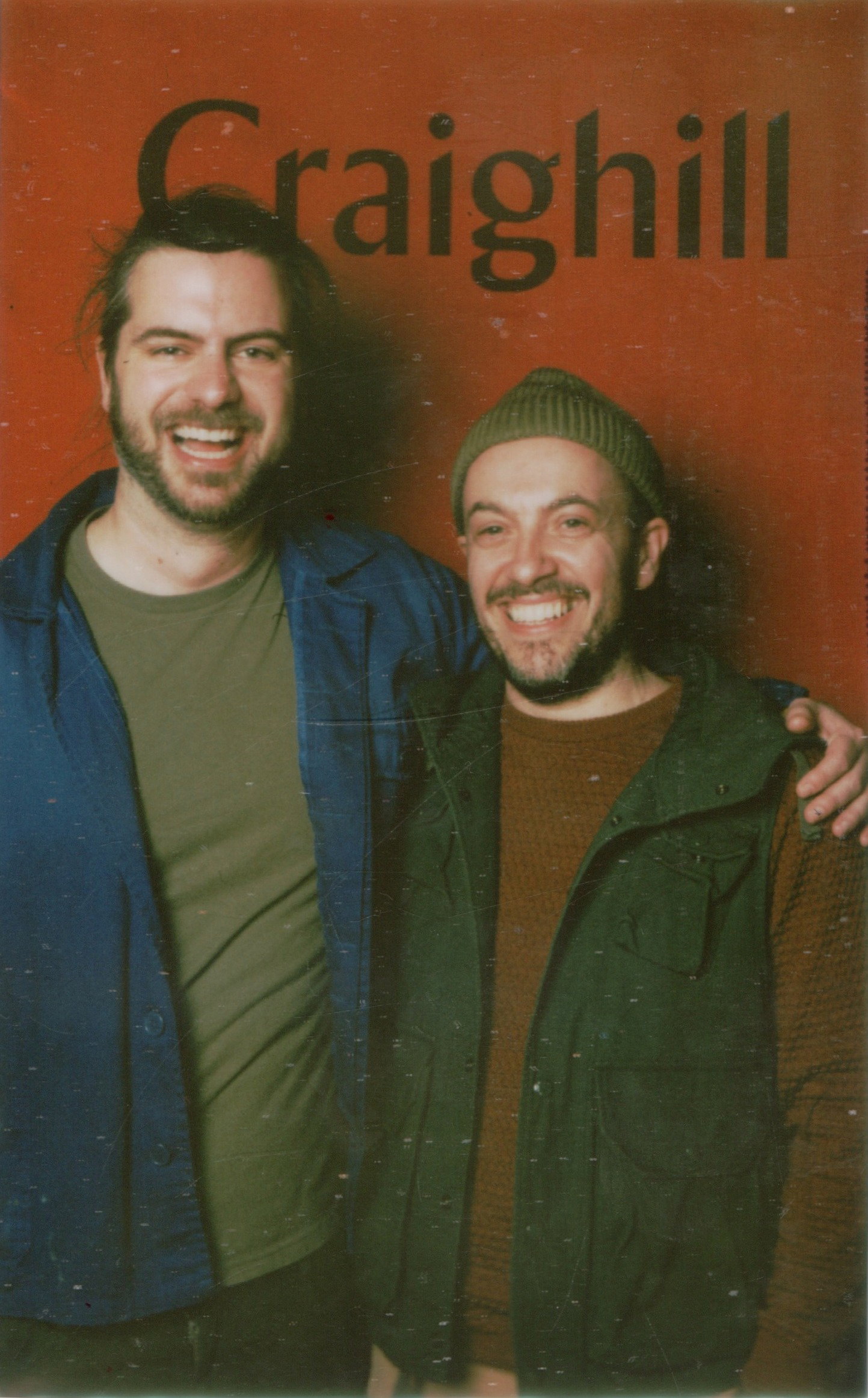
Many of you have already met our founder Hunter Craighill. You might’ve seen him extolling the virtues of the pip, or the allure of a tasteful knurl on our Instagram. He’s good at explaining how things work, so we asked him how Craighill the brand emerged from Craighill the man. Read on as co-founder Zach Fried gets to the bottom of how, exactly, all this even happened in the first place.
|
|
Zach Fried: Hey, Hunter.
Hunter Craighill: Hi, Zach.
Z: You ready?
H: Ready. I got my beverages hydrated, my phone's on silent.
Z: All right. Were there any formative experiences in your childhood that, in retrospect, led you down the path to becoming a designer?
H: I played with a lot of Legos, which is a semi-generic answer. But I do feel like there was this process of creation, building, and problem solving — getting to know systems and understanding materials and components — that shaped how I approach design. My dad was entrepreneurial, but he was almost — I hope he doesn't read this — almost embarrassingly not handy. He did not have tools at home. He did not fix things around the house. He didn't make stuff. And so I didn't grow up with a wood shop in the basement or something like that. But I do have a memory of when I was going to college, at Wesleyan freshman year. The dorms that we had were small, crappy rooms, and I wanted a sofa. But I couldn't find a small enough sofa to fit in the area that I had. So somehow I found a floor plan of my dorm room and mapped it out and just built it. My girlfriend's dad helped, actually, to build this sofa from scratch. I remember going and framing it out with two by fours and going to this foam supplier, buying the right amount of foam, and sculpting it with some kind of saw and going to a fabric store and buying fabric, and I made this just terrible sofa.
Z: I never heard this. I love it.
H: It ended up in the Eclectic Ballroom (student society house at Wesleyan -ed.) for a while.
Z: I bet it did.
H: I think it had zebra fringe fabric. That was a moment where I felt like I was connecting with spatial reasoning and starting something and just finding it satisfying. You're like, “oh, like that was fun and fulfilling. I want to do more of that.” I think I did that and I felt it, but I didn't really connect it until later that that was something I could do, and not just for fun. I mean it is fun, but, you know.
|
|
“Part of me still secretly wants to design buildings and to design furniture. I want to design lots of things.”
|
|
Z: You studied architecture and then moved into product design. What motivated you to move from wanting to make things that people lived in to making things that people lived with? And how has that shift influenced your creative process?
H: I love architecture still. And part of me still secretly wants to design buildings and to design furniture. I want to design lots of things. But yeah, I think in the academic world the architecture was really fun. We could explore projects that didn't have constraints, like clients and budgets. I mean, they had briefs and we had to kind of fulfill them and justify our decision-making. But it was pretty crazy stuff. And then in practice after school, it became very client-driven and it wasn’t as exciting as the kind of academic, open, very exploratory side of things. And yeah, I think what I discovered when I dipped my toe into product design was that it satisfied a lot of the things that I wanted to do.
A lot of things I found satisfying about architecture in school were there, but at a smaller scale and a lot faster-paced. Studying architecture really taught me how to think about design. We had to go through the critiques of our projects and really had to justify all of our decision-making, which I really appreciated. It gave me a context in which to make decisions.
It wasn't just “I thought this thing was pretty.” It was “I found this reference of this form and this is what I'm pulling from, or this function is what everything else radiates out of.” And that kind of forces you to find a narrative within your design thinking, and find that one thread to pull on.
|
|
“The solution we found was: we want to design products that are one material, one component, and ideally one process applied to those components.” |
|
Z: We communicate with our community pretty frequently, but we've never properly started from the beginning and given background on how all of this really started. So let's start at the very beginning. Can you share your journey from studying architecture at Wesleyan University, graduating in 2009 to founding Craighill in 2015? How did the work you did in those intervening years shape your approach to design and get you prepared to start Craighill?
H: That's a great question. In the narrative that I tell myself about my journey, there were two turning points that helped me. The first was at Wesleyan when I was discovering architecture and taking that one first-year class and realizing that I loved building architectural models way more than I loved writing term papers. That was the unlock. After graduating, I worked for an architect briefly, then a graphic design studio, and then I did printmaking and some marketing work which is how I came across Best Made. It was, at that point, a new company, and it was an outdoor brand that had amazingly beautiful products — and their flagship product was an axe. I wrote the founder, Peter, and just found myself being incredibly animated and excited about the brand and the product development that he was doing, and I talked my way into an internship and then a job there. I led the product development for the first few years. I never really understood what industrial design actually was prior to that. But I began to understand the process of product development and product design and sourcing and working with factories. Then finding Best Made and finding product development is where I think I fell back in love with design, and found the right lane within the design world.
I spent a few years there until about 2013, then left. I tried to start a similar small design company with my cousin Dylan, General Manufacturing, and didn't quite get enough traction there. Did some consulting and learned about wholesale and how to run other sales channels outside of just direct to consumer. Then I kind of hit a point in 2015 where I was like, okay, do I throw in the towel on trying to work for myself and go work somewhere else, or do I give this one more shot? And that's when I approached my good friend Zach and talked to you. That was maybe the third unlock for how to get this business off the ground. I’d learned how to make products, but I did not have the skills or the excitement around communicating about them. And that's where you came in.
|
|
“Do I throw in the towel…and go work somewhere else, or do I give this one more shot?” |
|
Z: How has your design approach shifted and developed through the process of building Craighill over the past nine years?
H: I think when we started, we had a network of suppliers. We were very financially bootstrapped, just trying to get this thing off the ground for next to no money and to get as many products as we could into production. We were very limited by our supply and our finances. Through those constraints, the solution we found was: we want to design products that are one material, one component, and ideally one process applied to those components. We could just hit up one specialist machine shop in Wisconsin that could do one thing like the Jack Puzzle — it's just brass half-inch bar stock cut into 3-inch lengths with different notches milled into it. We wanted to find products that were super simple to create, but also had high perceived value for that simplicity. So I think some cool products and some great wins and solutions came out of that limitation.
Since then, we’ve expanded our manufacturing supply chain further and found better partners with more complex and sophisticated capabilities. So there’s more confidence to get behind some new designs that have opened up a lot of doors. And it’s come hand in hand with bringing in talented designers like Kevin [Chee] and Walmen [Dumaliang]. There’s been this evolution of the complexity of our products.
Having released lots of products over 10 years, we’ve learned what has done well and what has not done well with our community. I think we've developed a slightly clearer understanding of what types of products and what types of stories we're excited about that our community is also excited about. And that ultimately shapes the design process in increasingly significant ways.
|
|
“I just wanted to make products, and I felt a little odd about it just being me.” |
|
Z: When it came time to name the company, what led you to “hang your name on the door” and call it Craighill?
H: I remember talking to you about this at great length. Naming a business is hard, as anybody who's had to name a business or name a band knows. One of the ideas on the list of names was like Hunter Craighill Studio or something like that, or Hunter Craighill. You know, it was truly me. And it felt a little like a vanity thing — too intensely about me as the person, the figurehead. I just wanted to make products, and I felt a little odd about it just being me. But I think that I have a somewhat distinctive last name — Craighill — and I was thinking back about some historic brands, like Filson and Sears.
There's lots of these timeless brands that are just an ambiguous or abstract, almost decontextualized family name. That felt like the right middle ground where it was kind of about me, but not really about me.
Z: I remember talking to you about this and feeling very strongly that it's really hard to name things, and that a lot of the names that you had put on the list for one reason or another, I was like, “not that”. Just knowing that there are some people whose last name could anchor a business, and also that you are not a remarkably egotistical person, but that your last name is a really good-sounding last name for a business. I remember really loudly encouraging that and just saying, “Stop the search. Just do that”.
H: I vividly remember the conversation. I remember you encouraging me and feeling like that gave me the confidence. I was like “Okay, I can do this”.
Z: That's probably why you asked me to join you in running the business. It’s your ego raising its hand and being like, is this okay? And I was like, “Yeah, not only is it okay, you have to do it”. And you were like “all right, you're hired”.
H: Yeah. But the result is that now everybody calls me Craig. At all the trade shows, everyone asks “are you Craig?” I'm like, well, kind of.
|
|
"Now everybody calls me Craig." |
|
Z: That’s all for now, hopefully we can ask some more questions later. You can ask me questions.
H: Cool. I'm gonna ask you questions next time. It's been a pleasure speaking with you today, Zach, and I look forward to seeing you. I look forward to seeing you soon. I look forward to seeing you very soon.
Z: All right.
H: Have a wonderful day.
Z: So long.
H: Bye.
|
|
|
|
|