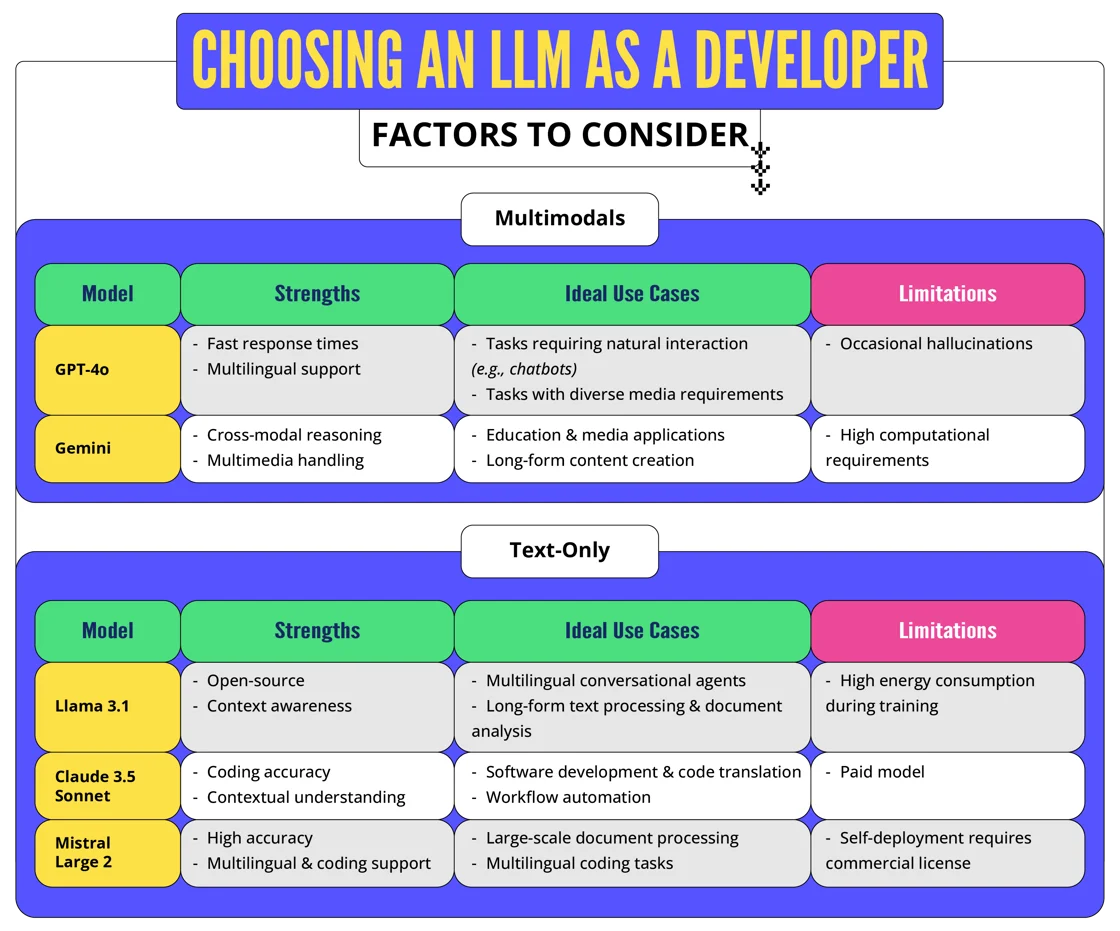
Comparing GPT4o, Gemini, Llama 3.1, Claude 3.5 Sonnet, and Mistral Large 2.
With so many options out there, it can be confusing to know which LLM you should work with as a developer.
But one thing is clear: every developer has to start building LLM skills.
In a McKinsey survey this year, 65% of respondents said their organizations regularly use Generative AI — an amount that nearly doubled across a ten-month period.1
This spike in AI use isn't just a fast trend that's due to fade. AI tools will become more prevalent in development workflows, and understanding how to leverage LLMs is a non-negotiable skill if you want to keep up with the times.
LLM skills are essential for future-proofing your career, and we're lucky to have these amazing tools at our disposal. From automating code generation to crafting personalized user experiences, LLMs can streamline your work and free you up to solve more complex problems.
To help you navigate the LLM landscape, I'll compare 5 popular LLMs today:
GPT-4o
Gemini
Llama 3.1
Claude 3.5 Sonnet
Mistral Large 2
Along the way, I'll share why you need LLM skills, and how to start building them.
Let's get started.
We've extended your Early Bird offer...
...and are even throwing in a Mystery Gift that you'll receive in your confirmation email if you subscribe this week!
👉 Remember, you'll get access to hundreds of state-of-the-art AI, ML, and Data Scienceresources, including:
You can narrow down your choice of LLM based on various factors:
Desired modality: Different models offer different modes of input and output. If you want multimodal input (not just text, but images, videos, and audio too), GPT-4o and Gemini are your best bet.
Reasoning quality: For complex problem-solving, you might go with a model known for its reasoning and accuracy, like Gemini or Claude 3.5 Sonnet.
Coding support: If you’re coding or debugging, pick an LLM that excels at coding tasks, like Claude 3.5 Sonnet and Mistral Large 2.
Context window: For handling long documents or conversations, you'll want to look for a large context window. Llama 3.1 and Mistral Large 2 offer large context windows of 128k tokens).
Latency: If you need real-time responses, prioritize models known for their speed, like GPT-4o.
Cost: We all have to work within a budget, so find a budget that matches best with the capabilities you're looking for.
There's no such thing as a perfect model, so you'll have to consider which of these requirements are the most important (and which requirements you're willing to compromise on).
Comparing 5 popular LLMs
Here's a quick breakdown of these 5 LLMs to demonstrate how they stack up.
1. GPT-4o
GPT-4o is OpenAI's latest "omni-capable" model (which just means it's multimodal).
GPT-4o is known for:
Natural interaction speeds
232ms response time when handling audio
GPT-4o has excellent multilingual support, along with advanced image and sound comprehension. That said, GPT-4o can still be prone to hallucinations, so you should be sure to review its outputs for accuracy.
Use Cases:
Customer support chatbots
Apps with multimodal interactions
Writing creative content
2. Gemini
Google's Gemini comes in various versions (Ultra, Pro, Nano) that can accommodate different tasks and computational requirements.
Gemini has strong cross-modal reasoning, making it excellent for applications that combine text with visual or audio data. Its benchmark performance also positions it as a strong competitor against GPT-4o.
Use Cases:
Scenarios that require analysis and generation across different data types, like:
Educational content
Media processing
3. Llama 3.1
Meta's Llama 3.1 is one of the most capable open-source options for LLMs.
Llama boasts a 128k token context window, ideal for long-form text applications. The 405 billion-parameter version can provide solid support for tasks like multilingual translation and coding support.
Use Cases:
Scenarios requiring long, context-aware responses, such as:
Document summarization
Creating multilingual bots
Serving as a coding assistant
4. Claude 3.5 Sonnet
I'm not going to lie, the latest version of Anthropic's Claude 3.5 Sonnet is pretty exciting.
Sonnet has a new beta feature: "Computer Use," through which the model can take control of your computer — clicking buttons to typing text — to complete a task for you.
Claude 3.5 Sonnet has impressive accuracy in coding tasks. On the SWE-bench Verified benchmark (a new evaluation framework), Claude scored 49.0%, outperforming other publicly available models more than two-fold.2
Use Cases:
Complex, multi-step software tasks like:
Updating legacy code
Translating between languages
Automating workflows
5. Mistral Large 2
Mistral AI's model, Mistral Large 2, is a popular choice among developers. Trained on 80+ coding languages, Mistral Large 2 boasts impressive coding accuracy.
Like Llama, Mistral Large 2 supports a 128k token context length.
While it requires a commercial license, the model's strengths correlate with a solid performance-to-cost ratio that many view as worthy of investment.
Use Cases:
Handling long documents
Multilingual coding tasks
You’ve chosen an LLM. Now what?
LLMs are truly a gamechanger compared to other AI models. They can handle complex, multi-step tasks and retain context, addressing challenges older models couldn't, such as advanced problem-solving and workflows.
Once you’ve selected an LLM, it’s time to apply it to your work.
Here’s how you can do it:
Integrate the API: You can add natural language understanding to your application by connecting directly to the LLM's API. This can mean adding features like a chatbot, a recommendation system, or a content generator.
👉 Example: Using OpenAI’s GPT-4o API to build a chatbot that processes multimodal inputs like text and images.
Use tools like LangChain: For workflows that involve multiple steps, LangChain acts as a mediator between you and the LLM. It simplifies complex processes by chaining prompts, retrieving data, and managing context across tasks.
Hone your prompt engineering skills: By learning the best practices of writing effective prompts, you'll get better results from your LLM.
Leverage tools built on the LLM: You can use pre-built tools or plugins to automate tasks like code generation and translation, freeing up your time for more complex and custom development.
Get future-ready with LLMs
If you're still unsure while working with an LLM, don't overthink it — just pick one and get started. The skills you gain, from prompt engineering to API integrations, will carry over no matter which model you end up using in the future.
If you want a guided approach to building your LLM skills, Educative has a few resources you might find helpful: