Hello!
Here’s your recap of Examine’s November 2023 updates.
[Absence of evidence] is not [evidence of absence]
Fully understanding the above phrase is absolutely critical for understanding evidence-based health.
On the surface, the concept seems simple: just because there haven’t been studies on something doesn’t mean it’s not true. But that’s not the whole story.
Feedback of the week:
If you had to pick, is it more important that Examine …
Click on one or reply and let us know!
What types of things don’t have much evidence?
Lots and lots of things!
Primarily individual responses.
You know how creatine works for most people, yet some people are creatine “non-responders” and don’t experience much, if any, benefit?
Well, creatine is one of the most researched supplements of all time, so creatine non-response has actually been studied. Think about all the hundreds of other popular supplements with way less evidence. Their response rates and the possible mechanisms explaining who they work for and who might not experience an effect haven’t been studied.
Now consider how little side effect data is collected, compared to efficacy data. Or the scarcity of evidence on interactions between different supplements, or supplements interacting with foods, drugs, genetics, or the microbiome.
But that all pales in comparison with the biggest evidence gap: interactions between a treatment and a health condition.
People with health conditions are explicitly excluded from trials
If you want to find out if a supplement works, you’d test it in the simplest population group possible.
For example, if you’re testing fish oil’s effects on high blood pressure, you’d recruit a group of participants with high blood pressure. Not people with high blood pressure plus a couple of other chronic health conditions, because those health conditions could affect the treatment’s efficacy.
One big problem though: 27% of Americans have more than one of the 10 most common chronic conditions. And that’s excluding the hundreds of less common chronic conditions!
Surprisingly little is known about the molecular mechanisms behind chronic conditions, or how they interact with other conditions. The body can respond in unpredictable ways when it’s not well.
So it’s not surprising that the results of a trial may not apply to you if you’re not totally healthy. Or you may experience a reaction that your healthcare provider doesn’t believe, because it’s not in the evidence they’ve seen.
This has happened to me several times. Here’s one example:
I once had a lidocaine injection into a joint, and it didn’t numb the area very well. The surgeon said that it should have, and maybe my mind was playing tricks on me. Years later, I found studies showing that people with Ehlers-Danlos Syndrome like me are more often resistant to local anesthesia.
Don’t go all conspiracy theory now!
Please don’t take all this to mean that healthcare providers don’t know what they’re talking about, or that evidence doesn’t matter.
Rather, just know that healthcare providers are fallible (as is everyone!), and evidence is hugely important but also fallible and incomplete. Four years of medical school and several years of residency exposes physicians to vast amounts of knowledge and many patients, but health is insanely complex and nobody can be perfect.
This is complicated by the thousands of important health studies published each month. No healthcare provider or lay person has the time or expertise to read through all of them.
If any of you Examine readers are secret billionaires and volunteer to give us an unrestricted grant, we can use that money to analyze many more studies than we currently do. We could even expand outside of nutrition and supplementation into exercise, medications, surgeries, and other topics. I’m pretty sure it would help humanity. Plus you might be able to get a tax deduction?
Whether you’re a secret billionaire or not, just keep in mind that humility is key to both assessing your own knowledge of health, and when choosing a healthcare provider. It’s great when you can find a doctor who can say “I’m not sure — I’ll look into it.” And sometimes even looking into it isn’t enough, because the evidence only covers so much!
Check out this graph of holiday weight gain in three different countries.
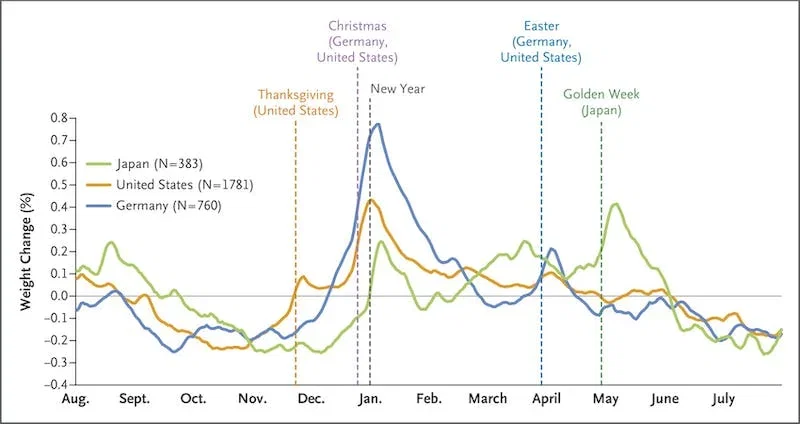
About two-thirds of our readers live in the U.S., so we’ll focus on Thanksgiving today.
Thanksgiving is the start of America’s “eating season”, a 40-day period that stretches until New Year’s Day is over. Despite constituting only 11% of the 365-day year, this period contributes the bulk of yearly weight gain for many people.
Decision tree time:
- If you’ve ever gained weight that you didn’t want during the holidays, you have a couple basic options that we’ll cover in this email.
- If you don’t care one bit about holiday eating and weight, feel free to skip this email and join us next week for a new topic!
You might think I’m going to suggest that you eat healthy on Thanksgiving. Nope!
Your holiday eating is up to you, and nobody should shame you for it or force healthy (and typically less tasty) options on you.
But it’s good to be aware of your options.
Your first option is to eat mostly whatever you feel like on Thanksgiving, in mostly whatever amount you want. This option is a good one if you’re confident that …
- You won’t have an acute reaction that negates your happiness from eating delicious food, such as stomach upset or worsening of a health condition.
- Overeating on Thanksgiving won’t open the spigot, so to speak, paving the way for your brain to allow more overeating during the rest of the holidays.
Keep in mind that the strategy of “This is a one-time thing — I’ll just go back to eating mostly healthy tomorrow,” works for some people, but fails for most.
So do you feel confident about the above two bullet points?
- If so, you can stop reading.
- If not, check out the strategies below.
There are two main strategies for mitigating holiday weight gain.
First, you can eat differently on the days around the holiday, but eat what you’d like on the holiday itself. For example, a randomized trial from 2021 showed that doing a specific type of intermittent fasting during the holidays can curb holiday weight gain.
Any safe way of moderating food intake during the holiday period would help mitigate holiday weight gain.
The second strategy is to change the way you eat on the holiday days themselves.
You can still eat your favorite foods, but load up on appetite-suppressing foods first: protein, fibrous foods, and water.
If you need to, you can also add on any other reasonable method to keep overeating to a low-to-moderate level: calorie counting, having an accountability buddy, having only one portion of trigger foods, and so on.
Using one or more of these strategies can help you shift the holiday weight gain odds in your favor. You might overeat a bit on holiday days, but knowing that you put forth some effort to control your eating can help you psychologically on the non-holiday days and boost your self-confidence.
That way, you won’t be as likely to yo-yo diet, meaning you won’t eat a ton, then deprive yourself for long stretches, for dieting cycle upon dieting cycle.
Keep in mind that your mileage may vary, and what works for most people might not work for you.
In any case, whether or not you watch what you eat during the 40 days from Thanksgiving to the end of New Year’s, I hope you eat some delicious food and get to spend time with loved ones. Just don’t preach to them about dietary choices! (But maybe tell them about Examine. Kidding … or am I?)
Every month, we summarize 150+ recent studies for our Examine+ Members. You can read five of this month’s most favorited Study Summaries for free by clicking the links below.
The Study Summaries marked with  are Editor’s Picks, which provide more details about the study, mention related studies, and include helpful graphics.
The role of dose and frequency in vitamin D supplementation
In this meta-analysis of randomized controlled trials, supplementation with vitamin D increased circulating vitamin D levels, without significant differences between daily and intermittent supplementation schedules.
Time-restricted eating versus calorie counting
In this year-long randomized controlled study, time-restricted eating was as effective as intentional calorie restriction for weight loss, even though the participants in the time-restricted eating group weren’t specifically told to reduce their calorie intake.
Food intake and appetite during sleep restriction
In this randomized crossover trial, sleep restriction increased hunger, cravings, fatigue, and energy intake from snacks.
Can napping boost physical and cognitive performance following partial sleep restriction?
In this randomized crossover trial, taking a nap after two nights of partial sleep restriction did not affect physical performance, but there was evidence to suggest that it benefited cognitive performance.
Do omega-3 fatty acids increase BDNF levels?
In this meta-analysis of randomized controlled trials, supplementation with omega-3 fatty acids elevated serum levels of brain-derived neurotrophic factor.
You can also check out the most-favorited summaries from previous months.🔥
So, did you find something of interest? If not, please reply to this email to let me know which topics you’d like us to tackle. And if you’re ready to stay on top of the latest research, you can try out Examine+ for free for 7 days.
It’s Nick, Lead Researcher at Examine, checking in again to show you what we’ve accomplished since my last email! This time, we focused on doing a smaller number of big updates, plus a bunch of small stuff, like adding individual new studies to pages and adjusting language.
Major Updates (Considerable updates to the FAQs, database, or both.)
|
Intervention Pages
|
Health Topic Pages
|
|
|
|
Minor Updates (Small additions, changes, or corrections.)
Plus, in case you missed it: Examine has a referral program! Just log into your Examine account, set your unique referral code, and send links to your friends and family. If anyone signs up using your link, you’ll get a 33% commission for every payment they make, for life!
As always, I love hearing from you, so please reply to this email if you have any suggestions for studies or topics we should cover. And if you’re ready see all the content we have to offer, you can try out Examine+ for free for 7 days.
Results are in from last week’s email on i+1 learning!
- The email got far, far more replies than any email in Examine’s 12-year history
- 97.7% of respondents wanted more i+1 learning
- 2.3% of respondents did not want more
The replies were also more enthusiastic than for any email in our history.
TL;DR: We’re going to develop a free four-week email course on meat as a test of i+1 science learning.
Click here to join the course!
What did replies from readers say?
Respondents ranged from physicians, professors, and dietitians to college students, busy executives, and elderly readers struggling with multiple chronic conditions. Here’s a tiny sliver of the responses:
Absolutely LOVE this concept Kamal, why haven’t I/we thought of this before? It’s a bite-size step by step mechanism to learning detail in a fascinating manner.
This is a fantastic idea. If I can doomscroll for 15 minutes I can certainly take 5 minutes to learn something useful.
As someone with ADHD, reading small chunks of information with logical breaks and spacing improves retention of information.
By focusing on a ”one card, one concept” approach, users will find it easier to remember and retrieve information. This could have profound implications for how information is absorbed and utilized.
I’m about to board a long flight, so no more email for the next 14 hours at least. But this was too good to let it go. Yes, I would definitely be very interested in that addition to Examine.
This is an amazing concept. I love this idea for more complex subjects. Whenever I am reading about a new subject I feel like I need to look up another 20 words just to understand that topic better.
Wow! You guys are going above and beyond what I signed up for. Yes please add the i+1 write-ups to your site.
This is an incredibly genius approach for learning more about science and not only applying what’s learned, but remembering it!!! 100% love it and hope you move forward with this!
Very interesting. I enjoy reading, however, on days when my brain has consumed enough long, jargon-heavy text; this method seems very effective. I enjoyed the simplicity and brevity very much.
What’s the next step?
We’re going to develop a free four-week email course on meat as a test of i+1 science learning.
Click here to auto-enroll in our
free i+1 email test course on meat
This test will let us polish the i+1 learning format to get it ready for prime time. We need specific feedback on different things we’re thinking about trying. Note that nothing on the Examine site will be replaced by i+1 learning. We’ll continue producing our usual material in its usual format.
You might be thinking, why meat? While meat is a food source, meat is also the bulk of an organism’s weight and more complicated than it seems at first glance, so it serves as a unique launching point for learning.
As we incorporate each additional “+1” layer of knowledge, we can go from the ground up to explore interrelated concepts involving tissue structure, protein, cholesterol, micronutrients, plant versus animal physiology, muscle gain, fat loss, and more.
This learning is diet-agnostic: even if you eat little to no meat, you are made of meat. It helps to know what you’re made of and how that relates to potential food and supplement choices.
Note that Examine has no “stance” on meat’s health effects, just like we have no set stance on any health topic. We’ll explore the pros and cons of meat, including research you have likely never learned about before.
We employ omnivore researchers, vegan researchers, researchers who have eaten carnivore diets, and everyone in between. As new evidence rolls in, we update our knowledge base. There’s no cherry picking at Examine.
This course will start with simple, well-supported concepts interspersed with interesting facts and tips, and then build up to deeper concepts of increasing complexity. When there’s uncertainty around a concept, we’ll note that.
The course construction will be a team effort. We don’t pretend to know everything about this topic, let alone nutrition as a whole. But the 30 Examine researchers combined are quite the formidable force. Our internal debates help sharpen our knowledge bases and produce better ideas, kind of like Abraham Lincoln’s Team of Rivals, but with much tinier impacts. 🙂
Lastly, I wanted to give a big shout out to each of the ~700 of you who replied to last week’s email.
As I mentioned in a previous message, I have a life-long habit of excessive self-criticism and self-doubt. Here’s proof from the day I first mentioned the i+1 idea in our team’s messaging app:

And even a few days later:
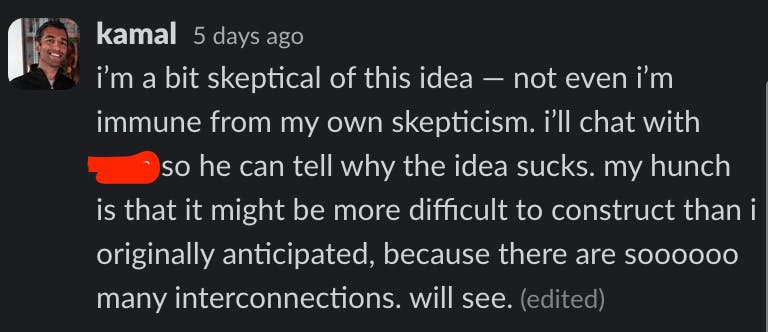
While it might indeed be difficult to construct, I think the results will be worth it.
All that is to say — this learning approach might have stalled if you all hadn’t replied like you did! This isn’t just lip service. We heavily rely on you telling us what you want.
So if you’d like to be one of the first testers of our i+1 course …
Click here to auto-enroll in our
free i+1 email test course on meat
Sincerely,
Kamal Patel, Nick Milazzo, and Morgan Pfiffner
P.S. Are you a health professional with patients or clients who ask you about supplements? We’re developing Examine Pro, which will enable health professionals to generate handouts and protocols from Examine’s FAQs and Supplement Guides. If you would be interested in using this feature, please reply to this email. We’d love to chat!