All of that has been making me think differently about what it means simply to still be here, and about how I want to spend whatever time I’m fortunate enough to get. And, maybe strangely, that has also changed the way I think about aging. I’m getting closer to 50, and I look around at the culture we live in — especially the culture surrounding women — and so much of what we’re told is that aging is something we should be desperately trying to prevent from happening. And to hide it when it inevitably does. Don’t look your age. Freeze the wrinkles. Fix your neck. Tighten your jowls. Lift those eyelids. Make your face look like it did twenty years ago.
I understand the impulse. I have a mirror too. Most mornings when I look at my face I’m not thinking great thoughts. And if you want to freeze the wrinkles, freeze the wrinkles — truly, no judgment if you do. But lately, and especially today, I keep coming back to a very different thought.
What an extraordinary privilege it is to get wrinkles. What a privilege it is to have a face that changes because you were fortunate enough to keep living. The jowls, the gray hairs, the lines around our eyes — they mean we got another year. And then, if we’re fortunate enough, another one after that.
There are so many people who would have given anything to grow old. I know my husband’s late wife, my stepsons’ mother, would have given all the wrinkles in the world to see her boys grow into men.
There are people taken by cancer and disease long before they should have been. There are lives ended by accidents and circumstances nobody could have predicted. And there are also so many people among us struggling with mental illness, addiction, depression, loneliness and pain that can become so enormous they cannot see a way through it. That part has been weighing on me a lot lately.
Not in relation to any one person’s death, because I don’t know anyone else’s story well enough to do that. But more broadly, I keep thinking about where we are as a society when so many people are hurting this badly. How have we gotten to a place where so many of us are trying so hard not to look like we have lived, while so many others are struggling just to keep living?
I don’t have a tidy answer to that. Or even a real one. All I have are a lot of thoughts and even more questions. And I definitely don’t want to turn grief into some kind of life lesson, because I think we try to do that far too often. Sometimes something is simply heartbreaking and we’re allowed to let it be heartbreaking. But it is changing the way I think about my own aging. And, much more importantly, how I show up in the world for others.
I’m trying to stop looking at every new line as something that needs to be corrected and start seeing at least some of them for what they actually are: proof that I got to stay. I got another birthday. I got another year with the people I love. I got more ordinary, exhausting days where I sometimes don’t feel like showing up well, but will do my very best to. Because it truly is an honor and a privilege. And there is absolutely nothing ordinary about that.
And I think that makes how we show up for each other feel even more important right now. We can’t know what everyone around us is carrying, and it seems like we’ve become less curious about that and less gentle with each other at exactly the time we need more of both. We aren’t going to fix someone’s grief, depression, loneliness or pain with the perfect words. We can’t even really know the full extent of what they’re going through. But we can notice. We can reach out. We can be a little kinder than necessary. We can tell someone we love them while they’re here, and when someone they love is gone, we can resist the instinct to stay away because we’re afraid of saying the wrong thing. I think maybe showing up imperfectly is actually more important than ever now. At least it feels that way to me.
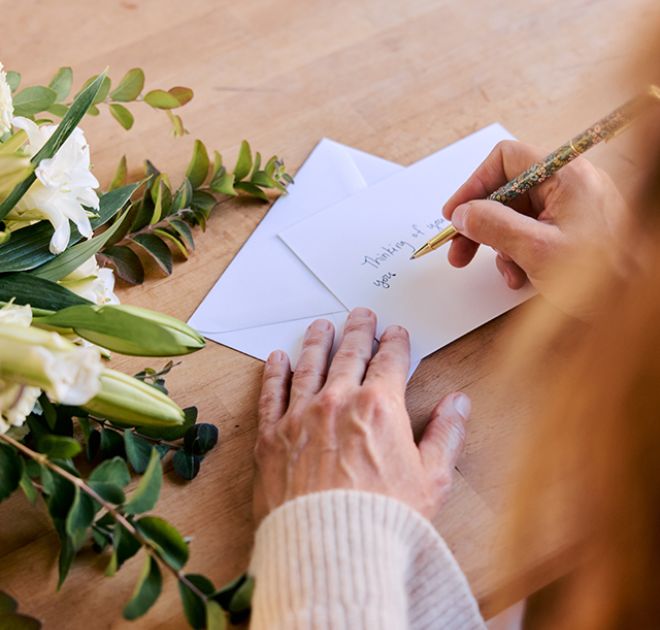
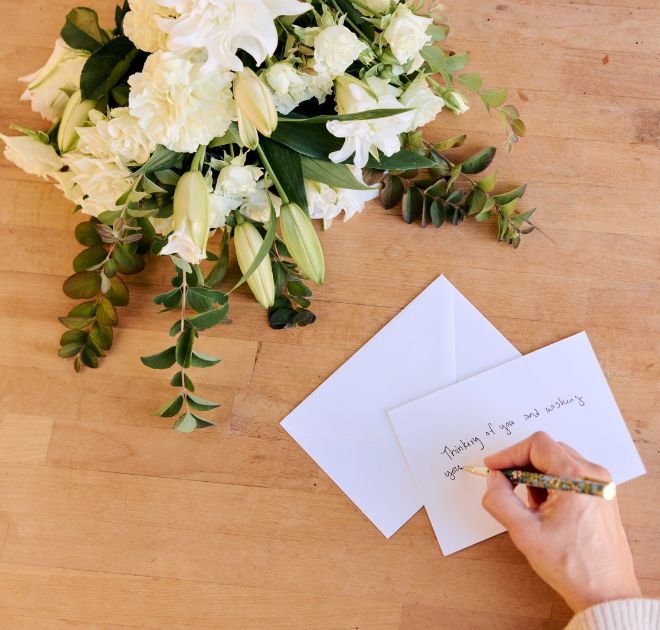
Which brings me to sympathy cards, which is what I sat down to write about (per my marketing assignment) that turned into a super long essay, as it often does with me. But I think that’s exactly why they’re so hard to write. We’re looking for words big enough to meet a loss that words simply can’t be big enough for. There is nothing you can write in a sympathy card that will make someone come back to us or make the person who loved them hurt less. That’s an impossible standard for a tiny card attached to a bouquet. But the card can do something else. It can say, I see what you’re going through. I’m thinking about you. I remember them. You matter to me, and you’re not alone. And maybe, especially right now, that’s reason enough to write it.
If someone you love is grieving and you have a blank card sitting in front of you right now, I wrote down everything I’ve learned about what to put in it, after reading thousands of them over the past fifteen years.
xx, Christina