|
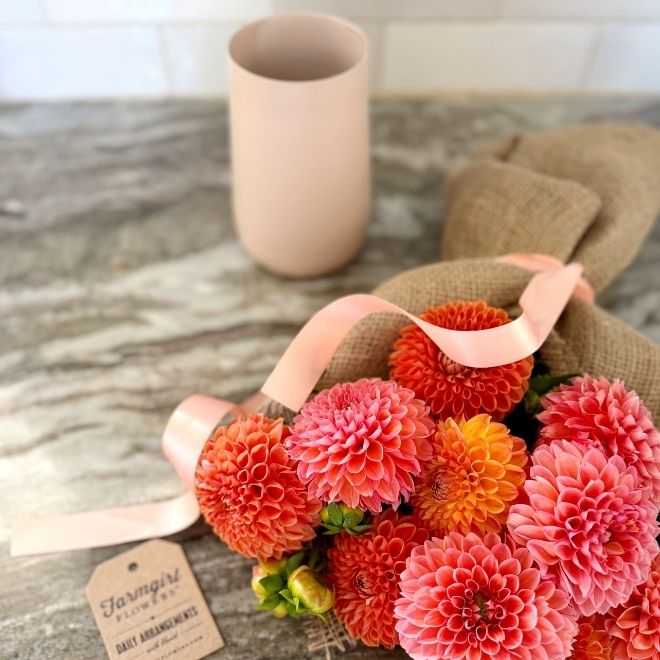
The 101 on fall’s favorite, prolifically-petaled, stem? It’s, in typical Farmgirl fashion, a little more 401 in length. |
|
|
|
There are more than 40 species and over 57,000 registered cultivated varieties of dahlias.
And while that sounds like a lot, compared to orchids - which ring in at over 100,000 registered hybrids - there’s some headroom left before things get close to what we’d officially consider prolific.
What’s the difference between a species and a registered cultivar? We’re so glad you asked.
In case you were doodling in the margins during this particular section of biology class, a species is a distinct group of individual organisms in nature that share common characteristics. A registered cultivar, in contrast, refers to a plant that was chosen or created by humans because of a unique feature, such as a specific color, petal shape/formation, or disease resistance (among other points of differentiation). And between these two classifications lies type or form, which is yet another umbrella category created by science-y people to designate cultivars within species based, again, on more specific characteristics like color and petal/shape formation.
And just because we’re on a roll, the word cultivar is a blend of "cultivated variety." If you’re headed to pub trivia later and the host is angling in an agricultural direction, you’re welcome.
These classifications flow from broad (species) to specific, individually named plants (registered cultivars). Types/forms help us organize cultivars together in similarly appearing or presenting groups.
|
|
|
Dahlias’ once upon a time comes from Mexico, where they’re native to, along with parts of Central America. Many centuries ago, indigenous Mesoamerican people grew and cultivated wild varieties. They gave dahlias their Nahuatl names Acocotli or Cocoxochitl, which mean “water pipes” - an homage to their hollow stems.
Not coincidentally, and in no small part due to their longstanding history in the country, dahlias became Mexico's national flower in the 1960s, when they were given the designation by President Adolfo López Mateos.
What makes a plant or flower native to a region? A plant is considered native to an area if it occurred, evolved, and naturally established itself there over thousands of years without direct or indirect human intervention (i.e. it was brought to the area through trade, travel, or other means of transportation). Evidence of dahlias can be found in Aztec records documenting tubers as a food source. It can also be found in the records from Spanish colonial conquests that documented and illustrated wild varieties during the country’s exploits in Mexico in the 16th century.
|
|
|
If we got into the weeds of all 40+ species, we’d need a tweed blazer, a monotonous voice, and a student named Bueller. To save you (and us!) some time, we’re going to cover the usual suspects today, and leave the more specialty species to the experts. Though, if you’re so inclined, we recommend diving down that particular rabbit hole with the American Dahlia Society.
Out of the more than 40 wild species of dahlias, the vast majority of the 57,000+ modern garden cultivars come from the cross-breeding of two, main parent species: Dahlia coccinea (Red Dahlia) and Dahlia sorensenii. Seeds from both of these species were sent from Mexico to Europe in the late eighteenth century. This was more than a few decades before Gregor Mendel - the nerdy monk we all learned about in that same biology class - was fussing around with peas and learning how to selectively breed for (or against) certain traits. It was this same tinkering/nurture-not-nature spirit that fueled the discovery that these two species of dahlias easily cross pollinated, and thus was born the hybrid Dahlia x pinnata. This new species had a complicated genetic combination that allowed for an exponential increase in new shapes, sizes, and colors, and is directly responsible for almost every registered cultivar grown today.
And no, in case you’re wondering (because we were, too) pinnata didn’t come from piñatas, but rather from the Latin word pinna, which means “feather.” Which is degrees of magnitude less fun, but still potentially useful at the pub later. Again, you’re welcome.
|
|
|
Within this species, there are a few types that most flower lovers/gardeners will easily recognize.
Decorative: but not in the 1994, HGTV home crafting sense
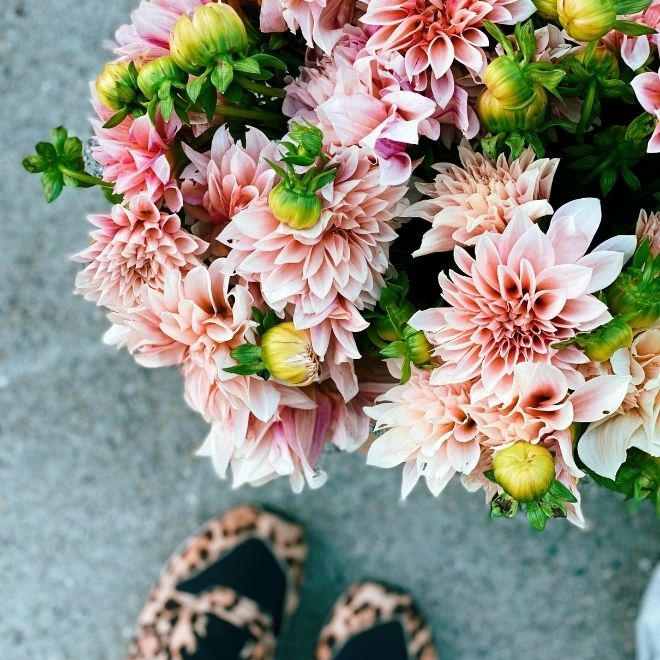
Dahlias in the Decorative type are fuller and rounder, with no visible center. This form splits two ways: Formal Decorative (which sounds like something out of a ballroom dancing lesson) and Informal Decorative. Formal Decoratives have more board, flat, and tidily arranged rows of petals, while Informal Decoratives have twisting petals that tend to curl and warp in different directions.
Dinnerplate: the faux form
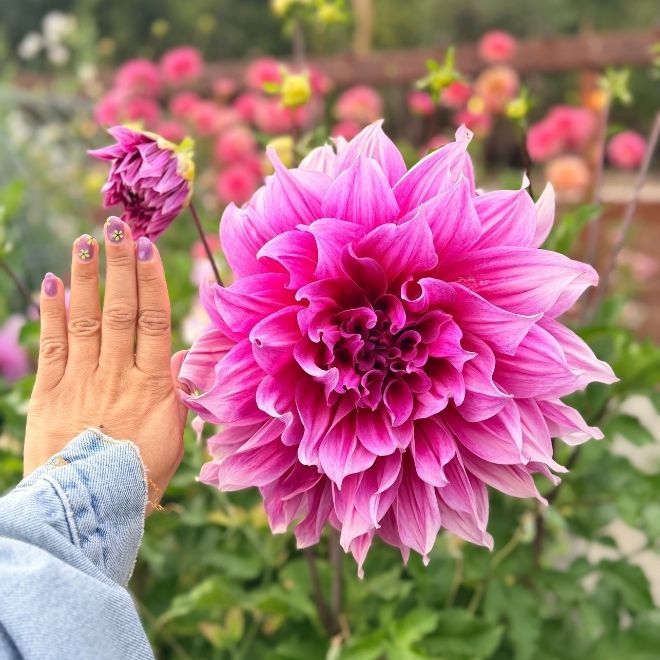
It’s not a scandal fit for the headlines, but “dinnerplate” isn’t actually a true type of form. Instead, it’s a designation given to any dahlia that measures more than eight to 10 inches across. This shoe fits regardless of petal shape, and it’s a category many fan favorites (like Cafe Au Lait) fall into. N.B. If you want to get nerdy, these oversized overachievers are technically Informal Decorative form.
Ball and Pompon: BE AGGRESSIVELY SPHERICAL AND GEOMETRIC
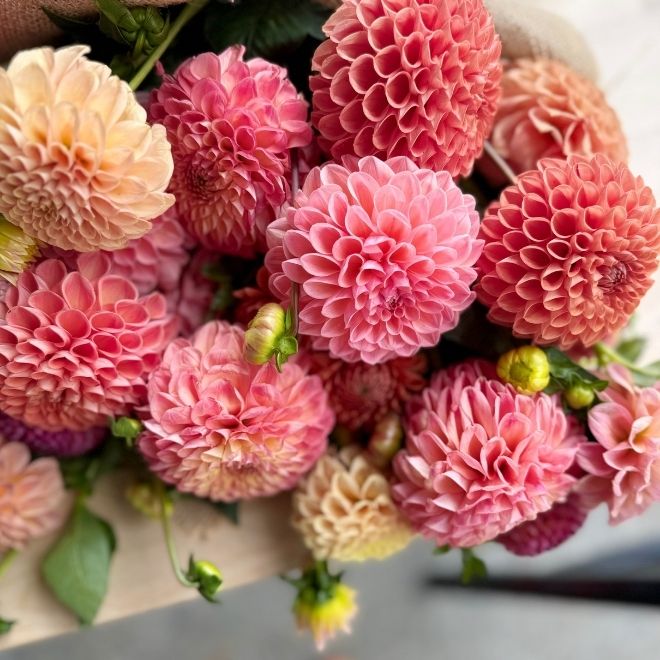
The Type A to Informal Decoratives’ type B bedhead, Ball and Pompon forms are a series of concentric petals, rolled into tubes that cascade outwards so precisely the resulting flower looks built, not bloomed. While similar in shape and petal formation, Ball forms are slightly larger than more tightly woven Pompon varieties.
Cactus and Semi Cactus: spiky in name only
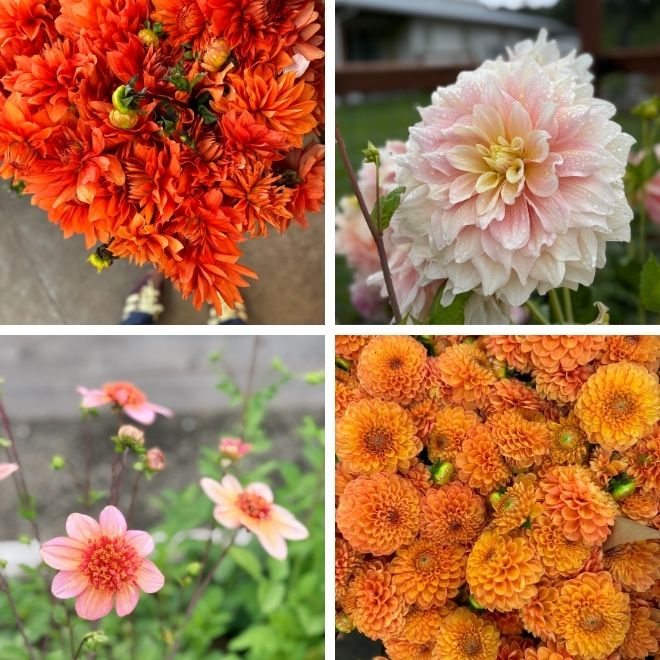
Cactus forms are characterized by their rolled petals that narrow into points at the end. The resulting flower has a porcupine-type presentation, almost like a firework caught mid-explosion. Straight Cactus varieties point outwards, while Incurved Cactus curl back towards the center.
Semi Cactus forms have the broad petal bases of other forms that roll into points as they reach their tip.
Anemone, Collarette, and Single: the “center” of attention
While most forms typically hide, or limit the view, of their centers, these more sparsely-petaled varieties show it off, rimmed either by a small, inner row of petals (such as Anemone or Collarette) or by nothing at all (Single).
|
|
|
While some bedhead is normal for certain cultivars, the stresses of shipping can cause some unnecessary roughing on more delicate varieties. After much trial and failure (read: a lot of sad boxes of flowers), we’ve worked with our growers to narrow down a list of mostly Ball and Pompon varieties that weather the confines of corrugate and time in transit best. The occasional Cactus and Semi Cactus have been known to make their way into this mix, as well, but it’s rarer.
And while we’d love to ship a dinnerplate, their absolutely behemoth flower would make it difficult to fit more than a few in one of our shippers. Coupled with the all out tantrum most of them throw when cut (read: they wilt faster than a snowflake on a sunny day), and this variety is best when picked and enjoyed within the same zip code.
|
|
|
If you’ve made it this far, first of all, thank you. While we live, breathe, eat, and literally sometimes sleep flowers, we still have to double check and cross reference our sources when we’re getting all scientific like this, so we’re more than appreciative when someone hangs in there with us ‘til the footnotes.
And while we’re fresh out of gold stars, if you’re looking for a reward for landing at the bottom of this decidedly long form email, you can deliver a box of dahlias on your own doorstep while they’re in peak season. Send us a photo via DM or email and we’d be happy to help you ID your new flower friend!
|
|
|
|
id: 2026-09-09-04:24:43:681t |
|
|
|