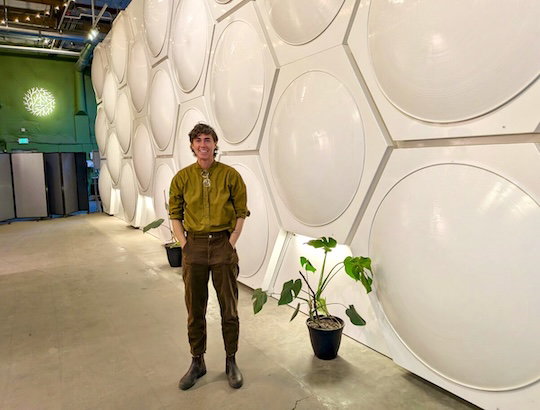
What if the greenest thing you ever do is die? The latest episode of GeekWire's sustainability podcast "Positive Charge" dives into human composting — turning a body into clean soil instead of ash or embalmed remains. Hosts Lisa Stiffler and Laura Scott go inside Recompose, the Seattle company that pioneered the practice and got it legalized, and meet the surprisingly broad range of people choosing it. It's the option Martha Stewart says she wants, and one of the season's most hopeful episodes.
Read more and listen here, and check out more episodes of "Positive Charge" on
our show page.
Microsoft commits $60M to “Genesis Mission”: The tech giant is providing $40 million in Azure AI cloud credits and $20 million in engineering support to back the U.S. Department of Energy’s effort to accelerate AI-powered scientific research across national labs. Microsoft is also establishing a dedicated internal team, named SPARK, to directly manage deployments and coordinate projects like material discovery and threat detection. Read more.
Microsoft 2.5: Nearly 20 years after her "Microsoft 2.0" book on the post-Gates era, and more than a decade into Satya Nadella's tenure as CEO, Mary Jo Foley is launching a new GeekWire series profiling the people setting the company's direction now. Read the preview, and stay tuned for the first installment Thursday.
Simulated space in Seattle: The Mars Society is partnering with South Seattle College to build an analog research station on its West Seattle campus, aiming to train students for future crewed missions to the moon and Mars. Read more.
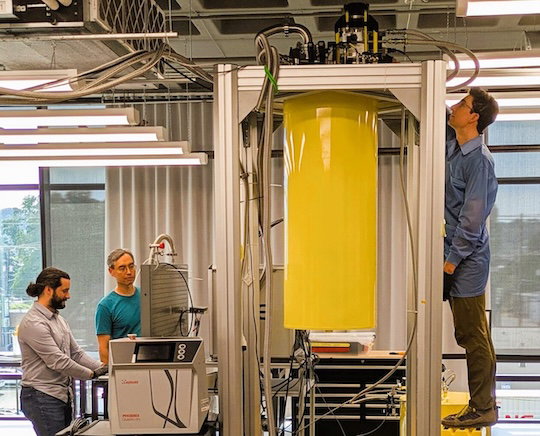
Cool breakthrough: Seattle-based space startup Interlune successfully extracted 99% pure helium-3 from ordinary terrestrial gas using its "Cold Capture" technology, proving out a process it ultimately aims to deploy on the moon. (Above: Mechanical engineer Sam Heyd, Chief Technology Officer Gary Lai and chemical engineer Brenden Pelkie operate the Cold Capture system in Interlune’s Cryogenic Lab at the company’s Seattle headquarters.) Read more.
New open-source document format: Docugami, the Kirkland, Wash., startup led by XML co-creator Jean Paoli, is open-sourcing DGML, a format that turns business documents into structured, verifiable data. The company is releasing it under an open-source license, partnering with Inveniam and Mantra to anchor the data on a blockchain, betting it can become a standard way to turn documents into data that people and AI agents can trust. Read more.
Kalshi hits a wall in Washington: A King County Superior Court judge issued a preliminary injunction against prediction-market company Kalshi, finding the state is likely to prove the fast-growing platform amounts to illegal online gambling. Judge John McHale rejected Kalshi's core argument that federal CFTC oversight preempts state gambling law. The ruling doesn't immediately halt operations — a full order is due Aug. 5. Read more.
Hot Links:
-
The Gates Foundation’s own review found staff repeatedly warned senior leaders — including Bill Gates — about the risks of meeting with Jeffrey Epstein, identifying roughly 30 interactions from 2011–2014 before the foundation cut ties. (Seattle Times)
-
Amazon laid off an unspecified number of employees in its artificial general intelligence (AGI) organization, as it invests heavily in programs to help businesses implement AI. (Reuters)
-
Jimothy the viral Seattle raccoon is officially a playable character in “Dungeons & Dragons,” Renton, Wash.-based Wizards of the Coast announced. The beloved critter also scurries across the screen now when his name is searched in Google. (Screen Rant)
Thanks for subscribing, and have a great day. — GeekWire editor Todd Bishop, [email protected]; reporter Kurt Schlosser, [email protected]; and reporter Lisa Stiffler, [email protected]