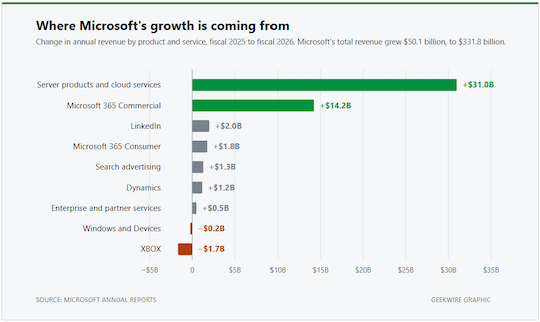
Microsoft's business growth (and decline) in one chart: Of the $50.1 billion the tech giant added in revenue for its recently completed fiscal year, 90% came from two categories: server products and cloud services, and Microsoft 365 Commercial. Two of its longstanding businesses, Xbox and Windows, both got smaller, and LinkedIn now brings in more revenue than Windows.
Read more takeaways and catch up with
the rest of the results.
AWS is giving its agentic AI chief a bigger job: Swami Sivasubramanian will now also oversee emerging technologies and help shape AI strategy across the cloud division, as Amazon reshapes its broader AI strategy and teams. Read more.
Rallying cry for Seattle: AI House co-founder Jacob Colker delivered a passionate speech at a Seattle Tech Week event, urging the local tech community to overcome self-doubt, recognize the region's world-changing innovations, and rebuild a sense of civic pride and connection. Read more.
Navigating the new VC era: Seattle investor and founder Nikesh Parekh argues that venture capital has split in two: record money flowing to a narrow band of AI companies while most founders find it harder than ever to raise. He lays out what founders should do about it, from raising VC to angel funding, venture debt, revenue-based financing, and bootstrapping to profitability. Read more.
Talent grab: Salesforce has hired a nearly 30-year Microsoft veteran, Krishna Kumar Parthasarathy, as executive vice president of engineering to lead its Agentforce and Service Cloud teams, marking the latest high-profile departure from Microsoft's security leadership ranks this summer. Read more.
Latest space news:
-
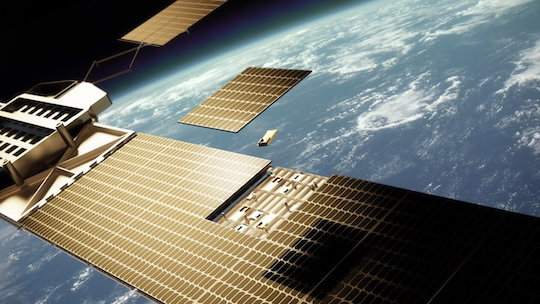
Solving AI's orbital heat problem: Sophia Space and Caltech have secured a patent for a modular, tile-based satellite architecture that uses passive cooling to run energy-intensive AI data centers in space without bulky centralized radiators. Read more.
-
Betting big on mega-satellites: K2 Space, which recently opened a Seattle engineering office, has raised $500 million in Series D funding at a $6.8 billion valuation to scale up production of its high-power, mega-class satellites. Read more.
-
Laying the groundwork for a moon base: Seattle startup Interlune is expanding its partnership with industrial manufacturer Vermeer to build heavy construction tools — like site-leveling and compaction equipment — for NASA's planned lunar infrastructure. Read more.
-
A game about building on the moon: "Moonbase Y," in development at Seattle-based game studio August Interactive, will put players 13 and older in charge of a lunar colony, from launch through construction. Read more.
Expanding beyond cross-border remittances: Seattle-based Remitly launched the Remitly Global Card, a new Visa debit card and multi-currency account designed to convert international money transfers into an everyday banking solution for global users and immigrant workers. Read more.
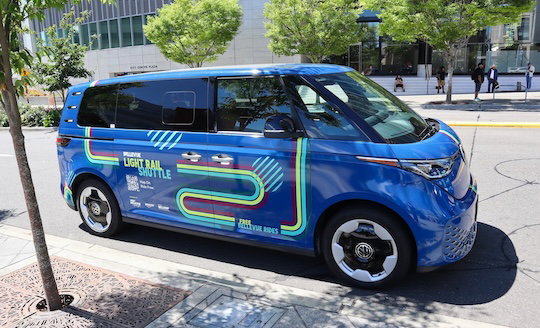
Closing the last-mile gap: Visit Bellevue, with funding support from Amazon, is launching a free electric shuttle pilot program on Aug. 3 using Volkswagen ID. Buzz vans to transport Sound Transit light rail passengers to downtown destinations. Read more.
Hot Links:
-
Microsoft is deepening its AI partnership with the English Premier League, rolling out a Copilot-powered assistant for the Fantasy Premier League designed to help more than 13 million managers analyze players and make lineup decisions. (Microsoft)
-
Amazon's Zoox won the first federal clearance to charge for rides in a robotaxi built with no steering wheel or pedals — a temporary NHTSA exemption capped at 2,500 vehicles a year for two years. (Bloomberg)
-
Washington State University launched an updated interactive web tool that provides high-resolution air quality forecasts — including wildfire smoke, fine particulate matter, and ozone levels — across Washington, Oregon, and Idaho. (WSU Insider)
Thanks for subscribing, and have a great day. — GeekWire editor Todd Bishop, [email protected]; reporter Kurt Schlosser, [email protected]; and reporter Lisa Stiffler, [email protected].