|
| |
|
|
|
|
Hi there,
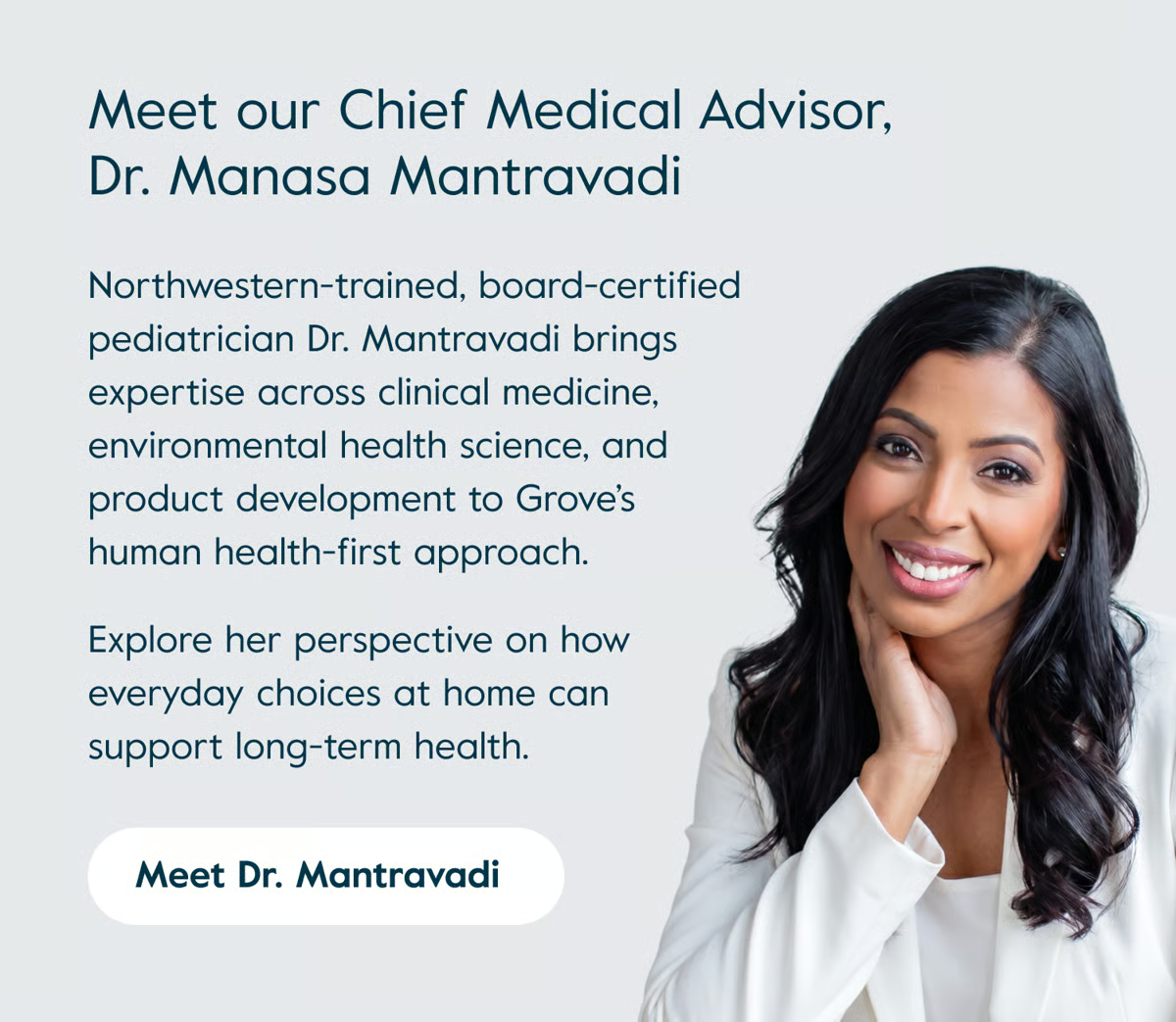
I’m Dr. Manasa Mantravadi, Grove’s Chief Medical Advisor and a board-certified pediatrician. Every month I share one thing from the world of health research that’s genuinely worth your attention — no fear, no hype, just what the evidence actually shows and what it means for you and your family.
This month: living longer, and living better. There's a lot of conversation right now about supplements, IV drips, and "anti-aging" solutions. Some approaches show promise, while others need more research. So let's start with what the science most consistently supports — and where additional tools may fit alongside a strong foundation.
The Research
Nearly a decade of healthy years — mostly within your control.
In a large study that followed adults for decades, people who maintained a healthy weight, never smoked, stayed active, and drank alcohol only in moderation lived about nine more years free of chronic disease between ages 40 and 75 than people who practiced none of these healthy behaviors.
That’s not nine extra years of being sick. It’s nearly a decade of extra healthy years — and none of it required a prescription.
The Science, Simply
Lifespan vs. healthspan — and why the basics win.
There are really two questions in longevity: how long you live (lifespan), and how long you stay healthy (healthspan). The goal isn’t just more birthdays — it’s more good years.
Here’s the part the wellness industry doesn’t love: the strongest evidence points to a short list of everyday habits, not a shelf of pills. Below are the levers researchers keep coming back to — ranked, roughly, by how much they move the needle.
What To Do
Six levers that actually add healthy years.
Move your body is the single biggest lever — but the full list, in order of impact, is below.
|
→ Move Your Body (the single biggest lever)
| · |
Aim for about 150 minutes a week of moderate activity — brisk walking, cycling, swimming. That alone is linked to roughly a 31% lower risk of dying from any cause. |
|
| · |
Add strength training twice a week. People who do both aerobic and strength work have about a 40% lower risk of death than inactive people. |
|
| · |
It’s never too late. The biggest gain comes from going from doing nothing to doing something. |
|
|
→ Eat for the Long Game
| · |
A Mediterranean-style pattern — vegetables, fruit, whole grains, legumes, nuts, olive oil, fish; less red and processed meat — has the strongest longevity evidence. |
|
| · |
2–4 cups of coffee a day is associated with about a 15% lower risk of death from all causes. |
|
| · |
Don’t chronically overeat — but skip extreme calorie restriction unless a doctor is guiding you. |
|
|
→ Keep a Healthy Weight
| · |
A BMI under 25 shows up in nearly every “long, disease-free life” combination in the research. |
|
| · |
It works alongside the other habits, not instead of them — the effect is in the combination. |
|
|
→ Protect Your Sleep
| · |
7–8 hours a night is linked to the lowest risk of death and the most disease-free years. |
|
| · |
Sleeping 5 hours or less in your 50s was linked to a 30% higher risk of developing multiple chronic diseases. |
|
| · |
Both too little and too much (9+ hours) track with faster biological aging. |
|
|
→ Skip Smoking, Go Easy on Alcohol
| · |
Never smoking (or quitting) is one of the most powerful things you can do for a longer life. |
|
| · |
If you drink, keep it moderate — heavy drinking ages blood vessels and shortens life expectancy. |
|
|
→ Mind a Few Key Nutrients (food first)
| · |
Three key nutrients that have the strongest evidence: vitamin D, magnesium, and selenium. |
|
| · |
The win is correcting a real deficiency — not megadosing. Extra supplements “just in case” haven’t been shown to help, and some (like high-dose beta-carotene) can harm. |
|
| · |
Ask your doctor to check your vitamin D — especially with limited sun, darker skin, or age over 65. Food sources: nuts, seeds, leafy greens, beans, whole grains (magnesium); Brazil nuts and seafood (selenium). |
|
The Honest Take
What about the longevity pills everyone’s talking about?
GLP-1 medications (like semaglutide) are genuinely promising — in large trials they lowered the risk of death and heart events. But they’re prescribed for specific medical reasons, not as anti-aging drugs for otherwise healthy people.
Metformin, rapamycin, and senolytics are being actively studied and are scientifically interesting — but none is proven to extend life in healthy people yet.
Expensive IV drips (the $250–$1,000-a-session kind) and other longevity therapies have become increasingly popular, but a review of more than 100 studies found no consistent evidence of meaningful health benefit in people so far. While researchers continue to study these therapies, no intervention has been shown to outperform the foundational habits above. Here, the marketing is well ahead of the science. No pill beats the basics — and please talk to your own doctor before starting anything.
|
|
Here’s what I want you to take away: the most powerful longevity tools we have are free, and they’re already in your hands — move, eat well, sleep, don’t smoke, keep alcohol moderate, and fix any real nutrient gaps. Together, those habits can add years — even a decade — of healthy life.
And one pillar that’s easy to overlook: the environment you live in. The home is a lifestyle-medicine lever too — and it’s the one we spend our time on at Grove.
If you’re weighing a specific change — or any supplement or medication — talk with your healthcare provider. They can help you prioritize what matters most for you. As always, I’m here to help you cut through the noise.
Dr. Mantravadi
Chief Medical Advisor
|
|
|
|
|
The information provided in this marketing material is for general educational and informational purposes only and does not constitute the rendering of medical advice, diagnosis, or treatment. No physician-patient relationship is created by reviewing or interacting with this content. Always consult with a qualified healthcare professional regarding any medical condition or before making any decisions about your health.
|
|
References
Primary peer-reviewed sources and published guideline statements.
1. Garcia L, Pearce M, Abbas A, et al. Br J Sports Med. 2023;57(15):979–989.
2. Zhao M, Veeranki SP, Magnussen CG, Xi B. BMJ. 2020;370:m2031.
3. Mok A, Khaw KT, Luben R, Wareham N, Brage S. BMJ. 2019;365:l2323.
4. Hamczyk MR, Nevado RM, Barettino A, Fuster V, Andrés V. J Am Coll Cardiol. 2020;75(8):919–930.
5. Pietri P, Stefanadis C. J Am Coll Cardiol. 2021;77(2):189–204.
6. Kritchevsky SB, Cummings SR. JAMA. 2025;334(12):1094–1102.
7. Nyberg ST, Singh-Manoux A, Pentti J, et al. JAMA Intern Med. 2020;180(5):760–768.
8. Stenholm S, Head J, Kivimäki M, et al. J Gerontol A Biol Sci Med Sci. 2019;74(2):204–210.
9. Sabia S, Dugravot A, Léger D, et al. PLoS Med. 2022;19(10):e1004109.
10. MULTI Consortium, O’Toole CK, Song Z, et al. Nature. 2026.
11. US Preventive Services Task Force, Mangione CM, Barry MJ, et al. JAMA. 2022;327(23):2326–2333.
12. O’Connor EA, Evans CV, Ivlev I, et al. JAMA. 2022;327(23):2334–2347.
13. Sutherland JP, Zhou A, Hyppönen E. Ann Intern Med. 2022;175(11):1552–1559.
14. Fan X, Wang J, Song M, et al. J Clin Endocrinol Metab. 2020;105(10):dgaa432.
15. Zhang X, Xia J, Del Gobbo LC, et al. Clin Nutr. 2018;37(5):1541–1549.
16. Bagheri A, Naghshi S, Sadeghi O, Larijani B, Esmaillzadeh A. Adv Nutr. 2021;12(4):1196–1210.
17. Cui Z, Xie R, Lu X, et al. Redox Biol. 2025;85:103755.
18. Marzano F, Paolillo S, Gargiulo P, et al. Cardiovasc Diabetol. 2026.
19. Lincoff AM, Brown-Frandsen K, Colhoun HM, et al. N Engl J Med. 2023;389(24):2221–2232.
20. Lee MMY, Sattar N, Pop-Busui R, et al. Diabetes Care. 2025;48(5):846–859.
21. Kang YM, Bohula EA, Lincoff AM, et al. Diabetes Obes Metab. 2025;27(7):4017–4021.
22. Khan J, Pernicova I, Nisar K, Korbonits M. Lancet Diabetes Endocrinol. 2023;11(4):261–281.
23. Espinoza SE, Khosla S, Baur JA, de Cabo R, Musi N. J Gerontol A Biol Sci Med Sci. 2023;78(Suppl 1):53–60.
24. Forman DE, Kuchel GA, Newman JC, et al. J Am Coll Cardiol. 2023;82(7):631–647.
25. Gallagher C, Emmanuel OO. Ageing Res Rev. 2026;116:103057.
26. Damgaard MV, Treebak JT. Sci Adv. 2023;9(29):eadi4862.
27. Nakazzi F, Zarei M, Lopes M, et al. Cancer Lett. 2026;645:218334.
|
|
|
|