|
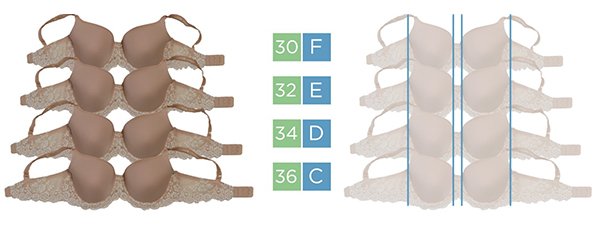
Note how the vertical lines splay out as the band size increases. The cups are getting a little larger with each band increase – they are increasing by one full cup size, though all are D cups. And here’s an homage to bra manufacturers; each of these four D cup sized bras must also have their own unique underwire size to adjust to the expanding base of the breast.
Cup Sizing Rule 1:
Moving up 1 band size – 36D to 38D – also increases your cup volume.
Moving down 1 band size – 36D to 34D – also decreases your cup volume.
Cup Volume Changes with Band Size
When your bra band starts feeling tight on its loosest hook, it’s time to move up a band size. I just explained above that moving up a band size also increases cup size volume. If your breasts have also increased in size, moving up a band and keeping your cup size the same gives you an increase in both – so that’s your new bra size and it fits. Conversely, should you lose weight, and your breasts lose some fullness, moving down a band size and keeping the same cup size gives you a decrease in both – so that’s your new bra size and it fits.
Weight loss and weight gain often do not impact our breast volume – breast volume and size stay the same. It’s these scenarios where most women make the incorrect choice in selecting their next bra size to try. And, it’s completely understandable. Without knowing how bra cup sizing is determined, you would never think to try the size I’m about to recommend. It simply doesn’t make sense.
When all you want in your next bra size is a bigger band, your next bra size move should be to go up a band and down a cup size. Conversely, if all you want is a smaller band, your next bra size move should be to go down a band and up a cup size.
|