Charles Lieber Is Back. But The Nanotech King Never Left.
A globe-spanning tale of science, state power, and the race to map the human mind.

Is this your brand on Milled? Claim it.

Truth That’s Not Fit To Print In The Inverted Matrix of B.S Charles Lieber Is Back. But The Nanotech King Never Left.A globe-spanning tale of science, state power, and the race to map the human mind.
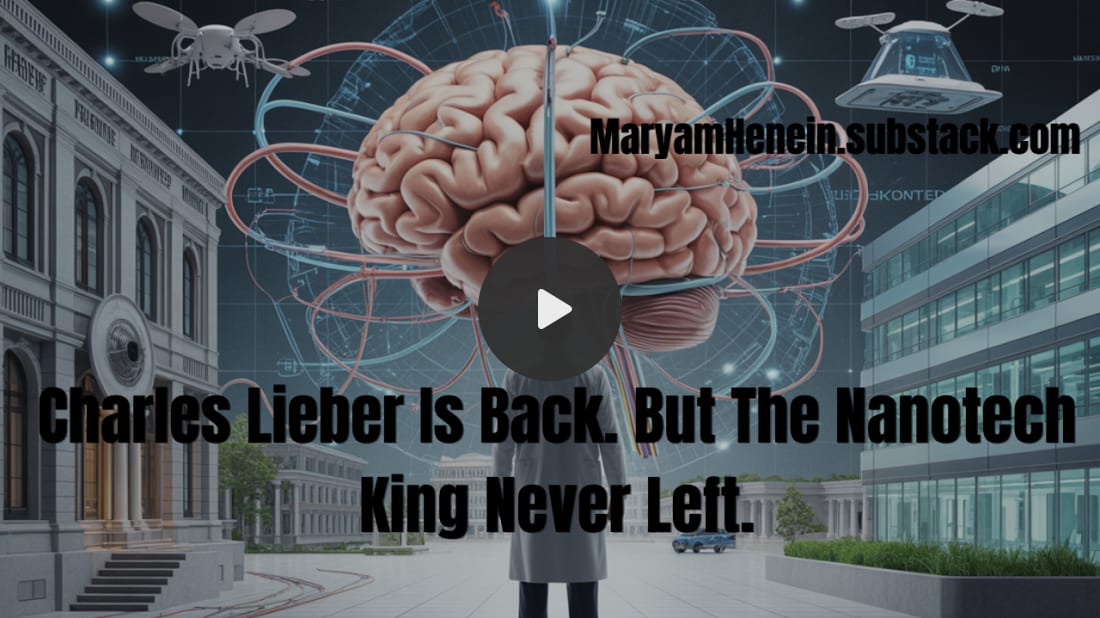 Follow: Twitter | Instagram Truth Lives Here: Rumble | Odysee | YouTube HONEYCOLONY | Websites: MaryamHenein.com | HoneyColony.com| BUY NOW ON AMAZON!: Operation George Floyd Charles Lieber is back in the headlines, but the truth is, the Nanotech King never left. He quietly shifted scenes, re-emerging inside China’s state-backed push to read, map, and perhaps eventually write the human brain. For a scientist who spent decades at the nexus of glory and controversy, the move is less a comeback than a relocation, with bigger stakes, better equipment, and far more disturbing questions. In a corridor of Shenzhen’s science district, the hum is clinical, almost ceremonial: an air-shaft whisper, the soft click of keyboards, the distant centrifuge whir. At its center sits a man who has spent decades at the nexus of glory and controversy: once a cornerstone of Harvard chemistry, he is now an official figure in China’s bold, state-backed quest to fuse biology, nanotechnology, and machine intelligence. The same man who was convicted after lying about his ties to China is now reportedly inside China’s state-backed brain–computer interface ecosystem. Ah-mazing! And he’s not selling fish at a wet market. According to Reuters, Lieber is now overseeing China’s state-funded i-BRAIN, the Institute for Brain Research, Advanced Interfaces and Neurotechnologies, in Shenzhen. The project is framed as brain-computer interface research aimed at medical breakthroughs: restoring movement to paralyzed patients, assisting those with ALS, and advancing neural-interface science. That is the white-coat version, and yes, the technology may very well help people. But brain-computer interfaces do not fall into a single moral category. The same technology that can restore movement can also read intent, accelerate command decisions, enhance cognition, and potentially tilt the balance of power in high-stakes military contexts. Reuters noted the dual-use concerns directly, reporting that scientists in China’s People’s Liberation Army have investigated brain interfaces to engineer “super soldiers” by boosting mental agility and situational awareness. I have been tracking Lieber for six years, ever since he got “arrested,” not because I enjoy courtroom theater, but because I quickly realized he represents something much larger than a single Harvard scandal. His career sits at the crossroads of nanotechnology, brain-machine interfaces, biological electronics, Chinese talent programs, U.S. research funding, and the global race to turn the human body into a platform. That may sound dramatic to people who still think technology is neutral. Technology is never neutral when power is attached to it. He is the Nanotech King, with dozens of patents and applications across nanowires, nanosensors, injectable electronics, nano-bioelectronic scaffolds, and brain-adjacent probes. Justia’s patent database lists his latest granted patent as U.S. Patent No. 11,768,174, issued in 2023. But the real red flags are “Systems and Methods for Injectable Devices”, which describes nanoscale wires and injectable devices that can enter soft matter, including biological tissue, and “Nanoscale Wire Probes for the Brain and Other Applications”, which names the brain outright. This is not a scientist adjacent to the transhumanist frontier. This is one of its architects. In my 2021 Vaxxter piece, “From Espionage to Tax Evasion,” I argued that Lieber’s case had been reduced to legal paperwork while the deeper story — his role in blurring biology, electronics, nanotechnology, and the machine-human interface — remained largely untouched. Even then, there was a striking paucity of serious coverage about the man who helped blur the line between man and machine. Thomson Reuters had ranked him as the world’s top chemist for the decade 2000–2010, and Lieber himself had said that when electronics are scaled down, “the difference between digital & living systems blurs,” making possible things that once sounded like science fiction. That sentence should have been treated like a flare over the battlefield. Instead, much of the press treated the story like a disclosure dispute with a side of tax trouble. Faux Fall GuyLieber’s legal story is damning enough without adding rhinestones. In April 2023, the Department of Justice announced that the former chair of Harvard’s Chemistry and Chemical Biology Department had been sentenced for lying to federal authorities about his relationship with Wuhan University of Technology, his participation in China’s Thousand Talents Program, and for failing to report income he received from WUT. His punishment? Time served — meaning two whole days in prison — plus two years of supervised release, six months of home confinement, a $50,000 fine, and $33,600 in restitution to the IRS. Apparently, when you are the Nanotech King, the American justice system handles you with oven mitts. And this was not some adjunct professor fudging receipts for a conference trip. According to the DOJ, between 2008 and 2019, Lieber’s Harvard research group received more than $15 million in research funding from U.S. government agencies, including the Department of Defense and the NIH. During part of that same period, he had become a “Strategic Scientist” at Wuhan University of Technology and a contractual participant in China’s Thousand Talents Plan. The official story became false statements, tax forms, and reports of foreign bank accounts. But the deeper story was always transfer of prestige, knowledge, networks, and technologies sitting dangerously close to the future of the human-machine interface. Two days. For a man who sat at the top of Harvard chemistry, received U.S. government-funded research support, hid a foreign affiliation, and was tied to a Chinese talent program that the DOJ described as one of China’s most prominent talent-recruitment plans, designed to attract high-level scientific talent in furtherance of China’s scientific development, economic prosperity, and national security. That is not my characterization. That is the government’s own framing. Back in my own reporting, I noted that Judge Rya Zobel denied Lieber’s motions for acquittal and a new trial. I also wrote that when the DOJ first accused Lieber in January 2020, I had already dubbed him the Nanotech King, and that the original story had been diluted down to tax evasion. There was an abundance of evidence: emails, testimony, and recorded statements. I also noted that Lieber admitted to bringing cash in paper bags from China. My question remains the same: who hands over wads of cash without a clear end goal in mind? That question looks even more radioactive now. According to Reuters, Lieber said he arrived in China on April 28, 2025, with “a dream and not much more.” Lovely. Very Hallmark, if Hallmark made geopolitical thrillers about brain chips, nanofabrication, and primate research. Reuters reports that his new Shenzhen lab has access to dedicated nanofabrication equipment, including a deep-ultraviolet lithography system from ASML, as well as to Brain Science Infrastructure Shenzhen, a Chinese Academy of Sciences-linked facility with 2,000 primate cages and dedicated space for i-BRAIN’s work. That is not a retirement chapter. That is a launchpad. And here is the part that should make every honest person pause. According to The Harvard Crimson, Lieber was already seeking employment opportunities in China while still under U.S.-supervised release. In 2024, he obtained court approval for at least three China-related trips, including one for “employment networking” and another to attend the International Beijing Brain Conference. So the man convicted for lying about his China ties was later allowed to travel to China for career networking in the same general orbit. How does that work? Apparently, with a Harvard judge’s permission, a passport, and the kind of institutional softness usually reserved for people who know where the wires are buried. Pun intended. Legally, supervised release does not automatically mean a person cannot travel abroad. Courts and probation offices can approve travel. Fine. That is the procedural answer. But the political and moral answer is something else entirely. The scandal is not necessarily that Lieber violated supervision; the scandal is that the system appears to have permitted the exact pipeline everyone claimed to be worried about. After years of hand-wringing over undisclosed ties to China, the Nanotech King was not exiled from the frontier. He was cleared to keep walking toward it.  The Shenzhen ChapterLieber’s reemergence in Shenzhen is not just a career move. It places him inside a different playing field: dedicated nanofabrication equipment, primate facilities, and a lab connected to China’s national science infrastructure. It is not a sidebar. It is a signal of how fast the map of who does what, where, and with whom is being redrawn. The broader point is not about one scientist in exile. It is about a system that treats brain interfaces as a national strategic asset. China is not hiding its brain-computer ambitions. In March 2026, Reuters reported that China approved the world’s first commercial use of an invasive brain-computer interface medical device. The device is meant to help patients with quadriplegia regain hand-grasping ability and uses minimally invasive extradural implantation and wireless technology. China’s regulator said BCI products are being prioritized as part of Beijing’s latest five-year plan. Reuters also reported that China could see brain-computer interface technology move into practical public use within three to five years, according to BCI scientist Yao Dezhong, director of the Sichuan Institute of Brain Science. Beijing has elevated BCIs alongside quantum technology, embodied AI, 6G, and nuclear fusion as strategic future industries. China’s national BCI strategy reportedly aims for major technical breakthroughs by 2027 and to cultivate two or three world-class firms by 2030. So no, this is not theoretical. This is not fringe. This is not “maybe one day.” This is an active race, and Lieber is reportedly now sitting inside one of China’s most consequential neural-interface ecosystems. The tension between care and control is not a philosophical debate. It is a budget line, a timeline, a regulatory pathway, and a geopolitical calculation. The same technology that helps a patient move again may also help a military system reduce reaction time. The same interface that restores communication for someone with ALS may also serve to read intent, monitor cognition, or connect a human operator to drones and decision systems. This is how the machine comes dressed as mercy. The Super Soldier Is Not A Marvel CharacterAnd no, the “super soldier” angle is not merely New York Post clickbait, though of course the tabloids will do what tabloids do. The serious issue is that brain-computer interfaces are inherently dual-use. They can be sold as medical miracles while also being developed into military command-and-control systems. A device that helps a paralyzed patient move a cursor could also, in another context, help a soldier control unmanned systems. A bioelectronic system that reads intent can compress the time between perception and action. An implant that restores function can become part of a battlefield network. The AI super-soldier document I reviewed describes China’s military modernization as progressing through mechanization, informatization, and now “intelligentization,” in which AI, biotechnology, exoskeletons, ubiquitous sensing, brain-computer interfaces, and a master “cloud brain” reshape the individual combatant into a node within a larger machine-command system. It describes the “AI super soldier” not as a comic-book mutant but as an integrated human platform, physically, sensorially, and neurally enhanced, then connected to a broader battlefield cloud. That is the real story. The future soldier is not necessarily bigger. He is interfaced, monitored, sensed, synced, and folded into a command architecture operating at machine speed. His body becomes data. His brain becomes a control surface. His reactions become part of a system that does not wait for human contemplation. The same report describes the “Cloud Brain” as the conceptual center of PLA intelligentized warfare: a system that fuses data from satellites, drones, ground sensors, and soldier biosensors into a unified battlespace picture. In this model, the soldier is not an autonomous warrior in the old sense. He is part of a “super system” in which AI performs resource integration, algorithmic command, and self-reconfiguration of the network when nodes are lost. That should chill every living soul who still believes the human being is sacred. The New York Post version screams “AI super soldiers.” The Reuters version speaks in the sober language of brain-computer interfaces, state-backed labs, and dual-use concerns. I am less interested in the cartoon headline than the architecture underneath it. The real super soldier is not Captain America. He is not necessarily bulked up in a lab. He is a human node inside an AI-mediated battlefield, where perception, reaction, command, and compliance can be monitored, accelerated, and potentially directed. The Nervous System FrontierYour enemy does not need to occupy your land if he can occupy your nervous system. That is the part the legacy media cannot quite say, because it is still trapped inside the language of faux medicine, markets, and military modernization. But the deeper issue is sovereignty. Once the brain becomes readable, it becomes writable. Once the nervous system becomes a platform, the self becomes a battlefield. Once perception can be monitored, nudged, or overridden by machine systems, freedom is no longer merely a political question. It becomes neurological. This is why Lieber matters. He is not just one disgraced scientist who got a soft sentence and moved to China. He is a symbol of the entire transhumanist pipeline: U.S. government-funded research, Harvard prestige, Chinese recruitment programs, nanotechnology, neural interfaces, primate testing, AI integration, and now the open conversation about soldier enhancement. This is not a conspiracy theory. This is convergence. Because this is not merely about China. China may be moving aggressively, but the deeper architecture is global. Neuralink, Synchron, DARPA-adjacent research, nanomaterials, injectable electronics, AI, wearable biosensors, digital identity, social credit systems, and cognitive warfare all belong to the same family tree. Some branches wear an American flag. Some wear a Chinese flag. Some wear a medical badge. Some wear a Silicon Valley hoodie. But the tree is the same tree. I have written about this before. In my 2025 Technofascism Update, I said the merging of man with machine would challenge our very notion of what it means to be human. I wrote that these are revolutionary times when AI and telepathy will concurrently exist, and that the question becomes whether you insert the chip or get relegated to the Savage Lands. That may sound dramatic to people who still think technology is merely a tool. But tools become systems. Systems become dependencies. Dependencies become cages when power controls the architecture. The patient dimension is real, and it should not be dismissed. There are people with paralysis, ALS, spinal cord injuries, and neurodegenerative conditions whose lives could be transformed by safe, ethical brain-computer interfaces. The hope is not fake. The problem is that hope is often used as the velvet rope guarding the war room. Once the same device class becomes clinically useful, commercially valuable, and militarily strategic, the governance questions are no longer optional. Who controls the data? Who owns the signal? Who audits the system? Who protects consent when the data source is not a phone, a laptop, or a wearable, but the brain itself? That is the line. Not “technology bad.” Not “medicine bad.” Not “science bad.” Spare me the sandbox-level debate. The question is who controls the interface between consciousness and machine. The Kingdom of the Programmable HumanLieber’s resurfacing in China is not random. It is a signal flare. The media will say: Convicted Harvard scientist rebuilds career in China. Reuters will say: brain-computer interface lab. The medical establishment will say: hope for paralysis. Military analysts will say: dual-use concerns. Technocrats will say: strategic industry. Investors will say: market opportunity. I say: the battlefield is and always has been your brain. Charles Lieber was always at the mouth of the portal where living tissue meets electronics, where biology meets command systems, where the brain becomes the next contested territory. His story was never just about foreign payments or tax forms. It was about the transfer of a technological priesthood from one empire to another. And if people still cannot see it, that is because they are looking for yesterday’s war. They are looking for tanks, missiles, flags, and boots on the ground. Meanwhile, the real war has moved inward. The frontier is no longer only the border. It is the blood-brain barrier. It is the synapse. It is attention. It is perception. It is will. This is why I called him the Nanotech King. Not because he is glamorous, and certainly not because he is admirable, but because his work sits at the threshold where living tissue meets electronics, where medical promise becomes military possibility, and where the nervous system becomes the next frontier of power. The programmable human is no longer science fiction. It is policy, infrastructure, and capital. And the gates are opening.  If this reporting matters to you, please share it and consider becoming a paid subscriber. I have been tracking Lieber, nanotechnology, technofascism, and the machine-human interface for years, long before the mainstream caught up wearing sensible shoes. Independent research takes time, and the receipts do not gather themselves.
You're currently a free subscriber to Maryam Henein on Substack. For the full experience, upgrade your subscription.
|