Part 48|| The Whale and the Wayfinder
You Are Here

Is this your brand on Milled? Claim it.

Follow: Twitter | Instagram Truth Lives Here: Rumble | Odysee | YouTube HONEYCOLONY | Websites: MaryamHenein.com | Georgefloydbook | HoneyColony.com| BUY NOW ON AMAZON!: Operation George Floyd Stardust is an ongoing serialized field report on consciousness, discernment, unconditional love, magical realism, and the lived experience of navigating intuition inside an inverted matrix. Stardust Series — Start Here What can mean the most to you is that which you hear as a faint refrain, one which goes ’round and through the twilight and dawn as if it were a songbird that would lead you into a clearing. You cannot see whence comes the bird, yet its message is one of consistency, and its guidance is as prolonged as the moments of everlasting beauty that thread themselves through your world. Look hither for some of those refrains; others will appear in those half-revealed coincidences which often cannot be dismissed. As you are moved to meet your destiny, so does destiny move forward to you. Snuffy walked through my front door as the AT&T technician was leaving my new abode. He paused for a moment, surveying the living room with a kind of restrained curiosity as if assessing my progress. “I like the stars,” he said casually. My walls were already covered in hundreds of them, arranged in an improvised constellation. I didn’t tell him that he had inadvertently inspired the entire new decor. I was too shy, and perhaps too unsure, to admit what had already begun stirring inside me. It was he who triggered the remembering of my celestial origins. Not through logic. Not through evidence. Certainly not through anything I could prove. It arrived another way entirely: as resonance. As recognition. What Judith Pennington, a researcher of consciousness, called “the faint refrain”—those half-revealed coincidences that refuse dismissal. Now, post-kundalini awakening, the lyrics to Major Tom took on a whole new meaning. He’d finally escaped the gravity field. While Ground Control panicked below, obsessed with systems, signals, and compliance, he was drifting, falling, toward his real home. Something about Snuffy reminded me of the cosmos. Later, I would learn that he genuinely loved outer space and knew a surprising amount about it. I envisioned him in a past life as a navigator of the seas who knew the heavens by heart. A man capable of reading stars the way others read street signs — instinctively, without hesitation. I could see him clearly: standing on the deck of a ship in a heavy tweed coat, holding a long brass refracting telescope toward the night sky, charting invisible coordinates between sea and heaven as though the stars owed him an answer.
Later, I learned that celestial navigation was not only real but refined over millennia. Polynesian wayfinders, Phoenicians, Arab navigators, and European mariners all memorized the sky and used it as a living map — a technology of orientation written in light. The brass refracting telescope, I discovered, was the instrument of choice between the seventeenth and nineteenth centuries for observing planets, taking bearings, and charting unknown territories. That detail struck me deeply, because the images had arrived spontaneously — long before I had researched any of it. The night he was helping me move in, Snuffy pulled up a planetarium app on his iPhone — the modern, pocket-sized rendition of that brass refracting telescope — and showed me Jupiter hanging above us in the Florida sky. We stood on my front lawn in the dark. The moment felt strangely disproportionate to its simplicity, as though something enormous had slipped quietly through an ordinary interaction. He returned to my place on the eve of a “ring of fire” solar eclipse in Libra — the sign of mirrors, contracts, justice, and the Other. The Moon was about to slide in front of the Sun without fully swallowing it, leaving a burning rim around the dark. I would only understand the strangeness later, when I found the same ring-of-fire image on his business card, printed beside the number 333. By then, I had also noticed planets scattered through his social media profile, as if the whole encounter had been seeded with celestial breadcrumbs for my soul to decode. Incidentally, I wanted a telescope as a child; my father gave me a microscope instead. One instrument trains the eye inward toward fragmentation and dissection. The other teaches you to search the heavens for orientation, myth, and meaning. The difference is not merely optical. It is philosophical. It shapes what you believe is worth looking for. Details matter. I did, however, own a Strawberry Shortcake shortwave radio at the ripe age of six. I remember lying in bed in a dim room, holding that humming portal — warm in my hands, smelling faintly of strawberries and plastic — utterly captivated by the ability to tune in to different worlds, different languages, different frequencies with nothing more than a twist of a dial. I am certain that synthetic strawberry scent imprinted itself onto an entire generation's nervous system like some half-remembered dream we can't quite locate or explain. I also remember reading Moby-Dick and wondering what it would feel like to be swallowed by a whale. Not eaten, exactly. Consumed by something ancient and enormous.
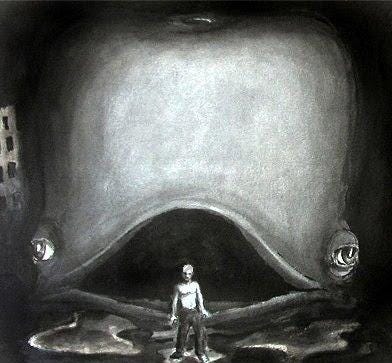
The whale is not merely a sea beast; it is a threshold guardian. You enter its belly, swallowed by confusion, terror, and the unknowable. And if you survive the underworld, you come back carrying truth. I am certain that synthetic strawberry scent imprinted itself onto an entire generation's nervous system like some half-remembered dream we can't quite locate or explain. Maybe that is why Snuffy disoriented me the way he did. I first mistook him for an answer. But he was the whale: the dark threshold, the ancient descent, the creature that pulled me under and forced me to confront what had been waiting beneath the surface long before he arrived. As time passed, he felt less like a man entering my life and more like a threshold I had crossed without realizing it. No other human being has ever made reality feel quite so unstable. There seemed to be a second story running underneath. Yet the same current that made him feel remembered also made him impossible to place. Nothing about him fit neatly into the categories available to me: stranger, friend, lover, muse, catalyst, projection, mirror. He seemed to occupy all of them simultaneously — and none of them completely. I knew him, and I did not know him at all. Deep down, I believe he knew we were made of similar material. We wore the same wounds. I moved toward them. He recoiled. What if the soul knows before the ego can mount its defense? The Greeks called it anamnesis — from the ancient Greek anamnēsis (ἀνάμνησις), meaning remembrance, or recollection. In Gnostic, Platonic, and mystical traditions, anamnesis is not a poetic metaphor for nostalgia. It is a cosmological claim: that truth is not learned externally but remembered internally. That awakening is the gradual, often disorienting process of recovering knowledge buried beneath incarnation, conditioning, trauma, and the relentless noise of a world that profits from your forgetting. Gnosticism framed remembrance not as metaphor but as recovery — an act of spiritual archaeology. Plato wrote that the soul enters this world already carrying knowledge, and that learning is, in many ways, the act of recovering what the soul knew before incarnation itself. The body forgets. The soul, given the right conditions, does not. From there, the diagnosis becomes cosmic: humanity suffers from amnesia. Salvation is not becoming something new. It is returning to what was buried, obscured, or stolen. Salvation is remembrance. Long ago, I had planned to work with Bruce Burgess, who released Bloodline in 2008. He was filming in the South of France on a documentary exploring the Grail legends, Rennes-le-Château, and the possibility that history had buried something far stranger than doctrine allowed. The Cathars appear almost like a whisper beneath the larger mosaic — not the center of the story, but one of its haunted refrains. After my Kundalini awakening, something strange and specific began surfacing. I was remembering things I didn’t know that I knew. For a long time, I had carried an inexplicable fear of someone pouring kerosene on my face. I couldn't explain its origin — there was no corresponding memory, no trauma I could point to. But after the awakening, a word arrived with unusual force: torched. That was the word I used, instinctively, before I had any context for it. Later, I learned that the Cathars themselves had been burned en masse during the Albigensian Crusade — a systematic, state-sanctioned incineration of those who refused to submit to Rome's doctrinal authority. Of course, I cannot prove I was a Cathar. Rationally, I understand how impossible that sounds. But the deeper truth is less about historical verification than archetypal recurrence. Some souls seem drawn repeatedly into the role of dissenter, truth-teller, heretic, exile — those unwilling or unable to fully submit to the dominant architecture of their age. I believe I have played this archetype many times before. Let’s just say this ain’t my first rodeo — a line I would later hear Snuffy deliver, in an entirely different context. Stranger ThingsSnuffy seemed a bit edgy and guarded as we moved into the once-upon-a-time sunroom. “Do you know there’s a guy standing across the street?” "What? No," I said, crossing to look through the blinds. I could make out a Black man — or rather, his sweaty, pimply forehead above the sill. He appeared to have a suitcase. It was odd, but this entire neighborhood was new to me, and I let it go. I don't remember much of what we spoke about that afternoon. The time felt like stepping into a wormhole — approximately four hours collapsed into seconds. What I do remember: looking down at him with undisguised desire as he lay on his back against the tiles beneath my partially assembled standing desk, doing something practical with his hands while something entirely impractical was happening in my chest. There would be another time when he would be the one looking down at me as I lay curled up on my bed, watching him fix my ceiling fan as we spoke. I recalled covering his entire face with soft kisses the second time I ever met him in person. He must have thought I was loco. It was not a lover’s greeting. It was more ancient than that — the way you greet a beloved sailor you haven’t seen in eons, whose return you had quietly stopped believing in. I had never done that with an actual lover or boyfriend. Not once. Now it was as though we had never been intimate at all. On many occasions, I imagined asking him in a humorous tone: So did you and I actually have sex? If so, wasn’t it awesome? Or was the whole thing some elaborate fever dream? What happened next would become one of the strangest chapters in the entire story: a truck, a contract, an axe, a prison call, copper cables, and a man who felt at once remembered and difficult to crack... Continue reading this post for free in the Substack app
|