|
In partnership with |
 |
|
Sriram Krishnan’s Departure from the White House |
Sriram Krishnan, the White House’s senior policy advisor on artificial intelligence, announced his departure from the Trump administration effective at the end of June 2026. A prominent Silicon Valley figure who previously led product teams at Meta, Twitter, and Microsoft before becoming a general partner at Andreessen Horowitz, Krishnan spent the last 18 months architecting the administration's business-friendly, deregulatory tech strategy alongside AI and crypto czar David Sacks. During his tenure, Krishnan served as a primary architect of the American AI Action Plan, a framework that heavily prioritized domestic data center construction and massive energy infrastructure expansion over rigid regulatory safety hurdles. He was also instrumental in drafting controversial executive orders designed to challenge state-level technology regulations and block federal agencies from procuring AI models showing perceived ideological biases. While he is leaving his formal government post, reports indicate Krishnan intends to launch an outside tech policy institution that will allow him to continue advising the administration on international diplomacy, early-access model review agreements, and sovereign compute strategies. |
|
Help make better ads |
|
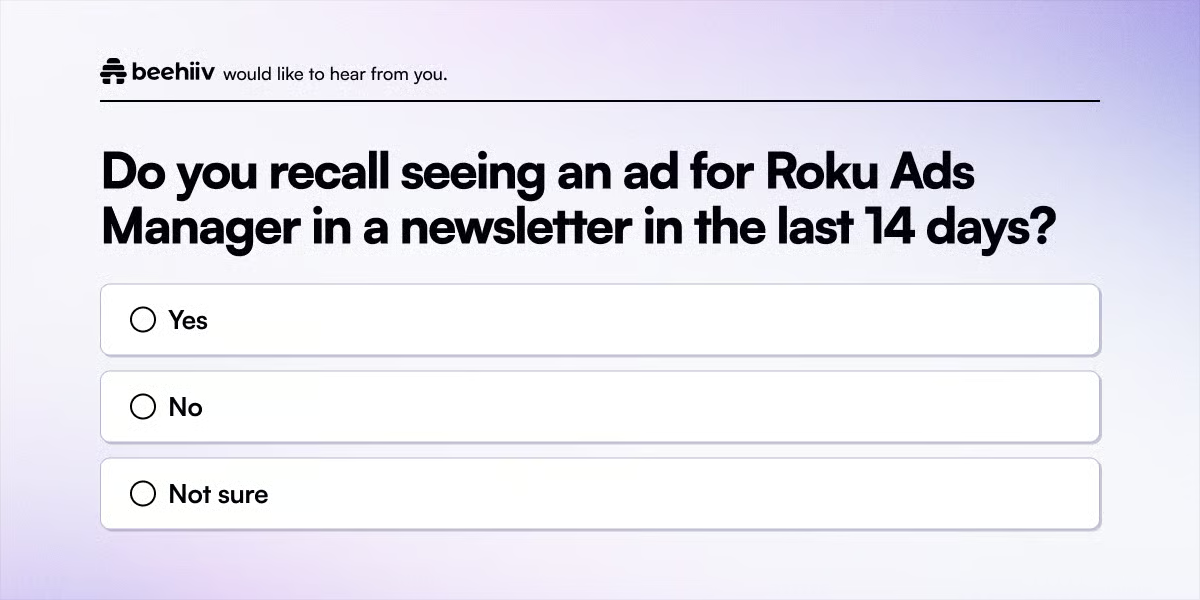
Did you recently see an ad for Roku Ads Manager in a newsletter? We’re running a short brand lift survey to understand what’s actually breaking through (and what’s not). |
It takes about 20 seconds, the questions are super easy, and your feedback directly helps us improve how we show up in the newsletters you read and love. |
If you’ve got a few moments, we’d really appreciate your insight. |
Take the survey. |
|
|
|
Strategic Analysis for Tech Founders and Venture Capitalists |
For startup founders and technology investors, Krishnan’s transition out of the White House signals a shift in how Silicon Valley will project its influence over federal technology policy. Over the last year and a half, the presence of top-tier venture capital alumni inside the West Wing created a direct pipeline for pro-innovation, anti-licensing viewpoints to reach the Oval Office, successfully blunting efforts to impose mandatory federal pre-clearance windows on frontier models. However, this aggressive deregulatory approach has faced escalating pushback from populist factions concerned about labor displacement and national security risks, resulting in recent executive orders shifting toward voluntary 30-day government review frameworks for advanced models. Krishnan’s move to establish an external, dedicated policy institution demonstrates that tech leaders realize long-term regulatory battles cannot be won through short-term government appointments alone. Instead, the tech ecosystem is building permanent, outside infrastructure to systematically counter bureaucratic expansion, craft model legislation, and preserve a high-speed development environment for American startups. |
Operational Guidance and Policy Navigation for Startups |
The primary takeaway for executive leadership teams is that while federal AI policy remains fundamentally deregulatory at the top, the lack of a uniform federal statute means startups must prepare for a fragmented and highly volatile compliance landscape. With the administration actively trying to preempt state-level oversight, states like California are doubling down on localized safety, privacy, and environmental mandates that directly impact how startups deploy models and build regional infrastructure. Practically, founders should ensure their regulatory compliance teams are tracking state-level legislative sessions rather than relying entirely on Washington's hands-off posture to protect them from local enforcement actions. Furthermore, as the federal government shifts toward multi-vendor procurement models for national security and defense applications—moving away from exclusive single-source contracts—startups have a unique operational window to bid on lucrative federal contracts. To capitalize on this, engineering teams should proactively implement robust internal benchmarking and voluntary security-sharing protocols, transforming transparent compliance into a powerful mechanism to win government trust and secure enterprise market share. |
|
In addition to our newsletter we offer 60+ free legal templates for companies in the UK, Canada and the US. These include employment contracts, investment agreements and more |
|
|
Newsletter supported by: |
See Why HubSpot Chose Mintlify for Docs |
|
HubSpot switched to Mintlify and saw 3x faster builds with 50% fewer eng resources. Beautiful, AI-native documentation that scales with your product — no custom infrastructure required. |
Simplify Your Docs Today |
|
|
|
|
|
This newsletter (or any other content provided by Law4Startups) is not legal, financial, or tax advice. We are simply providing legal information and collating news from around the world. We recommend that you consult an attorney before making any legal decisions. We do not make any representations and take no responsibility for the actions you take based upon this information. |
|
|
|
Update your email preferences or unsubscribe here
© 2026 Law4Startups
821 Cambie Street
Vancouver, BC V6B 0E3, Canada
|
|
| Terms of Service |
|
|
|
|
|
|