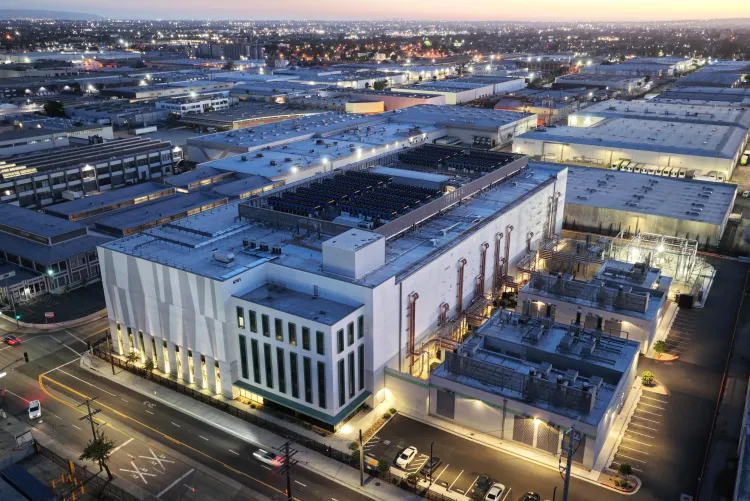
The only good data center is a canceled data center. Or so a growing number of Americans seem to feel.
Throughout the United States, citizens are mobilizing against the construction of new data centers in general — and the massive, “hyperscale” ones that fuel artificial intelligence, in particular.
Many Americans have come to think that these industrial complexes offer little to their host communities beyond economic burdens and ecological devastation. But the truth is actually more complicated: Data center projects can be quite good for localities, depending on how they’re fueled, regulated, and taxed. In many ways, it’s a matter of passing policies that minimize the risks of data centers — and maximize the following benefits.
Data centers do actually create jobs. Data center opponents often belittle their benefits to employment. And not without reason. Once built, a server farm is among the least labor-intensive industrial facilities one can find.
But data center projects can meaningfully benefit a region’s workers in both the short run (by creating lots of temporary construction jobs) and in the longer term (by fostering a favorable ecosystem for tech sector development, which creates more durable jobs and raises wages).
Consider a recent study from the Brookings Institution. To gauge data centers’ impacts on employment, researchers examined labor market trends in 93 counties that welcomed their first data center between 2008 and 2024 — and 3,000 counties that never received one.
After controlling for a variety of variables, the authors estimate that the arrival of a large data center raised private employment by 4 to 5 percent over a five- or six-year period. The data centers also appeared to lift wages for both existing workers and new hires by about 3 to 4 percent.
Servers will sometimes pay your taxes. Hyperscale campuses — the gigantic data centers that power AI — generate a lot of tax revenue without consuming a whole lot of public services. Many jurisdictions tax data centers on the value of their equipment, not just their buildings and land, which means they yield far more revenue per acre than a housing complex or office park.
What’s more, unlike the residents of a new subdivision, servers in a hyperscale facility do not send any children to a municipality’s public schools, drive around on its roads, or crowd its parks.
For these reasons, data centers can sometimes deliver immense fiscal value. In Loudoun County, Virginia, they now provide nearly half of the county’s tax revenue — enough to cover all of its government’s functions beyond the school system.
Data centers don’t have to be dirty. Much of the concern around data centers relates to their environmental effects. Opponents say they guzzle up water and generate noise and air pollution. To be clear, that has been true in many cases. But these also aren’t inherent features of data center projects, and there are ways to address or mitigate them.
When it comes to noise pollution, for instance, locating server farms in far-flung, industrial areas helps guarantee that their whirring and humming won’t disrupt residents. And municipalities can regulate data centers’ water use, much like they regulate water use for other industrial and agricultural purposes.
Air pollution is the biggest concern here: Hyperscale campuses can require as much electricity annually as a midsize American city, and they often get that electricity from natural gas or coal power plants. Those fossil fuel-burning facilities generate both emissions and air pollutants.
But data centers sited in regions with abundant non-carbon energy sources produce relatively little air pollution and point to an alternative approach. Google’s Oregon cloud computing operations run exclusively on non-carbon energy sources most of the time, for instance.
Data centers do come with drawbacks, to be clear. They often drive up an area’s electricity bills, and they can come with real environmental costs — which can be profound in certain circumstances.
But as more communities grapple with the AI boom, it’s worth understanding the trade-offs in full. Love them or hate them, the benefits of data centers may outweigh the costs in many parts of America.
Read Eric’s full story here.