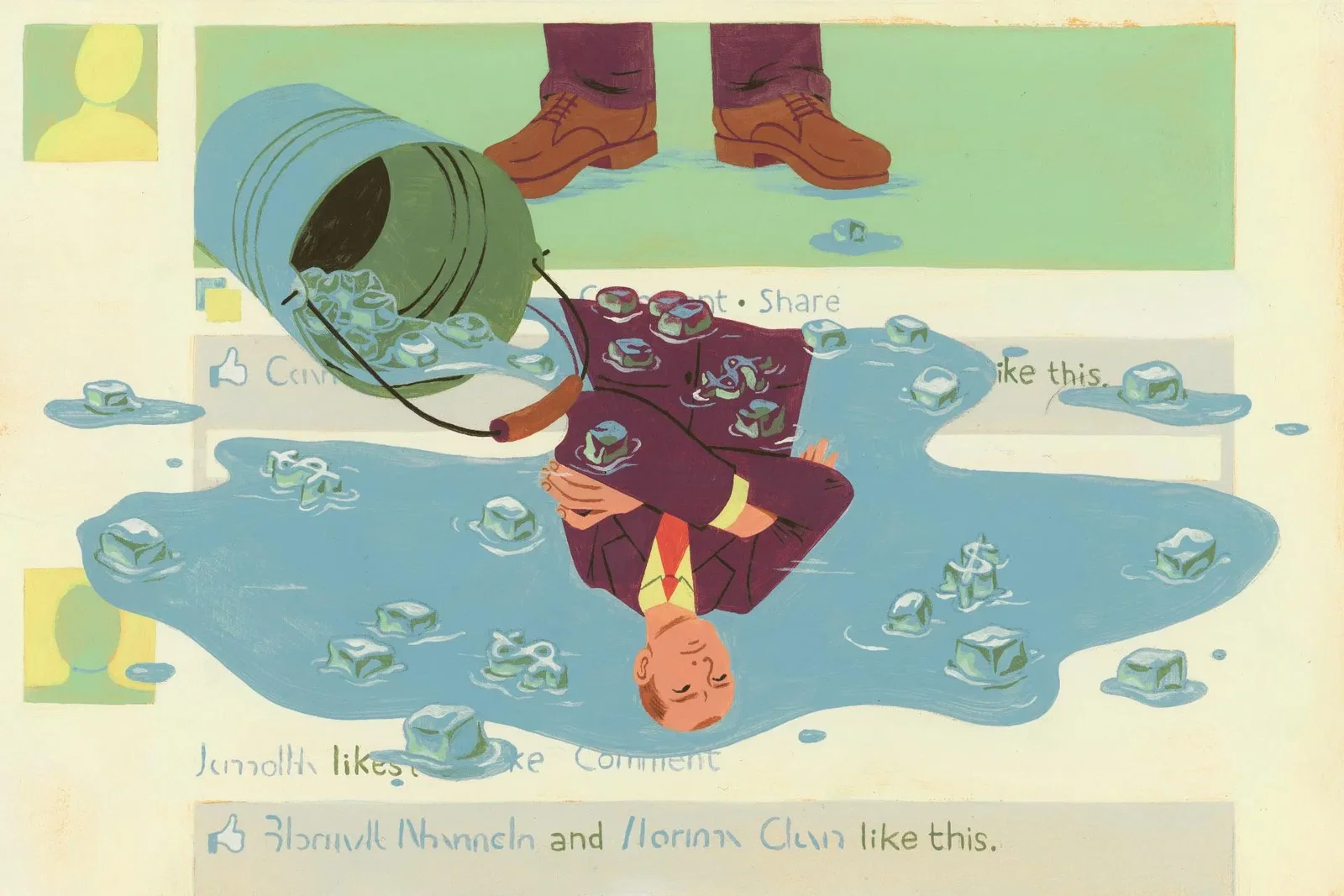
“Elon Musk, Ryan Seacrest, and Chris Anderson of TED, consider yourself challenged,” Bill Gates bellowed from his garden. Beaming, he tugged on a candy cane-colored rope that dumped a barrel of icy cold water over his head. “You have 24 hours. Good luck.”
It was the scorching hot summer of 2014, and the ice bucket challenge — a viral social media trend to raise money for amyotrophic lateral sclerosis (ALS) research that involved soaking yourself with ice water and pressuring others to do the same — was in full swing. Gates had been challenged by Mark Zuckerberg, who’d been challenged by then-New Jersey Gov. Chris Christie, with whom Zuckerberg had appeared on Oprah a few years prior to announce a $100 million donation to Newark schools.
By the time Musk tweeted out a video of his kids drenching him with their own makeshift ice bucket gizmo a day after Gates, the challenge had already reached tens of millions of people worldwide. Among the participants were Jeff Bezos, Justin Bieber, David Lynch — and Donald Trump.
As if under an icy spell, the world came together in a way it never would again. Today, the ice bucket challenge and the litany of surreal, grainy videos it spawned are a time capsule of a bygone era, or at the very least, a bygone internet.
In the early 2010s, platforms like Facebook “actually had the potential to be this century’s agora, a marketplace of ideas,” said Asha Curran, who co-founded GivingTuesday, a philanthropic counterweight to Black Friday, in 2012. “The social media environment wasn’t this sort of existential threat to our mental health and our democracy and our isolation that it is now.”
But it wasn’t just a different era for social media. Back then, generosity was trendy for the one percent and 99 percent alike, and Bill Gates — alongside both his then-wife Melinda French Gates and Warren Buffett — was influencer number one. In 2010, the Gateses and Buffett launched the Giving Pledge, a campaign to convince the ultra-wealthy to donate at least half of their fortunes to charity. At the campaign’s peak, about one in seven American billionaires — including Musk, Zuckerberg, and a broad swath of the country’s rising tech billionaire class — pledged to donate at least half of their fortunes to charity. Together, they promised to usher in a new golden age of philanthropy.
They also aimed to inspire giving from Americans of more modest means, who flocked to viral clicktivism campaigns while sporting TOMS shoes and (PRODUCT)RED iPod nanos. The idea was seductive: You too could help save the world while making a show of your generosity.
Today’s billionaires appear more cynical than they used to be, and the rest of us seem to be, too. Gone are the days when tech overlords challenged one another to charity stunts rather than cage matches. If social media once seemed poised to save the world one hashtag at a time — think #Movember, #Kony2012, and #BringBackOurGirls — then today, it feels considerably more likely to tear us all apart.
For much of the past decade, fewer Americans have chosen to give to charity each year, while most billionaires appear to be giving away a diminishing share of their ballooning fortunes. The Giving Pledge, which held so much promise in 2010, has lost much of its steam and even come under direct attack from techno-cynics like Peter Thiel. The vibes have turned very bad.
It’s no wonder today’s youths yearn for the hopecore, the millennial optimism, of the early 2010s, that mediascape of messy buns, post-recession electropop, and sincere posting about causes everyone cared about for a week or two. The internet’s Earnest Era propelled a culture of giving even among billionaires, who shared a fear of missing out on the next hashtag cause. But today’s more fractured internet has kneecapped that positivity. To some degree, it made even the idea of trying to save the world cringe. The problem is not so much a giving crisis, as it is an attention crisis, one that’s been exacerbated by rising inequality and the decline of generosity as a collective cultural value, the kind of virtue worth signaling.
“For a while, you almost needed to pick a charity as part of your online persona,” said Scott Harrison, a nightclub promoter turned founder of Charity: Water, a celebrity darling back when “it was really cool” to give in the early 2010s. He has struggled to fundraise in recent years. “It’s not on trend. It’s not what people are doing. It phased out. The cycle ended.”