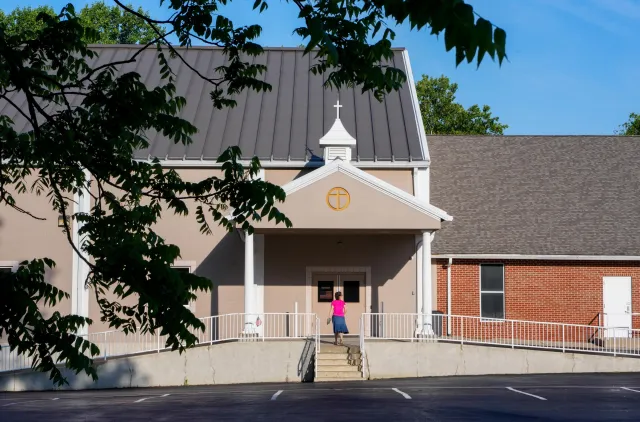
It’s not just the Southern Baptists: American Christianity has become increasingly associated with the political right over the past generation. In the early 2000s, Republicans and Democrats were about equally likely to say religion was “very important” to them. Today, roughly 6 in 10 Republicans still feel that way, compared with just 37 percent of Democrats.
When the Pew Research Center last broke this out by denomination in 2023, 6 in 10 Protestants said they favored the Republican Party. Three in four Mormons said the same. Catholics, meanwhile, were more evenly split between Democrats and Republicans — though even there, Pew gave a slight edge to the GOP.
Why are American Christians becoming more conservative, on average? The experience of the Southern Baptists points to two major factors.
First: The US is getting more secular. You wouldn’t know it from the rhetoric coming out of the White House, but Americans are generally less religious — and certainly less affiliated with organized religion — than they were 20 or 50 years ago.
As mainstream church attendance declined, many institutions came to be shaped by their most devout members. And those members have often been older people, people raised with traditional theological values, or people who came to religion with a more reactionary bent. In other words, many liberal and progressive Christians drifted away — and the conservatives were left.
The Southern Baptist Convention, or SBC, has itself lost a whopping 400,000 members since 2025 alone. Many of those defections stemmed from scandals in the church, not just secularization. Still, experts say the effect has been roughly the same: a smaller, ideologically “purified” church — at least in the telling of its conservative remnants.
Second: A new class of “theobros” are changing the conversation. Just as the advent of mass printing helped Martin Luther challenge the church, the internet is making it easier for an ascendant group of influencers to undermine more mainstream church leaders. Those voices have come from both the right and the left, but the right-wing “theobros” and “theo-blogians” have generally commanded more attention, said Heidi Campbell, a professor at Texas A&M University who studies digital culture and religion.
These right-wing religious influencers — an eclectic group that includes self-taught theologians, vloggers, missionaries, critics, and pseudo-scholars — frequently “merge religion with conservative ideologies,” Campbell said. They also draw heavily on the tropes and techniques of the right-wing internet, such as criticizing the alleged spread of “woke” culture.
In some faith traditions, right-wing influencers have become remarkably, well…influential.
“This is being driven, at least in part, by social media influencers who very much want to see the SBC move in a more conservative direction,” the former Baptist pastor, religious researcher, and professor Ryan Burge told Vox of that church’s rightward shift.
This all has serious implications for American religion and politics. As Christian lays out in his new piece, American churches are getting smaller and less influential — and losing moral authority in the process. Americans have historically looked to their religious leaders for moral guidance. Now, some believers are just as likely to turn to a TikToker who’s quoting Bible verses in pursuit of some political or social agenda.
Already, the US has seen rapid growth in nondenominational churches that are freer from the baggage of established denominations — but that often lack their cultural reach and institutional authority. And a growing number of believers, sometimes dubbed “unchurched evangelicals,” identify as Christians but don’t belong to a specific church, instead curating a personal theology that overlaps with the political and cultural values in their feeds.
“We’re very much a bottom-up society now, not a top-down society,” Burge said. Last week’s meeting of Southern Baptists won’t be the last example of that trend.
Read Christian’s full story here.