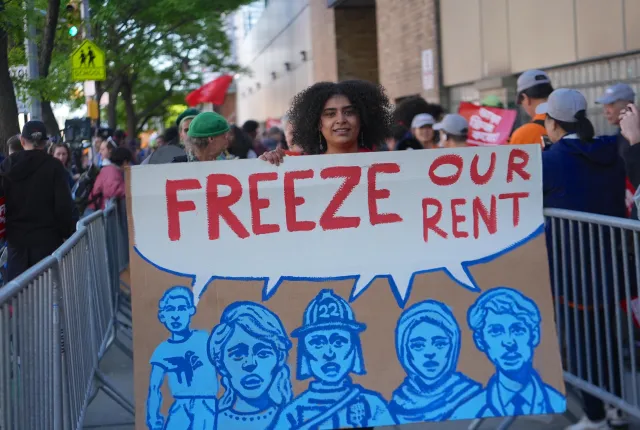
Housing costs surged in many US cities after the pandemic — and as policymakers searched for ways to bring costs down, the rent freeze emerged as one direct, if divisive, tool. Under a rent freeze, certain landlords can’t raise rents for a set period, typically no longer than a year or so. New York’s new rent freeze will last two years and exclude most of the city’s smallest buildings, as well as newer construction.
Freezes belong to a larger family of rent regulation measures, including rent control (which caps what landlords can charge, often on a permanent basis) and rent stabilization (which limits annual rent increases).
What are the benefits? Rent control obviously appeals to renters: Who wants to pay more for things? But advocates of rent regulation contend it does more than just save tenants money: By protecting renters from sudden increases, rent freezes also give tenants the ability to predict their costs and plan their budgets over longer periods.
That can give them the tenure and security they need to personally invest in things like their children’s schools or their relationships with their neighbors. In theory, rent freezes can also buy cities time to work on the much slower task of building new apartments. (More on that in a minute.)
What are the risks? Whatever their appeal to tenants, however, rent regulations are deeply unpopular among mainstream economists. In one 2012 survey, just 2 percent of economists agreed with the statement that local rent regulations “had a positive impact…on the amount and quality of broadly affordable rental housing.”
The biggest criticism is that these policies create disincentives for landlords and developers. Simply put, if you make it less profitable for people to build and maintain housing, then they’ll probably do less of both. Economists contend that rent regulations can also skew rental markets in favor of existing tenants, at the expense of future ones — and that they can lead some renters to linger in low-cost units even when those units don’t fit their needs anymore.
But policy design matters here, argues J.W. Mason, the chair of the economics department at New York’s John Jay College of Criminal Justice and the rare economist who defends rent regulations. In the (in)famous case of 1990s San Francisco, Mason recently told Vox, the supply of rental housing decreased not because developers scaled back construction, but because they converted existing rental units to condominiums. Lawmakers could have prohibited that.
And in dense cities like New York, Mason says, housing construction is limited far more by zoning rules and available land than it is by profit margin. “In cases like that, where supply is already constrained by land use rules or just by an absolute scarcity of buildable land…you’re not going to get any additional limitation on supply from rent regulation,” he said.
How else can cities rein in housing costs? Ultimately, most economists agree that the underlying cause of high rents is a shortage of homes. That’s why they overwhelmingly favor supply-side reforms that make it easier to build new rental units over measures like price controls.
Those reforms — which include things like updating zoning codes and allowing accessory dwelling units — have brought down rents in other places. Just look to Austin, Texas, where rents are actually cheaper now, in real terms, than they were before the pandemic.
Incidentally, Mamdani has proposed a package of similar reforms in New York, including changes to zoning laws and stricter enforcement of housing codes. It’s important to consider the city’s rent freeze in that context, Vox’s Abdallah Fayyad argued last summer.
The rent freeze isn’t “the solution to New York’s housing crisis,” Fayyad wrote. “It’s just one part of a bigger toolkit that can help tenants in the near term while the other tools finally put housing costs under control in the long run.”