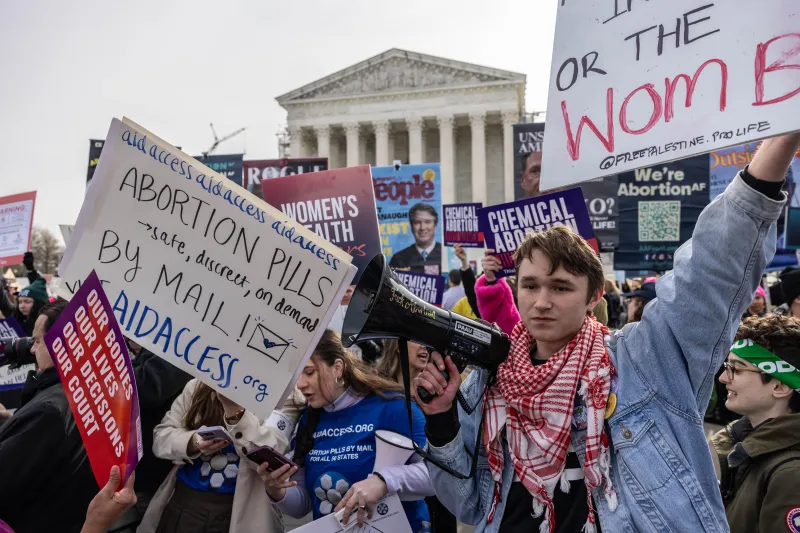
When it comes to abortion in the US, two apparently contradictory things are now true at once. First, it’s become very difficult for pregnant people in much of the country to get an abortion. Second, and in spite of that fact, the number of abortions performed in the US each year is still going up. It actually hit a 16-year high in 2025, according to the Guttmacher Institute.
Speaking at a national gala in DC last month, Marjorie Dannenfelser — the president of the anti-abortion organization Susan B. Anthony Pro-Life America — warned her fellow activists that “the victories that Dobbs enabled have been all-but-completely erased.” Needless to say, abortion advocates don’t interpret the Supreme Court’s Dobbs decision or its aftermath the same way.
Mapping abortion access in the US. Since 2022, when the Dobbs decision eliminated a national right to abortion in the US, 13 states have instituted total abortion bans and 12 more states have constrained abortion access. The ruling created an uneven patchwork, where the legality and availability of reproductive healthcare vary widely by state.
But providers found a workaround in mifepristone, a medication the FDA has allowed doctors to prescribe remotely since 2021. Today, two in three abortions use medication, according to Guttmacher — most commonly, a two-step regimen of mifepristone and misoprostol.
Telehealth visits account for a quarter of medication abortions and also allow a growing number of patients in states where abortion is illegal to get counseling and medications from doctors working in places like New York and California.
Targeting telehealth. Lately, this has made telehealth abortion Enemy #1 for a range of groups that advocate against abortion. Having already passed a slate of state-level bans and restrictions in the immediate aftermath of Dobbs, anti-abortion policymakers are now increasingly focused on closing loopholes.
The movement has sought to criminalize doctors who prescribe across state lines, to bar pharmacies and activists from shipping abortion pills, and to challenge the Biden-era rules that allow patients to receive mifepristone without an in-person visit.
The mifepristone case that was just appealed to the Supreme Court is part of that campaign: Essentially, Louisiana argued that FDA rules allowing mifepristone to be prescribed by mail unlawfully facilitated abortions in the state, which has a near-total ban. While a lower court agreed, the Supreme Court’s stay on Thursday evening keeps current federal rules in place.
Other tactics. But we haven’t seen the last of this issue. And anti-abortion activists have plenty of other irons in the fire. At the state level, they’re still working to pass new abortion bans and “clarify” the restrictions already on the books. In 2025, state legislatures stepped up their efforts to criminalize people involved in abortion access, including doctors, abortion funds, and patients themselves.
Anti-abortion activists scored several wins at the national level last year, too. Congress slashed federal funding to Planned Parenthood, blocked aid to international organizations that provide abortion counseling and referrals, and successfully booted abortion care from VA hospitals.
Last September, under pressure from anti-abortion lawmakers and attorneys general, President Donald Trump’s Food and Drug Administration also began a full-scale review of mifepristone’s safety record. That review, which is expected to wrap up later this year, could affirm or further erode mifepristone access.
What it means for women’s health. Restricting mifepristone access obviously makes it more difficult and costly for many pregnant people to get abortions. Some portion of those people will end up carrying an unwanted pregnancy to term — with all the psychological, physical, and financial consequences involved.
But there are impacts far beyond that, too. As Vox’s Keren Landman put it in 2024, “abortion influences everything” — including drug development, military recruitment, and economic growth. I’ve personally experienced a terrible, lesser-known side effect of this crackdown: When my doctor prescribed me mifepristone to help my body pass a miscarriage, I couldn’t find a local pharmacy that would fill the prescription.
That was almost three years ago now, and access in my home state of New York has improved. But in other parts of the country, of course, the opposite is also true.