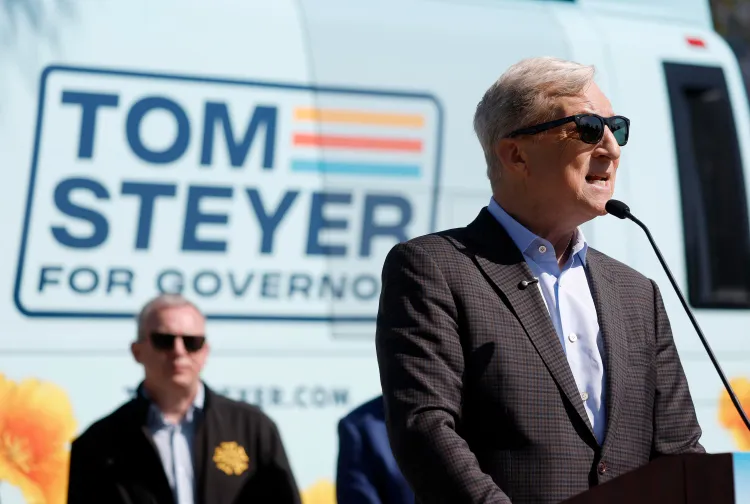
Left activists who love Sen. Bernie Sanders have this year flocked to a surprising new champion: hedge fund billionaire Tom Steyer.
In his campaign for California governor, Steyer has racked up the endorsements of Our Revolution (a group founded by Sanders 2016 campaign notables) and the California Nurses Association (the state’s leading champions of single-payer healthcare).
And earlier this month, even the Democratic Socialists of America’s California chapter praised Steyer as “most progressive of the current viable candidates for governor” — and advised against making a further-left protest vote.
Though all tout Steyer’s positions on the issues, the optics of the anti-billionaire left backing a candidate who has spent $132 million of his own money to saturate the state’s airwaves with his ads may seem strange.
Yet Steyer isn’t the only example of a very wealthy pol who’s won at least some left enthusiasm:
-
Illinois Gov. JB Pritzker, a billionaire from his family’s Hyatt hotel empire, impressed some left writers and posters with his progressive achievements once in office — and may run for president in 2028.
-
Rep. Ro Khanna (D-CA), who per financial disclosures has an estimated median net worth of $232.7 million (largely his wife’s money in a trust), is frequently mentioned as a potential presidential contender in the “Bernie lane” for 2028.
- Saikat Chakrabarti — who got quite wealthy through his work for the financial payments startup Stripe — is cultivating left support in a primary campaign to succeed Nancy Pelosi in the House of Representatives.
-
Wealthy politicians who can plow millions into their political runs are hardly new, of course, with plenty of current examples in each party, as well as independents like the late Ross Perot. Today’s progressives frequently trace their roots to Franklin D. Roosevelt, who was himself a scion of one of the most well-connected families of its era.
But the rise of this specific class of left-leaning ultra-wealthy candidates is noteworthy, because it comes after years of Democratic alarm over the influence of megadonors on elections in the Citizens United era — and over how billionaires have increasingly imposed their will on the government and society more broadly. (Hence the “Fighting Oligarchy” rallies from Sanders and US Rep. Alexandria Ocasio-Cortez around the country last year.)
In conversations about this broader topic with left activists, I heard some mixed feelings about backing wealthy candidates, especially prolific self-funders like Steyer — but also a general sentiment that, if they’re saying the right things on the issues and making the right enemies, they could be worth supporting.
“Every billionaire is a policy failure,” said Joseph Geevarghese, executive director of Our Revolution. “That being said, we have to operate in the world that we’re in. And in this world we happen to have a billionaire candidate who is ideologically aligned with our organization and our policy priorities.”
Others on the left have gone even further, and questioned whether the left’s anti-billionaire rhetoric itself has been flawed.
“The fact that the DSA and many progressives in California are coalescing around Steyer underscores the problem with casting billionaires, per se, as the enemy,” Katrina vanden Heuvel, editorial director and publisher of The Nation, wrote on X. “This frame doesn’t fare well in the real world, where some billionaires are very much part of the problem, while others are part of the solution.”
The candidates in question don’t hide from their wealth, nor do the progressives and socialists backing them pretend these tensions aren’t there. But each one has found their own individual way to address concerns — and an audience willing to hear them out. Here’s what the modern playbook looks like for a progressive tycoon seeking elected office.
You can read Andrew’s full story on the Vox site here.