In almost any other era of US history, Watson v. Republican National Committee would’ve been dismissed. But today's judiciary has proved unusually and alarmingly willing to entertain partisan legal theories, even when they don’t have much heft behind them.
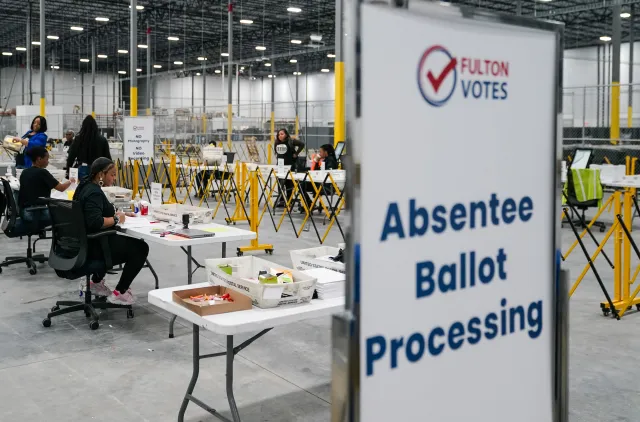
This particular case pitted the GOP and the Libertarian Party of Mississippi against the state of Mississippi, which counts mail-in ballots that arrive up to five days after the election. The Court ultimately ruled 5-4 in favor of Mississippi, with Chief Justice John Roberts and Trump appointee Justice Amy Coney Barrett joining the three liberal justices.
The (very lousy) case for setting voting rules back. The GOP’s lawyers didn’t exactly bring their A game on this one: “dubious,” “an extraordinary stretch” and “laughably weak” are just three of the choice descriptors Ian used in March to explain their legal case.
In a nutshell, they argued that when Congress set a federal Election Day in the mid-1800s, it intended to allow only ballots received by that date. The theory is hard to square with history, however, since virtually everyone voted in person until the Civil War, and modern absentee voting didn't emerge until the early 20th century. Lawmakers could hardly have intended to regulate a voting method that didn’t yet exist. That’s like saying the founders had thoughts on semi-automatic weapons. (Actually, about that…)
The quest to sabotage vote-by-mail. Still, in 2024, a panel of three judges — among the most partisan in the country — sided with the GOP. Had the Supreme Court upheld that decision, it would’ve upended mail-in voting.
For starters, Mississippi and a number of other states would have had to trash every mail-in ballot that arrived after the election. And if the Supreme Court had accepted some of the GOP’s more far-reaching legal arguments, that could have set the stage for the invalidation of an even wider swath of federal election laws, including those that allow for early voting, provisional ballots, and online voter registration.
All of this upheaval is, incredibly, in service of eroding vote-by-mail, which 29 percent of all voters use. But in recent elections, Democrats have been more likely to vote by mail than Republicans — and that has made the practice a primary target for both the GOP and the Trump administration. On Monday, President Donald Trump called the Supreme Court decision a “tremendous loss” and urged the Senate to pass his controversial SAVE America Act, which would introduce new voter registration and ID requirements and severely restrict mail-in voting.
“There is no excuse for a politician, or otherwise, to be against the [SAVE America Act],” Trump wrote in a Truth Social post. “There is only one reason to oppose — CHEATING!”
What this tells us about the Supreme Court. In the context of these larger attacks on mail-in voting, it might seem like good news that the Supreme Court ruled against the GOP. It’s certainly good news for mail-in voters in Mississippi, many of whom are, per national trends, likely elderly.
But Ian argues that a case this weak and transparently partisan never should have made it to the Supreme Court at all. And once there, it shouldn’t have split the justices 5 to 4.
“Watson is less a victory for democracy and the rule of law than it is a warning of what could come if Trump gets to replace even one more member of the Supreme Court,” he explains in a new analysis. “No reasonable judge could agree with Justice Samuel Alito’s dissent in Watson, but four of the Court’s nine justices did so, regardless.”
Read more from Ian here.