Shortly after brandishing his infamous chainsaw on a conservative conference stage last February, Elon Musk attended a Cabinet meeting where, giggling slyly, he admitted to having “accidentally canceled” Ebola prevention in his haste to obliterate the US Agency for International Development (USAID).
“We restored the Ebola prevention immediately,” he added, “and there was no interruption.” That claim has since proven untrue.
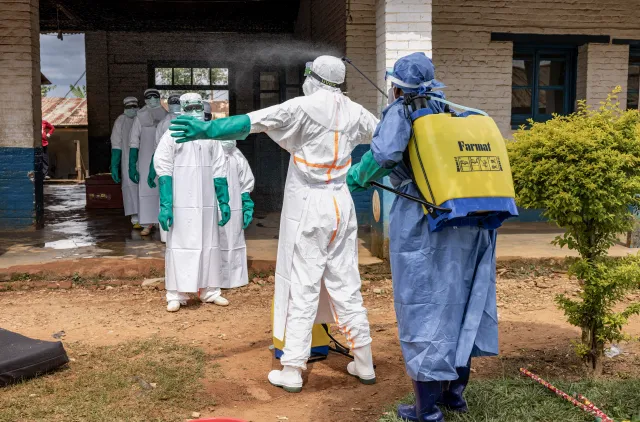
On May 17, the World Health Organization declared the rapidly spreading Ebola outbreak in Congo and Uganda a “public health emergency of international concern” — only the ninth such designation.
In the weeks since, at least 220 people have died of the highly fatal virus. It is already the third-largest Ebola outbreak on record. This is what happens when you defund Ebola prevention.
Where does Ebola fall in the grand scheme of scary infectious diseases? Ebola is what is sometimes called a “low-incidence, high-consequence” disease: It doesn’t break out all that often, but when it does, it’s deadly.
Roughly half of all people who contract Ebola die. And survivors’ experiences can be harrowing: Symptoms include fever, body aches, vomiting, diarrhea, and — in roughly half of cases — hemorrhagic bleeding from the eyes, ears, nose, and mouth. The virus is transmitted through bodily fluids, including sweat or blood, and can be caught through contact with soiled bedding or medical equipment.
About a decade ago, researchers developed a vaccine that prevents the spread of Ebola. It doesn’t work on the Bundibugyo strain, however, which is the type now circulating in Congo and Uganda.
Why did this outbreak spread so quickly? Since the Congolese health ministry first reported the outbreak two weeks ago, more than 900 people have been infected, including at least one American healthcare worker. And even that high toll is likely a tremendous undercount: Government labs are processing only a trickle of tests each day and have been slow to roll out robust countermeasures.
Some of the spread might have been inevitable. The Bundibugyo strain of Ebola is harder to diagnose, and this outbreak began in Ituri province — an active war zone.
But US foreign aid cuts also gutted the world’s Ebola detection and response apparatus last year. The Trump administration froze several programs that detect new Ebola cases, drawing out the time it took to identify it. It’s also much harder to come by the tests, nurses, doctors, and protective equipment. “It’s so bad,” Jean Kaseya, the director-general of the Africa Centre for Disease Control and Prevention, told Devex.
What is the Trump administration doing now? The US has done some course correction since the outbreak began. Last week, the administration pledged $23 million in emergency State Department funding for Congo and Uganda, and has also promised to deploy specialized CDC staff and disaster response teams to the region.
The Trump administration is also reportedly setting up a new treatment facility in Kenya for Americans exposed to the Ebola virus. And the Department of Health and Human Services has said it is working on an experimental monoclonal antibody treatment. Researchers in the UK, meanwhile, have begun development on a new vaccine that targets the Bundibugyo virus. Even in the best case, however, that’s months from deployment.
First hantavirus, now Ebola — is something happening here? The end times, possibly. Also: deforestation. Both viruses circulate in animals, and the risk of human spillover increases as people push into their habitats or otherwise cross paths with wildlife that carry pathogens.
The hantavirus and Ebola outbreaks also share another concerning commonality: Trump’s attacks on public health, and his retreat from the global health community, slowed the response to both viruses. On Monday, CNN reported that the Trump administration actually barred top research officials from communicating with the World Health Organization as hantavirus broke out, and has not significantly softened that stance in light of the Ebola epidemic.
All this suggests that things will probably get worse before they get better. While the majority of Ebola cases have occurred in Congo so far, Robert Redfield, the former head of the CDC, predicted last week that the virus could soon spread to neighboring countries like South Sudan and Tanzania.
Meanwhile, the US is without a current CDC director … among several other key public health officials. In fact, the agency has lost about a quarter of its staff over the past year or so.
Read more from Sara here.