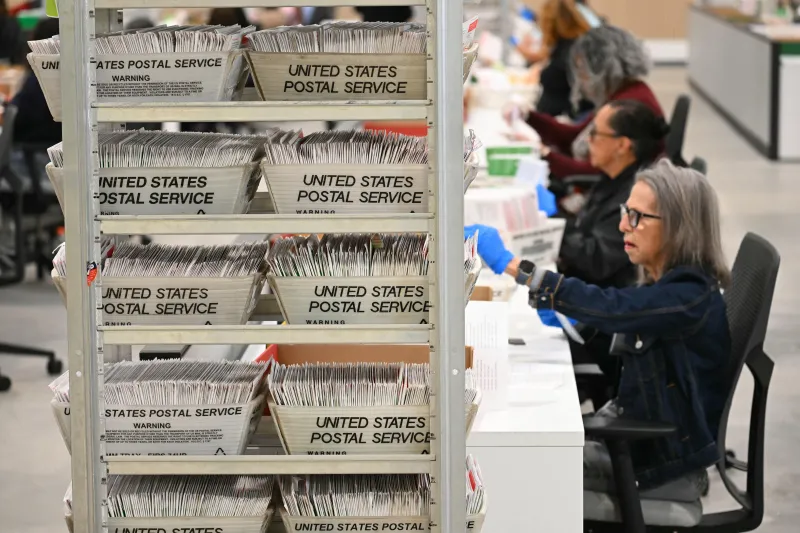
Six states held primary elections on Tuesday. But it could be days, or even weeks, until we get the full results from California, the site of several of Tuesday’s most consequential races.
California’s governorship is up for grabs. Los Angeles is electing a new mayor. But even a day after the polls closed, those contests were too close to call for certain. Much of that delay relates to California's infamously slow process for counting votes. But it also springs from a particularly chaotic election cycle, in which Democratic candidates up and down the ticket struggled to consolidate support.
To better understand what's happening in America's largest state, my colleague Christian Paz called up Dan Walters, a columnist at CalMatters and a veteran chronicler of California's politics. This morning, I'm sharing a (lightly edited and condensed) transcript of their conversation.
|
|
|
|
|
Caitlin Dewey, senior writer |
|
|
|
|
Caitlin Dewey, senior writer
|
|
|
|
The "messiest" election in recent memory |
|
|
|
|
Christian Paz
This has felt like the longest and messiest gubernatorial election in recent California memory. How did we end up here, and is it really that historic?
|
|
|
|
|
Dan Walters
It was so different because there was never a pre-campaign front runner. There's a stage before the official campaign launches where potential candidates are kind of testing the waters. That never happened here. Everybody was asking around, "Who's going to run?"
We got this deal where Kamala Harris stood around for what — a month, two months — making up her mind. And then, there were others who thought about it: Rob Bonta, the state attorney general; Alex Padilla, one of our US senators — they eventually both said, "No, we don't want to run." Eleni Kounalakis, the lieutenant governor, also announced she was going to run, and, then, she dropped out.
All this stuff was going on, and we didn't really even know who was running until basically the campaign got started earlier this year.
|
|
|
|
|
Christian Paz
Has this ever happened before in California? This void of leadership?
|
|
|
|
|
Dan Walters
I’ve covered governor’s elections here for 50 years, and I’ve never seen anything like it. Nobody else has ever seen anything like that, too, for the governorship of the nation's largest state. There seemed to be more people reluctant to run. Maybe they wanted to run, for whatever reason, but maybe they just figured governing California is so difficult. I mean, why would Alex Padilla give up a lifetime seat in the US Senate?
But the main overriding thing [is] there was never a natural front runner. Eight years ago, we knew Gavin Newsom was going to be running for governor. It was clear from the very beginning. We didn't have that this year. And that kind of set everything off.
And, so, finally, we have a field of 61 people running, ten whom you'd call serious candidates — that unfolded. Then, former congressman Eric Swalwell became the leading Democratic candidate at one point in early April. And then, within a few days, he was out of it, after he was accused of sexual harassment and resigned from Congress.
That ends up helping Xavier Becerra, who was down at about 4 percent in the polls at that point in early April. And he became, essentially, the candidate of what you might call a Democratic establishment. Voters either went to him or held back, and he leaped up, and it wound up being just him and Tom Steyer, who was spending $200 million mostly attacking Becerra at the end.
|
|
|
|
|
Christian Paz
It also seemed to me like it was voters almost running to the safest choice — like 2020, when everyone seemed to coalesce around Biden.
|
|
|
|
|
Dan Walters
Some people called Becerra's California's Biden — a safe bet, in other words. People wanted something known, something safe. Look, there’s a lot of angst out there about inflation and cost of living, gas prices, housing prices, that sort of thing. And I think people are kind of leery of somebody who comes along like Steyer and says, "I'll fix it!"
|
|
|
|
|
Christian Paz
Is it something about the job of governor that makes it so undesirable? Is it the state of the state? Are there structural issues that make it difficult to run or govern?
|
|
|
|
|
Dan Walters
We have a lot of what I would call existential issues: things that will really affect how California goes in the future.
You’ve got water supply issues. You’ve got homelessness. You’ve got a chronic budget deficit. You’ve got low education performance. There’s just no end of these things that need resolution but haven’t been resolved. And they’re going to be all lying there on the desk where the next governor takes over next January. Right off the bat, they got a lot to deal with. And you see Gavin Newsom for all of his supposed energy and engagement and everything has not really dealt very well with these existential issues.
|
|
|
|
|
Christian Paz
Is it fair to blame candidates and campaigns when these structural issues exist?
|
|
|
|
|
Dan Walters
There’s definitely something to the structure. It is unwieldy when you're dealing with complex issues, because it takes a high degree of agreement, of consensus, because the American system of government is a series of hurdles.
Committees, chambers of the legislature, the floor, the governor — every one of those hurdles, you have to get through all of them. And if you miss just one, you failed.
And so, it's fundamentally a negative process. It's set up to make it difficult to make policy. Consensus with all the stakeholders — business, labor, trial lawyers, environmentalists, consumer protection advocates — it’s extremely difficult and perhaps impossible to actually effectively govern California. You have to come in with very limited promises, deliver on those promises, but to do that, you have to ignore all the larger, more complicated existential issues.
|
|
|
|
⮕ Keep tabs
Big Tech's big flop: Even before all the votes had been counted, it was pretty clear that California voters had not looked kindly on tech-backed candidates. [Politico]
The irony of AI art: Multiple studies have shown that people prefer AI-generated images, poetry, and prose when they don't know that AI made them. Overall, however, people consistently say they want art made by humans. [Vox]
Regulation nation: President Donald Trump has closely involved himself in corporate mergers, drug approvals, and other regulatory decisions that were historically been left to independent agencies. It's changed the balance of power in Washington. [Wall Street Journal]
One weird trick for lowering property taxes: Building denser, more compact neighborhoods cuts the cost of infrastructure and maintenance. [Vox]
|
|
|
|
|
Trump enters his flop era
|
The Trump administration will no longer create a $1.776 billion "anti-weaponization" fund, the latest in a series of losses for the President and his agenda. |
|
|
|
Italian researchers used yeast found in the guts of Europe's oldest mummy to bake sourdough bread. With that, I think the post-pandemic sourdough trend is quite literally dead. |
|
|
|
Today’s edition was produced and edited by me, Caitlin Dewey. Thanks for reading! |
|
|
|
Are you enjoying the Today, Explained newsletter? Forward it to a friend; they can sign up here. And as always, we want to know what you think. Let us know by filling out this form or just replying to this email.
|
|
|
|