Mary Mother of the Church
A Gift of Christ to His People

Is this your brand on Milled? Claim it.

Journeys of Faith Newsletter update.
A Gift of Christ to His People
|





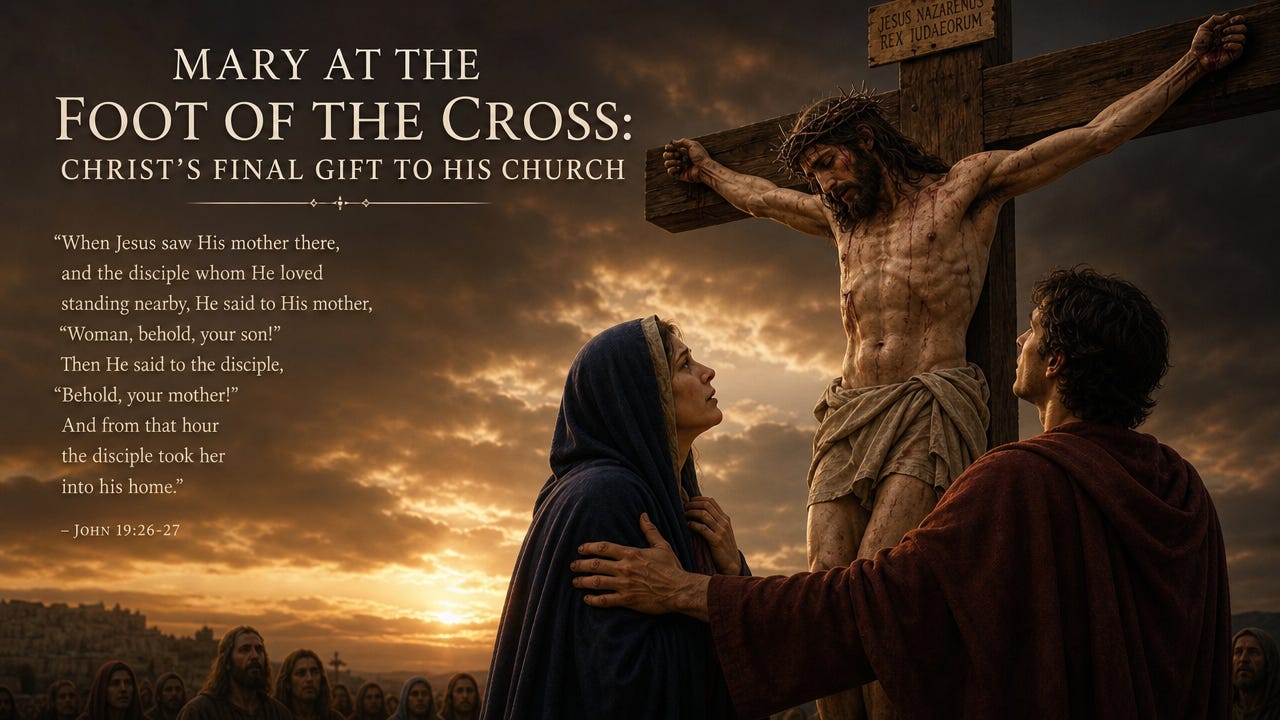 |
Mary at the Foot of the Cross: Christ’s Final Gift to His Church
Picture the scene on Calvary, shrouded in sorrow and yet bathed in God’s infinite love. As Jesus hung dying on the cross, suffering not only the agony of His wounds but the heartbreak of seeing His loved ones in sorrow, His eyes found Mary—His Mother—and John, the beloved disciple. Our Lord, even in His final moments, tenderly cared for His people.
Scripture tells us, “When Jesus saw his mother and the disciple whom he loved standing near, he said to his mother, ‘Woman, behold, your son!’ Then he said to the disciple, ‘Behold, your mother!’” (John 19:26–27) These were not just words of familial concern. They were a gift, a profound act establishing Mary as Mother of the Church. In that miraculous moment, the Lord entrusted Mary to John—and through John, to the whole community of believers.
This was not the first time Mary had quietly trusted God through darkness. She had carried Christ in her womb, pondered His mysteries in her heart, and followed Him in His ministry. But here, at the cross, her vocation reached its fullness. Mary’s maternal heart opened wide, embracing every disciple of her Son. In the midst of pain and loss, God gave us a loving Mother to walk with us on our journey of faith.
For so many Catholics, especially those facing sorrow or confusion, Mary’s presence at the foot of the Cross offers a profound consolation. She knows grief, she knows loss, and she knows unwavering faith. In our own struggles—whether in family, work, or the life of the Church—we are never alone. Mary stands with us, always pointing us to Jesus, reminding us that hope is born even in the darkest hour.
When we turn to Mary, Mother of the Church, we find a compassionate heart and a steady guide. She helps us remain faithful when life feels overwhelming, encouraging us to receive and trust in all that Christ gives, even in pain. Her gentle, motherly care is truly one of Christ’s greatest gifts—a sign of His love for His Church, for you, for me, for all His people.
Journey Deeper with Mary, Mother of the Church
Are you longing for a deeper relationship with Jesus and His Church? Take Mary’s hand on your own journey of faith. At Journeys of Faith, the legacy of Bob and Penny Lord lives on—inviting you to discover the powerful ways God works through Mary, the saints, and the treasures of the Church. Here’s how you can continue the journey:
Explore Our Devotional Resources: Dive into inspiring books, videos, and talks on Our Lady, Eucharistic Miracles, and the heroic lives of the saints—perfect for personal growth or sharing in your parish.
Bring Catholic Beauty Home: Surround yourself with reminders of faith. Browse our collection of rosaries, medals, icons, and Catholic art—all curated to help you feel Mary’s gentle presence each day.
Pray with Us: Download free prayers, guides, and novenas to foster a deeper devotion to Mary, the Mother of the Church, and open your heart to her loving intercession.
Stay Connected: Subscribe to our newsletter for faith-filled stories, upcoming spiritual events, and uplifting encouragement during times of struggle.
Let Mary, Mother of the Church, walk with you. Visit Journeys of Faith and discover resources that strengthen hope, fidelity, and your love for Christ.
What Does “Mother of the Church” Mean?
Imagine the scene at the foot of the Cross: Jesus, in His final moments, looks down at His sorrowful Mother and at His beloved disciple John. With a voice filled with love and finality, He entrusts Mary to John and John to Mary. “Woman, behold your son. … Behold your mother” (John 19:26-27). In that moment, Mary becomes more than Jesus’ earthly mother—she becomes the Mother of all those who follow Him.
For centuries, the Catholic Church has cherished the title “Mother of the Church” for Mary. But what does it mean? It’s more than a poetic name or a sentimental thought. It touches the very core of what it means to belong to the Church. The Church is not merely an institution or a building; it’s a family, a living Body with Christ as the Head. And every family needs a mother.
When we call Mary “Mother of the Church,” we proclaim that, from the moment Jesus gave her to us on Calvary, she has a unique spiritual role in God’s family. She cares for us, intercedes for us, and helps us grow closer to her Son. She is the gentle, loving presence that draws us together, especially when life’s burdens seem too much to carry. In the midst of confusion, doubt, or suffering, Catholics throughout the ages have turned to Mary, confident that, as any good mother, she will come to our aid.
This title also reminds us of Mary’s unique faith. She was there at Pentecost, praying with the apostles as the Holy Spirit descended, helping birth the Church into the world. Whenever we gather as disciples, whenever we persevere in faith, it’s as if Mary is quietly among us, praying for us, guiding us, and loving us into deeper communion with Christ.
It is no wonder Pope St. Paul VI made it official by declaring Mary “Mother of the Church” at the closing of the Second Vatican Council. The Church recognized what Christians had long believed: Mary’s motherhood did not end at Bethlehem or Nazareth or Calvary. It continues, now and always, as she loves every member of Christ’s Body with a mother’s tenderness and a queen’s strength.
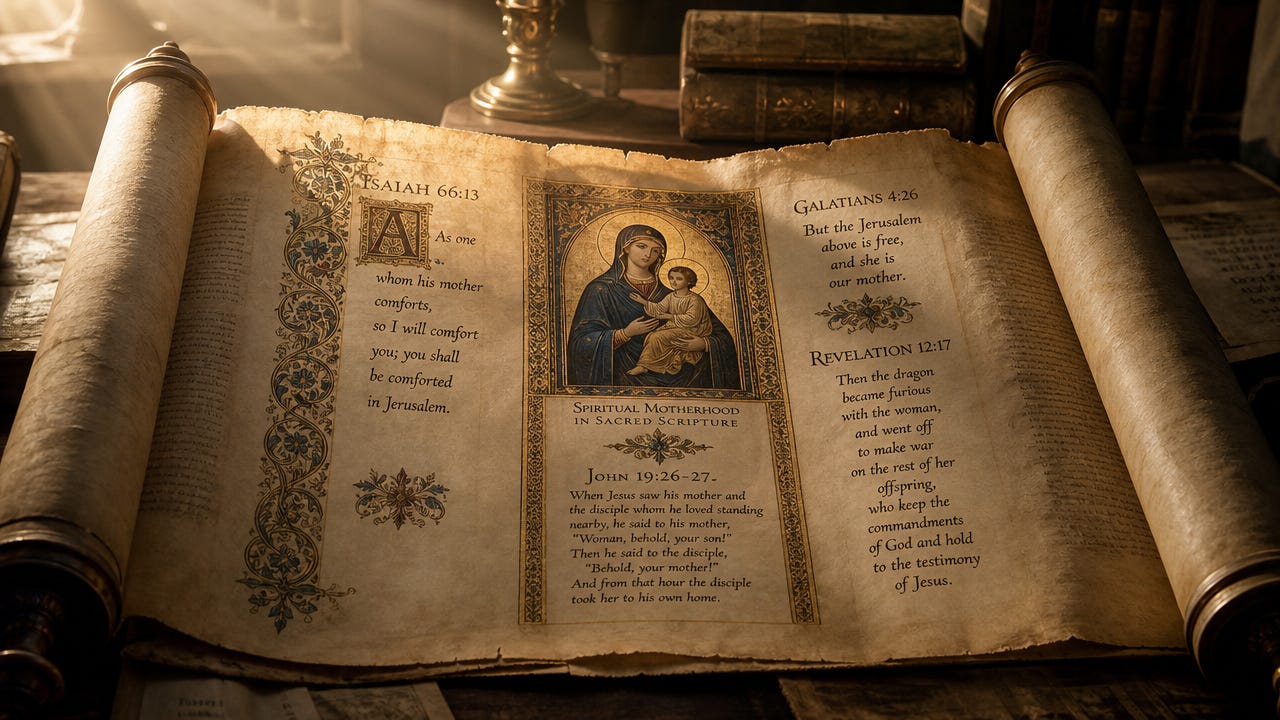 |
Biblical Foundations for Mary’s Spiritual Motherhood
When we speak of Mary as “Mother of the Church,” we’re not just using a beautiful title or poetic devotion. The roots of Mary’s spiritual motherhood are deeply woven throughout Scripture, demonstrating how God has entrusted her with a unique and loving role in His family.
The story begins at the foot of the Cross. In the Gospel of John, as Jesus is dying, He sees His mother and the beloved disciple standing below Him. With a heart full of love, He says, “Woman, behold, your son.” Then to the disciple: “Behold, your mother” (John 19:26-27). At that moment, Jesus gives Mary to the whole Church—represented by the beloved disciple—as a mother. This isn’t just a gesture of affection; it’s a divine entrustment, a profound act by which Christ extends Mary’s motherhood to all His followers for all time.
But even before Calvary, the Old Testament hints at Mary’s role. In Genesis, after the Fall, God promises that the “woman” and her offspring will crush the serpent’s head (Genesis 3:15). The early Church Fathers saw this prophecy fulfilled in Mary and Jesus defeating sin and death. Mary, the New Eve, stands at the heart of God’s plan, spiritually mothering those redeemed by her Son.
At Pentecost, we see Mary among the apostles, praying and waiting for the gift of the Holy Spirit (Acts 1:14). She’s there at the birth of the Church, interceding as a mother for her spiritual children. Like a gentle guide, she gathers the disciples in prayer, underscoring her ongoing maternal care.
These biblical moments reveal that Mary’s motherhood isn’t limited by time or place. She is present wherever the Church is, loving and guiding her children on their journey, just as she treasured and pondered all things in her heart (Luke 2:19). With her “yes” to God at the Annunciation, Mary opened her heart not only to Jesus but to all of us, becoming the tender mother the Church needs, especially in times of sorrow and uncertainty.
“Behold Your Mother”: A Closer Look at John 19:25–27
Standing on Calvary’s hill, among the jeering crowds and thunderous sorrow, stood the Blessed Virgin Mary at the foot of the Cross. In that most anguished of hours, Jesus—suffering for the world—saw His mother and John, the beloved disciple, standing nearby. And then, in a moment both tender and tremendously significant, Christ spoke words that would echo through the centuries:
“Woman, behold your son.” Then he said to the disciple, “Behold your mother.” (John 19:26–27)
These are not merely words of farewell; they pulse with divine intention. In entrusting Mary to John and John to Mary, Jesus was giving His own mother to all His disciples, to the entire Church. Mary’s maternal love, her gentle fidelity, became a gift for every follower of Christ.
Imagine that scene for a moment: the wind whipping dust along Golgotha, the darkness sinking in, the agony of loss on Mary’s face. Yet even here, Jesus is thinking not just of his own pain, but of you, me, and all who would come after. In His final breaths, He gives us His mother to be our mother—a comfort, a companion, a refuge in times of trial.
For anyone who feels alone or struggles in their faith, John 19:25–27 is a quiet invitation. Through these words, Christ invites each of us to take Mary into our lives as John did: to let her pray for us, strengthen us, and lead us closer to her Son. This is why the Church dares to call Mary “Mother of the Church.” From the Cross, she becomes the caring heart for every believer—a constant, gentle source of hope and encouragement on the journey of faith.
Mary as Mother of All Believers
Imagine standing beneath the Cross on Calvary, fragile and shaking, watching the Savior pour out His life for the world. In that solemn hour, with His dying breath, Jesus looked down at His mother and at the beloved disciple, John. Tenderly, He spoke: “Woman, behold your son,” and to John, “Behold your mother.” In that intimate exchange, Christ was not only caring for Mary and John—He was giving Mary to all of us, making her the mother of every Christian disciple.
Down through the centuries, the Church has cherished this gift. Mary isn’t just the mother of Jesus; she is our mother, too—a spiritual mother who loves as only a mother can. When the burdens of life feel heavier than our shoulders can bear, when doubt clouds our vision, or loneliness knocks at our door, we are not alone. Mary’s motherhood is gentle, persistent, and warm; her care never wavers.
The saints have always known Mary as their mother in faith. Whether it’s Saint Juan Diego hearing her comforting words at Tepeyac hill (”Am I not here, I, who am your mother?”), or Saint Thérèse of Lisieux placing herself in Mary’s loving arms, the stories echo a universal truth: to be Catholic is to be loved by Mary. She prays for us, consoles us, and carries our needs to the throne of her Son.
For us as believers, especially when the world or even our Church seems uncertain, Mary stands as a sure refuge. Her yes to God at the Annunciation was not just for her, but for all of us. When we imitate her trust and humble obedience, when we run to her in prayer and call her “Mother,” we are responding to a love that began at the foot of the Cross and endures forever.
Mary Mother of the Church means you have a mother who prays for you—guiding, teaching, and loving you right into the Heart of Jesus. In every trial, you can look to her as your model, your hope, and your gentle advocate along this journey of faith.
The Early Church and Devotion to Mary as Mother
If you step into the earliest centuries of Christianity, you find yourself walking alongside believers who clung to Christ—and to His Mother—through persecution, misunderstanding, and wonder. The Gospels tell us that after the crucifixion, Mary was not left alone; Jesus Himself, in His final moments, gave her to His beloved disciple (John 19:26-27). With just a few words—”Behold, your Mother”—He entrusted Mary to all who would follow Him, making her Mother, not only of John, but of the entire Church.
This truth wasn’t a distant abstraction for early Christians. In the Acts of the Apostles, Mary appears at the heart of the new community, gathered in prayer with the first disciples (Acts 1:14). Imagine those upper room moments—her gentle presence, her perseverance, her motherly concern—a sure sign of hope in times of confusion or fear. The apostles, facing an unknown future, looked to Mary as they once looked to her Son, learning from her quiet faith and unwavering trust in God.
As the centuries unfolded, the Church’s love for Mary deepened and matured. The first Christians called her Theotokos—God-bearer—not simply as a theological statement, but as a recognition of her unique closeness to Jesus and to all His members. Early bishops and Church Fathers wrote of Mary as the “new Eve,” whose “yes” to God began a new story of salvation. They saw her as both gentle Mother and courageous disciple, interceding, nurturing, and guiding the faithful with tender care.
Throughout ages of turmoil and uncertainty, devotion to Mary as Mother became a beacon. Christians prayed for her intercession, turned to her in trial, and brought their joys and sorrows to her heart—trusting that, just as she cared for Jesus, she would care for each of His children. In every generation, Mary has remained a consoling presence, a gentle reminder that no follower of Christ ever walks alone.
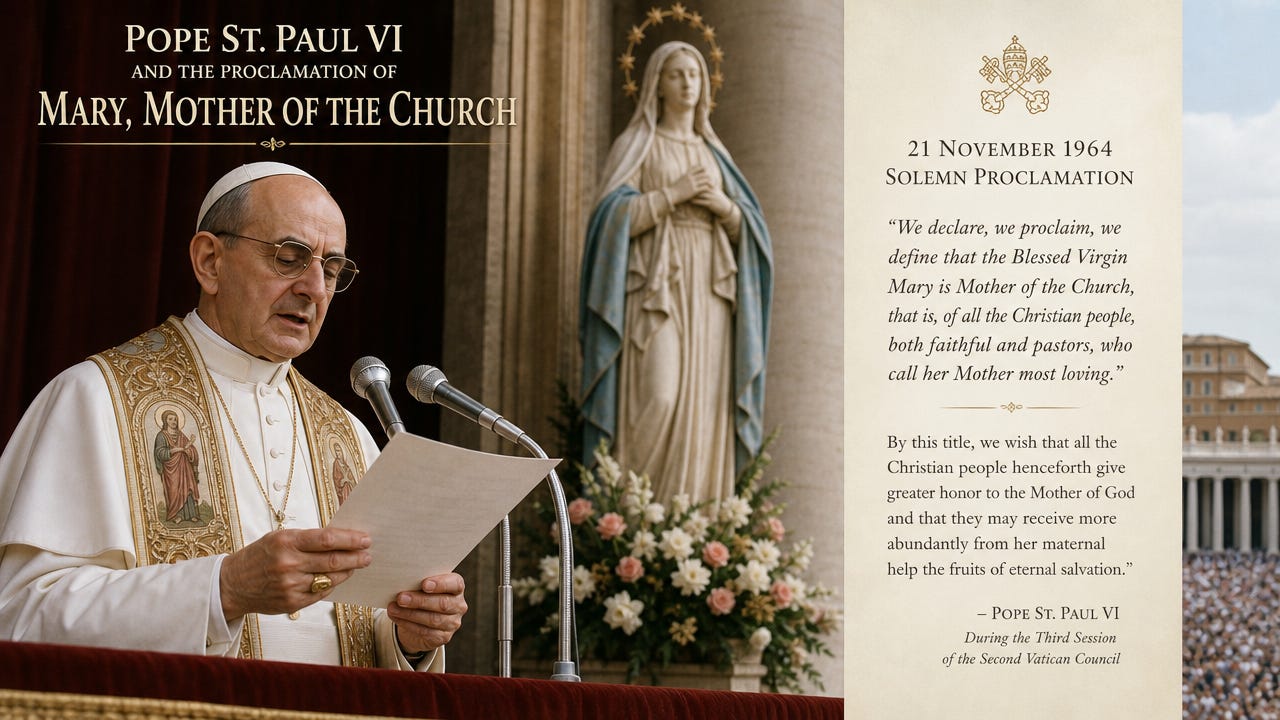 |
Pope St. Paul VI and the Proclamation of Mary, Mother of the Church
It was 1964. At the heart of the Second Vatican Council, the world’s bishops gathered in Rome, wrestling with how best to speak the Good News in a troubled world. Questions swirled about the Church’s mission, her identity, and her path forward. Yet, beneath all the passionate discussion and theological debates, there was a quiet yearning for reassurance—a sense that the family of God needed a mother’s tender care.
On November 21st of that year, something beautiful happened. Pope St. Paul VI, standing before the bishops in St. Peter’s Basilica, made a proclamation that echoed through history: he would formally declare the Blessed Virgin Mary to be “Mother of the Church”—Mater Ecclesiae. It was a moment rooted in ancient devotion, but it arrived with particular force and consolation for a Church called to live her mission in a rapidly changing age.
The very words—“Mother of the Church”—capture an unchanging truth known deep in Christian hearts from the earliest centuries. From the Cross, Christ had entrusted Mary to John, and in that moment, to all the faithful. She who said “yes” at the Annunciation, who stood steadfast at Calvary, who prayed with the disciples in the Upper Room—this same Mary was, and is, mother to every believer.
Pope St. Paul VI’s proclamation was not merely a new title, but a warm, motherly reassurance pressed into the heart of the Catholic family. With the world swirling in uncertainty, he pointed to Mary as the model of faith, hope, and charity—a loving mother who intercedes constantly for her children, guiding the Church with silent strength. He exhorted Catholics to draw close to Mary, to trust in her maternal care, and to let her lead them more deeply to her Son, Jesus.
The aftermath of this proclamation was immediate and lasting. St. Paul VI urged Christians everywhere to call upon Mary, Mother of the Church, especially in times of confusion and struggle. He even asked that she be honored under this title with particular devotion—reminding the faithful that, whatever storms may come, we are never alone. Our heavenly Mother walks with us, always pointing us to Christ.
Why the Church Celebrates Mary After Pentecost
Have you ever wondered why the Church, after the drama and fire of Pentecost, immediately turns our gaze to Mary, Mother of the Church? The answer traces back to the Upper Room, to that moment when the disciples sat together—frightened, uncertain, but not alone. There, the Acts of the Apostles tell us, “All these with one accord devoted themselves to prayer, together with the women and Mary the mother of Jesus” (Acts 1:14). The Church in her infancy found comfort and strength gathered around Mary, the Mother of Jesus. After Pentecost, this spiritual motherhood shone out in a new light.
It was not by accident that the Second Vatican Council and, later, Pope Saint Paul VI, gave Mary the beautiful title “Mother of the Church.” She was with the apostles at the birth of the Church, interceding as their gentle strength. Christ’s words from the Cross—“Behold your mother” (John 19:27)—were not spoken only to John, but to each of us, and to the Church herself. Mary’s presence after Pentecost is a living sign that the Church is always under her maternal care.
Devotion to Mary as Mother of the Church encourages us to see her not as a distant queen, but as a mother who walks with us, especially in times of confusion and trial. Historically, the Church began to spotlight her maternal role especially during the Monday after Pentecost—filling the world with hope just as Mary filled the Upper Room with trust and prayer. After the wind and tongues of fire, when the early disciples stepped into a world that could be hostile or indifferent, they knew Mary was with them, loving and praying for them as she does for us today.
When we celebrate Mary, Mother of the Church, right after Pentecost, we are reminded that devotion to her is not just about remembering the past; it is about receiving her ongoing help to live the faith with courage, hope, and unity, no matter what storms we may face.
Mary’s Role in the Life of the Apostles and the Early Church
Picture the Upper Room after the Ascension—the hush of expectation and uncertainty gathering over the small band of disciples. In that sacred space, at the heart of the first Christian community, stands Mary, Mother of Jesus and now, by Christ’s own gift, Mother of the Church. Her presence was not accidental; it was providential. She was more than a silent figure in the background—she was a source of comfort, hope, and steadfast faith for those who would soon carry the Gospel to the world.
The Acts of the Apostles paints the scene clearly: “All these with one accord devoted themselves to prayer, together with the women and Mary the mother of Jesus, and with his brethren” (Acts 1:14). Mary prayed with the Apostles as the infant Church awaited the coming of the Holy Spirit at Pentecost. The same Holy Spirit who overshadowed her at the Annunciation now filled the hearts of the Apostles, but Mary alone had already tasted the fullness of God’s life in her soul.
As the disciples wrestled with fear and doubt, still mourning the sorrows of Calvary and the mystery of the Resurrection, Mary’s faith shone as a gentle light. She understood suffering—she had stood at the Cross. But she also understood hope—she had cradled the Risen Lord in her arms. Her quiet strength was an anchor for the early Church in the storm of persecution and uncertainty.
Think of the questions swirling among the disciples: What now? Where do we go from here? No doubt they turned to Mary, who had lived closer to the mysteries of Christ than anyone else. Her words, sparse and measured, would have reflected the wisdom of one who pondered all things in her heart. In moments of confusion, when the path of discipleship seemed unclear, Mary’s example showed the way: steadfast trust in God and fidelity to His plan.
Even after Pentecost, when the fire of the Spirit sent the Apostles into the world, tradition holds that Mary remained their silent intercessor. She prayed with them, counseled them, and reminded them that the Church is always born—not of ambition or cleverness—but of humble openness to the will of God. This Marian way of discipleship would echo through the centuries, inviting every generation of Christians to receive Mary as their Mother, to trust as she trusted, and to allow her “yes” to become the pattern of their own lives.
Conclusion: Embracing Mary, Mother of the Church, on Our Journey of Faith
In every season of the Church’s life—amid growth, struggle, or renewal—Mary, Mother of the Church, has remained a constant, loving presence. From that tender scene beneath the cross where Jesus entrusted Mary to John and John to Mary, her motherhood became a gift offered to every believer: a real, spiritual guidance and gentle strength for each of us, especially when we feel lost or burdened.
At Journeys of Faith, our mission springs from this very truth. Like so many saints before us, we place ourselves under the loving care of Mary, trusting her wisdom to lead us to her Son. Through Eucharistic Miracles, stories of Marian apparitions, and the lives of holy men and women, we find that Mary never stops leading the way to Jesus and His Church.
If you feel confused, weary, or overwhelmed by today’s challenges, remember you are not alone. Mary, Mother of the Church, sees each one of us and intercedes with a mother’s heart. Let us answer Christ’s invitation to take Mary into our homes and hearts, walking the journey of faith with renewed hope, fidelity, and love for the Eucharist and the Church He gave us.
FAQs About Mary Mother of the Church
Who is Mary Mother of the Church?
Mary, Mother of the Church, is a title the Catholic Church gives to the Blessed Virgin Mary. It expresses the truth that Mary, as the mother of Jesus Christ, is also a spiritual mother to all members of His Mystical Body—the Church. Just as Mary cared for Jesus, she continues to care for all of us, guiding, interceding, and loving the whole Christian family as a mother.
What is the meaning of Mary as Mother of the Church?
To call Mary “Mother of the Church” means we recognize her unique role in salvation history and her ongoing, maternal relationship with every Christian. She is the Mother of Christ the Head, and so, by extension, the Mother of all the faithful who are His Body. This title reassures us that, even in times of confusion or struggle, we have the loving presence of Mary—always pointing us back to her Son and nurturing our faith.
When was Mary officially titled Mother of the Church?
Mary was officially given the title “Mother of the Church” by Pope Saint Paul VI on November 21, 1964, during the Second Vatican Council. This declaration recognized a truth loved and honored by countless saints and Catholics throughout history, now affirmed for the whole universal Church.
Who gave Mary the title Mother of the Church?
Pope Saint Paul VI formally proclaimed Mary as “Mother of the Church” (Mater Ecclesiae) in 1964. The Catholic faithful and theologians had long referred to Mary in maternal terms, but it was this act of the Pope, under the inspiration of the Holy Spirit and the Magisterium of the Church, that made the title official.
Why is Mary considered a gift to Christ’s people?
Mary is a gift from Christ because, from the Cross, Jesus entrusted her to the beloved disciple: “‘Woman, behold your son.’ Then He said to the disciple, ‘Behold, your mother.’” (John 19:26–27). In this act, Jesus gave us His own mother to be our spiritual mother. Through her intercession and example, she brings us closer to Jesus and helps the Church grow in love, faith, and unity.
What biblical basis supports Mary as Mother of the Church?
The strongest biblical foundation comes from John 19:25–27, where Jesus, in His final moments, gives Mary and John to one another. The Church sees in this moment Mary being entrusted not just to one disciple, but to all disciples for all time. Additionally, Acts 1:14 tells us that Mary was present with the disciples at Pentecost, praying as the Holy Spirit came and the Church was born.
What significance does Mary hold in relation to the Church?
Mary’s “yes” to God opened the way for Christ to enter the world. She is the first and most perfect disciple, a model of faith and surrender. While she is not divine, her role as Mother of the Church means she always leads us to Christ, prays for us, and helps us persevere in faith—especially when we face struggles, doubt, or suffering.
How is the feast day of Mary Mother of the Church celebrated?
The feast of Mary, Mother of the Church, is celebrated on the Monday after Pentecost. Parishes offer special Masses and prayers, asking for Mary’s intercession to strengthen the Church. This is a day to honor Mary in a special way—praying the Rosary, reading about her life, and entrusting ourselves and our families to her motherly care. Catholic faithful are encouraged to draw closer to Jesus through His Mother, especially on this joyful feast.
You're currently a free subscriber to Journeys of Faith Newsletter. For the full experience, upgrade your subscription.
| ||||||||||