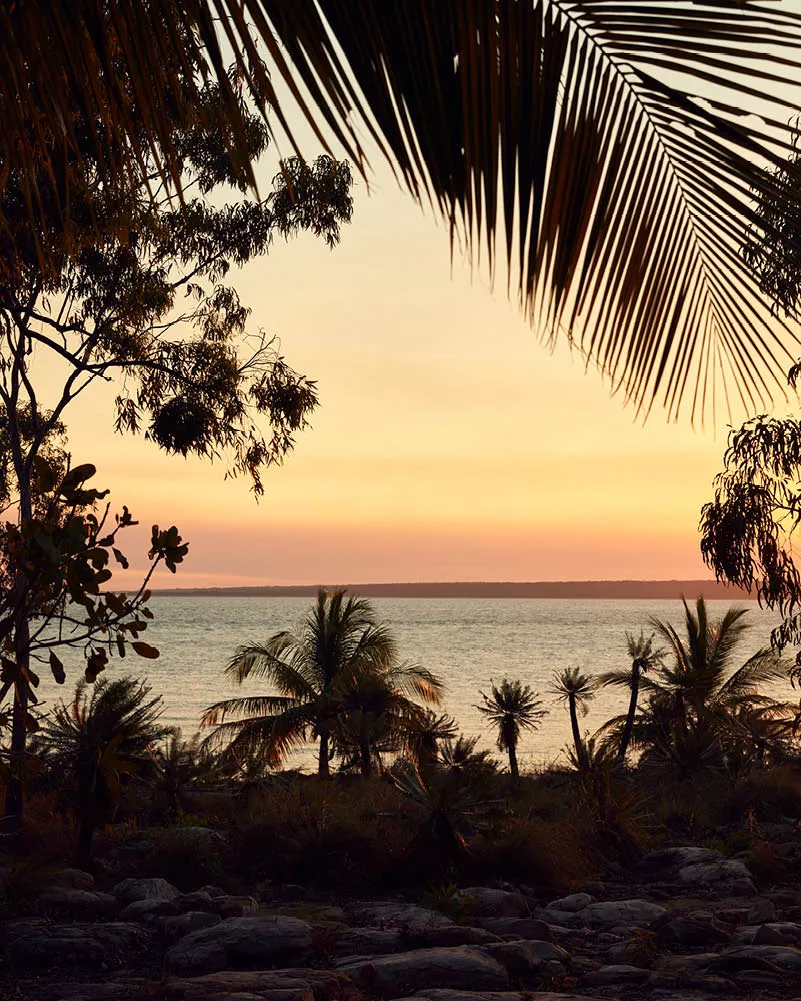
Groote’s night sky is a planetarium, and the silence is thick. There’s no background hum — just stars, wind, and water.
From here, the journey goes deeper into the Top End. Commercial flights won’t take you, so the next stop — Davidson’s Arnhemland Safaris — is reached by Cessna. As the plane lifts from Darwin, the world below becomes red escarpments and winding rivers, unreachable for half the year.
The lodge sits on 700 square kilometres of sacred Amurdak land. It’s remote luxury — not measured in thread count, but in space and silence. Keeping beer cold requires diesel trucked in from Darwin, and when the Wet hits, it’s nearly impossible.
Before heading into the bush, ranger Luke Troup offers a warning: “If you walk off out here, you tend to perish.” Even freshwater isn’t safe — saltwater crocs cross floodplains at night.
In the back of a weathered LandCruiser, they travel past rainforest and paperbark swamp, into escarpment country. High on a rock face, a painted serpent winds across the stone. “This one’s about 20,000 years old,” Luke says. Many sites here have never been seen by scientists. Locals decide who gets access — and what gets shared.
Among the rocks, grevillea blooms and kentia palms grow improbably green. Ochre, red, white and yellow images stretch across the cliffs — stories painted over tens of thousands of years.
Later, on a billabong boat at sunset, a croc somewhere nearby stirs in the shadows. Champagne in hand, it’s easy to forget for a moment just how wild this place is.
If human history in Australia were a single day, non-Indigenous people have been here only minutes. The First Peoples? Since dawn.
A trip to the Northern Territory isn’t just about where you go. It’s a journey back — through deep time, into country that remembers.