Did a friend forward you this message? Sign up here so you get them all! |
|
|
S&P 500
7,631
(-0.71%)
Nasdaq
26,100
(-1.03%)
Dow
52,767
(-0.79%)
Bitcoin
77,328
(-2.05%)
|
|
|
|
|
|
|
|
|
|
|
|
1. Investors Want Shovels Before Software |
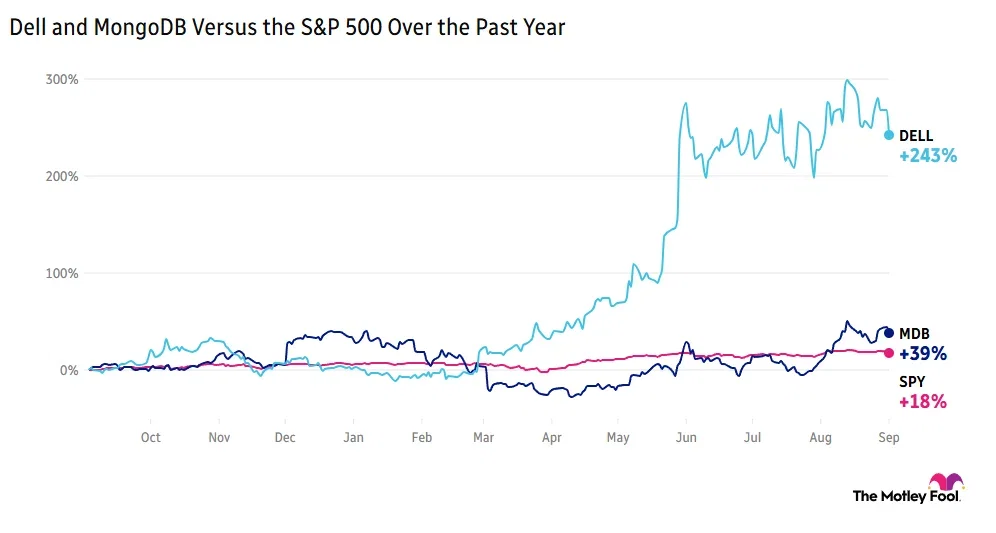
Dell posted record revenue and AI-server business for its fiscal second quarter. It beat estimates and raised full-year guidance. We don’t have any active recommendations on Dell, so why talk about it? Because its post-earnings rally could be telling us more about the market’s mood (read: AI perception) than about Dell itself. MongoDB’s 30% revenue growth in Q2 was the highest in several years. Like Dell, it beat estimates and lifted its full-year outlook. Yet, the stock reacted in polar opposites – Dell zoomed around 10%, while Rule Breakers recommendation MongoDB slumped almost 15%.
|
-
The shift in AI narrative: Investors are no longer rewarding high-flying AI promises or spending. They want to see AI capex hit profits and cash flows. Dell’s upside came from selling the physical infrastructure – servers, storage, networking gear – that hyperscalers are buying to build out AI capacity. MongoDB has a fast-growing software business with real AI upside, but it faces a timeline lag: it can monetize as developers build more AI applications after that physical infrastructure is deployed. MongoDB foresees slower revenue growth for Q3, giving investors an excuse to sell.
-
Why picks-and-shovels are winning: That’s not to say MongoDB’s model is broken, or there’s a demand problem. Not even close. It simply comes down to sequencing: physical infrastructure first in the AI build-out race. From specialized rack assemblies and liquid cooling to optical networking, hardware is the non-negotiable bottleneck of the AI supercycle right now.
|
|
|
2. Palo Alto's $1 Trillion Pitch Meets a Skeptical Market
|
Palo Alto Networks fell around 2% in pre-market trading despite beating fiscal fourth-quarter estimates and issuing strong full-year guidance. CEO Nikesh Arora used the earnings call to make a blunt claim. He said $1 trillion of global cybersecurity infrastructure is too old to defend against attacks that now move at machine speed. Since Anthropic launched its Mythos model on April 7, proof AI could exploit software vulnerabilities, the Rule Breakers recommendation has surged 113%.
|
-
The scare became the sales pitch: Arora says he spent eight years trying to convince customers their defenses were outdated. Anthropic's launch did it in one event. Palo Alto has since talked with 2,000 companies about its new Frontier AI Critical Defense Program. The $1 trillion figure frames the size of the opportunity, but it says nothing about whether Palo Alto is capturing that spend.
-
Growth still comes gradually: The stock's after-hours round trip (up 6%, then down 2%) fits a pattern. After climbing so far since April, anything short of a blowout disappoints. Palo Alto still has to turn that trillion-dollar upgrade cycle into results that justify the run.
|
|
|
3. PwC Pegs the AI Buildout at $31.6 Trillion |
Accounting giant PwC estimates the world will spend $31.6 trillion building AI data centers through 2050, more than any infrastructure buildout in history. For long-term investors, the exact number matters less than the horizon behind it. A multi-decade spending cycle means years of demand for the power, chips, and cooling suppliers. They get paid regardless of which AI model wins. |
-
The upside case reaches $50 trillion: Spending could hit that level if AI adoption accelerates beyond PwC's base case. Microsoft, Alphabet, Amazon, and Meta are the hyperscalers actually writing the capex checks. That capex only creates shareholder value if it converts into monetized cloud and AI revenue and margin, not just installed capacity.
-
The total dwarfs a year of U.S. GDP: PwC says the spending tops what the world once spent building railroads, the electrical grid, and the internet. Long-dated forecasts like this carry a wide margin for error, so don't anchor on the headline figure. Track the near-term, verifiable capex guidance from the companies actually spending the money instead.
|
|
|
4. Broadcom, Five Below, and Snowflake: AI Spending's Next Test |
Three Team Rule Breakers recommendations report earnings after the market closes today, and each one tests the same question. Is AI demand still accelerating, or just holding steady? |
|
|
-
Broadcom is expected to post AI semiconductor revenue near $16 billion, more than triple last year's level. Fool contributing analyst Lou Whiteman discussed the company in August with TMF co-founder and CEO Tom Gardner. He said “this is a clear leader in its category, which is reflected in Broadcom's strong tech, AI, and product scores” and “Broadcom is a master at converting that tech expertise into cash.”
-
Five Below posted EPS of $2.22 versus a $1.77 estimate last quarter. The bull case rests on CEO Winnie Park's turnaround execution, but analysts warn store expansion could outpace profitable demand. Same-store sales will matter as much as the headline growth number.
-
Snowflake has beaten estimates each of the last four quarters. The average beat has been nearly 22%. Its last beat was especially large, with EPS of $0.39 versus $0.14 expected. Watch for commentary on AI feature adoption. That's the real test of whether this growth holds up. The stock is outperforming the S&P 500 by 28% since the August 2023 Stock Advisor recommendation by Team Hidden Gems.
|
5. The Little Fintech That Could
|
|
|
We first recommended Sezzle in August 2024 at $21.32, back when Wall Street treated buy-now-pay-later as a subprime accident waiting to happen. Sezzle got caught in that, yet we saw a founder-led cash machine that we believed could outgrow its industry's reputation. Shares have more than quintupled since, and we've recommended it 22 more times across the Hidden Gems universe.
|
-
Priced like a lender, built like software: Sezzle trades at 25 times earnings, a multiple that fits a consumer lender with thin margins and loan risk on its books. Sezzle's economics look nothing like that. It converts 61% of revenue into free cash flow, the way software companies do, and those routinely fetch 40 times earnings and up. Mispriced companies are a Hidden Gems specialty, and this one still qualifies.
-
Squeezing more out of each sale: Every time a shopper splits a purchase into installments, Sezzle covers the cost upfront and pays interest on it. In May, it secured a new funding facility that cut its borrowing costs by almost 3 percentage points. The result? Sezzle’s transaction margin (revenue remaining after transaction costs) reached 63.5%, up 2.4 points year over year. Team Hidden Gems looks for management teams that can control every expense within their power, and Sezzle went after its biggest one.
|
Team Hidden Gems has a 5-year price prediction of $206.48, against roughly $114 today. Getting there won't be smooth, since Sezzle's 2.2 beta means it swings more than twice as hard as the market. We'll take that volatility, as the business underneath keeps getting better. |
|
|
What would it take to shake your confidence in the buy-now-pay-later business – think Sezzle, Affirm, Klarna, and PayPal?
Debate with friends and family, or become a member to hear what your fellow Fools are saying!
|
|
|
|
How did you like this email? |
If you have any questions, check out our Help Center here.
The Motley Fool, its directors, employees, contractors or staff may own positions in the companies mentioned in this email. For more details, please see our disclosure policy.
The Motley Fool
2000 Duke Street
Alexandria, VA 22314
Manage your email settings.
Copyright 2026 The Motley Fool. All rights reserved.
|
|
|
|