Did a friend forward you this message? Sign up here so you get them all! |
|
|
S&P 500
7,712
(-0.25%)
Nasdaq
26,402
(-0.52%)
Dow
53,560
(-0.02%)
Bitcoin
77,486
(-3.12%)
|
|
|
|
|
|
|
|
|
|
|
|
A quick note before we begin: Today's Breakfast News is a special edition — a single deep dive on the AI power build-out in place of your usual Monday preview of the week ahead. Regular service resumes tomorrow. Fool on! |
17 Stocks, 3 Tiers, 1 Question |
In September 2024, Microsoft signed a 20-year contract to buy every kilowatt-hour of power from a nuclear plant that had been shut down five years earlier. Three Mile Island Unit 1, which stopped generating electricity in 2019, is now being restarted at a cost of $1.6 billion — because Microsoft needs its 837 megawatts to power AI data centers that won't otherwise have anywhere to plug in.
That tells you almost everything you need to know about the state of the AI infrastructure build-out in 2026. Hyperscalers are paying to restart plants they didn't want six years ago. Utilities are planning gas fleet expansions that would have been politically inconceivable a decade ago.
Start-ups are borrowing tens of billions of dollars against warehouses full of graphics processing units (GPUs) that will be obsolete before the loans are repaid. It's all happening at an unprecedented scale. McKinsey estimates the world will need more than $7 trillion of data center investment by 2030, with over $5 trillion of that dedicated to AI.
We've all seen this movie before: an initial euphoric build-out, a moment of realization that supply has run past demand, a punishing digestion phase, and a small number of survivors that emerged with structural moats intact. Think of railroads, fiber, and shale. In every case, the great fortunes were made not by the companies that captured the peak of the cycle but by the ones whose economics didn't require the peak to persist.
That brings us to the question at the heart of this piece. Of the public companies exposed to the AI data center build-out, which have positioned themselves to compound through the cycle, which are running plays that dissolve when demand normalizes, and which are so dependent on this one thesis that they have no obvious path if it doesn't hold?
We organized the answer into three tiers.
|
-
Structural: Constellation Energy, Equinix, Digital Realty Trust, Eaton, Corning, EMCOR, and Brookfield Asset Management. Companies whose moats will still be worth owning if AI capital expenditure (capex) normalizes tomorrow. Nuclear plants that took decades to permit. Interconnection density that took decades to build. Contract structures that lock in economics for 20 years. The build-out accelerated these businesses.
-
Cyclical: Talen, NextEra Energy, Entergy, EQT, GE Vernova, Vertiv, and Comfort Systems. Companies that benefit meaningfully from the build-out but whose economics rise and fall with its intensity. Think merchant power operators capturing spot prices that reflect scarcity. The category also includes equipment suppliers whose growth rate is the build-out's growth rate and regulated utilities making big rate-based capital bets on demand that must persist for the returns to earn out.
-
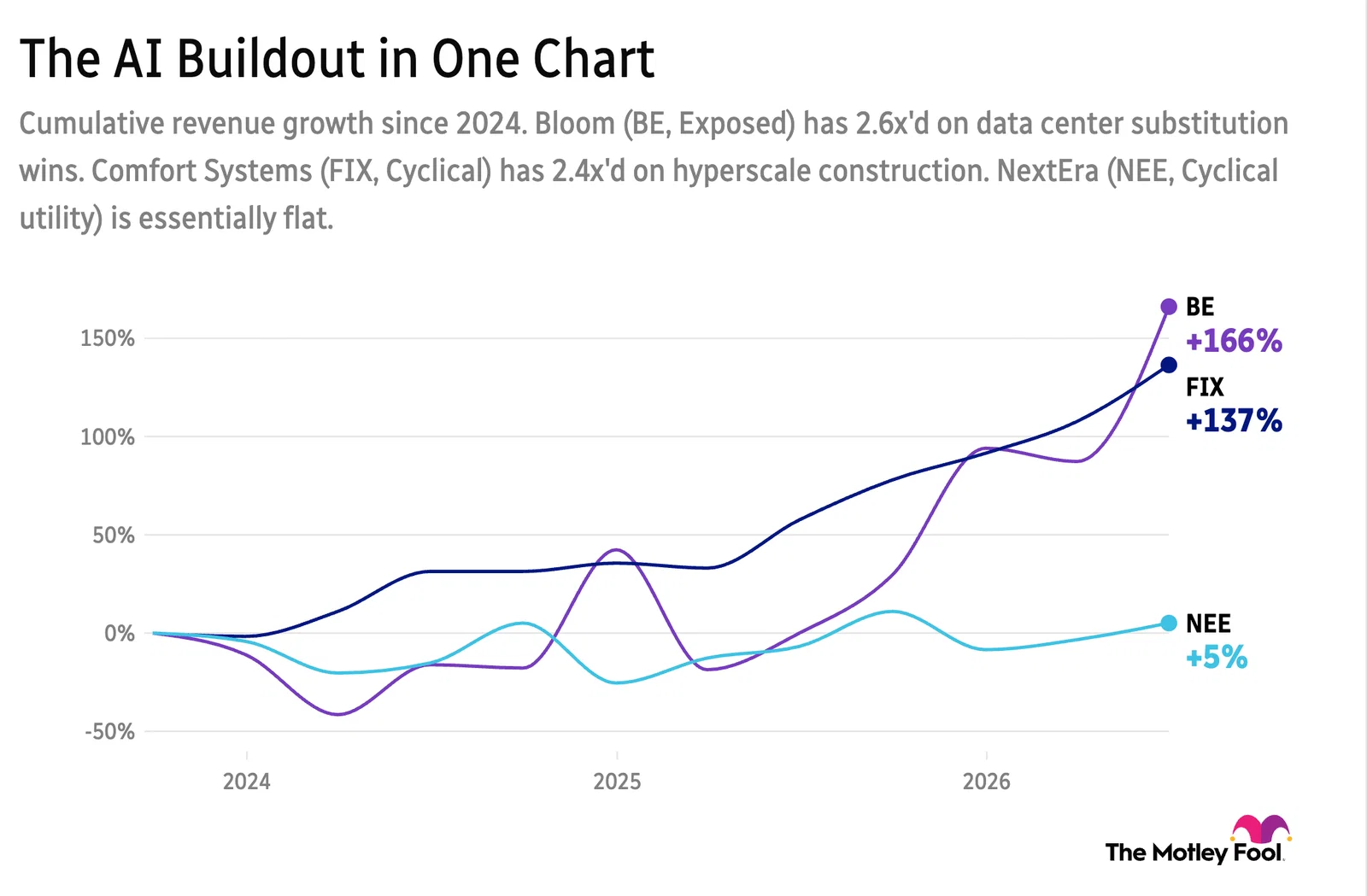
Exposed: CoreWeave, Bloom Energy, and IREN. Companies built for one specific scenario, whose assets have no obvious alternative use if that scenario fails. Think of single-purpose GPU cloud providers with concentrated customer bases and debt secured against depreciating hardware, or specialized on-site power companies whose economics depend on the grid staying constrained.
|
None of this is a recommendation. The point of the framework is to help you think clearly about what you actually own or might buy should you take a position on the AI build-out. |
|
|
Seventeen companies. Seven Structural, seven Cyclical, three Exposed. A few patterns stood out to us after sorting these companies.
Cyclical is the biggest bucket. That's how a capex supercycle looks from the supply side. You have merchant power operators capturing spot prices along with utilities making rate-based bets. Then the equipment suppliers whose backlogs are the buildout's backlog. This is also where earnings are showing up most dramatically in 2026, and where they'll compress most visibly when the cycle turns. Several of these are excellent businesses. They're just excellent businesses at a moment when the market is paying them for the moment – not for the decade.
Pure-play exposure differs from durable exposure. Vertiv and Eaton both sell into the data center. Comfort Systems and EMCOR both wire it. In each pair, the diversified operator ended up Structural and the pure-play ended up Cyclical. Purity concentrates the upside and downside symmetrically. Diversification is what lets the moat survive the driving thesis softening.
The same tech shows up in different tiers. These were the tier assignments we chewed on longest. Constellation Energy and Talen both own nuclear plants. Both have hyperscaler power purchase agreements (PPAs). Constellation converted its nuclear scarcity into 20-year fixed-output contracts across the fleet. Talen has done that for one asset while the rest of its portfolio rides the strongest merchant power market in a generation. The plants look similar, but the economics don't. That's where the framework really helps — separating ownership of the moat from conversion of the moat into contracted economics.
None of this is a forecast about who survives. It’s not clear which of these 17 companies will emerge with structural moats intact in 2035. What we do know is that the question is worth asking now, while the buildout is still going and the answer isn't yet obvious.
|
|
|
Sponsored by 
|
13 Retirement Mistakes Even Smart Investors Miss
You’ve saved for decades to enjoy your retirement, so one avoidable misstep shouldn’t set you back. But it can. Thankfully, Fisher Investments helps retirees protect what they’ve built. Their free guide, 13 Retirement Investment Blunders to Avoid, reveals the slip-ups that catch even savvy investors, from overpaying in fees to mistiming withdrawals.
Learn More
|
|
|
|
|
If you could own just one of the 17 companies named, which would it be — and why?
Discuss with friends and family, or become a member to hear what your fellow Fools are saying!
|
|
|
How did you like this email? |
If you have any questions, check out our Help Center here.
The Motley Fool, its directors, employees, contractors or staff may own positions in the companies mentioned in this email. For more details, please see our disclosure policy.
The Motley Fool
2000 Duke Street
Alexandria, VA 22314
Manage your email settings.
Copyright 2026 The Motley Fool. All rights reserved.
|
|
|
|