Did a friend forward you this message? Sign up here so you get them all! |
|
|
1. Software's Payoff Week |
This week's earnings tested a thesis of ours. We'd argued the "SaaSpocalypse" fear was overblown, and that AI agents will drive more software usage, not less. The worry was that agents doing human work would gut the per-seat licenses that software runs on. But agents still have to read and write the records living inside those platforms. So, the best software keeps getting paid, per seat or not.
|
-
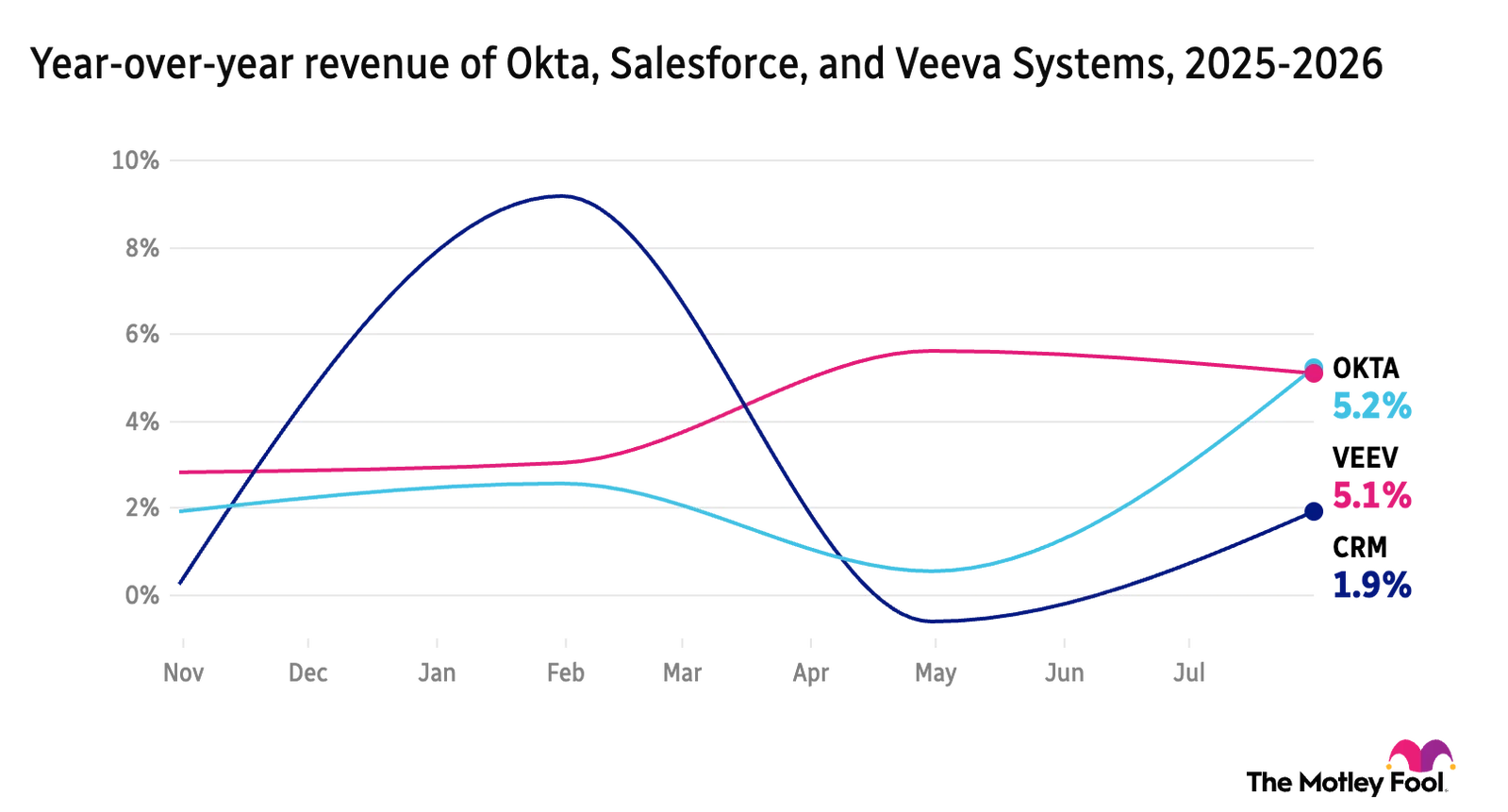
Okta sells the login layer that employees, and now AI agents, pass through. Revenue for this Stock Advisor pick rose 10.6% to $805 million, but operating income jumped 161% to $107 million. Profit is outrunning growth, exactly what long-term holders wanted.
-
Salesforce, recommended in Stock Advisor and Rule Breakers, showed that the agent-pricing model is working. Recurring revenue from its Agentforce and Data 360 AI products more than tripled from a year ago to roughly $3.9 billion.
-
Veeva Systems runs the trial and regulatory records that drugmakers can't afford to get wrong. As investors panicked in April about a software reckoning, Team Rule Breakers issued a fresh recommendation. It's up by 70% since. Revenue grew 18% to $928 million, and Veeva raised full-year guidance.
|
AI is paying off in software, not just chips. |
|
|
2. After CrowdStrike’s Record Quarter, We Reduced Our Stake
|
CrowdStrike protects a company's laptops, servers, and logins, and customers rarely rip it out. It's one of our most recommended stocks across services. The increasing security threat from AI has become a very compelling sales pitch for its services. |
-
The number that mattered: Net new annual recurring revenue hit a record $333 million, revenue grew 26%, and management raised full-year guidance. CEO George Kurtz called it the best quarter in the company's history.
-
What drove it: Kurtz credited a "Mythos moment," his name for the scramble after Anthropic's model showed it could exploit unknown software flaws. Every capable attacker that AI creates is one more reason enterprises spend on defense.
-
Tom Gardner sold a little: Hours after that report, he reduced exposure to CrowdStrike across the board, including a 15% trim of one Stock Advisor position. Our first recommendation there is up nearly 700%. Not because the thesis broke. The stock trades above 40 times sales in a frothy market, and it's a heavily weighted winner. He took a few chips off the table.
|
Trimming an expensive winner and maintaining conviction in its long-term story aren't mutually exclusive, and Tom still believes in Crowdstrike. |
|
|
3. Nvidia's Beat and a Telling Purchase |
Nvidia beat again. Revenue topped $96 billion, more than double a year ago, and the stock is up 9% since reporting. What lifted its shares? The CFO guiding for 70% revenue growth in 2028. But our analyst Emily Flippen calls Nvidia "a lagging indicator of the AI buildout, not a leading one." Its reported revenue just confirms spending that the market already knew about. But the more revealing news came Thursday, when Nvidia revealed what’s on its shopping list.
|
-
The deal: Nvidia reportedly agreed to buy Hugging Face, the open-source hub where developers publish and test AI models, for about $13 billion. It's Nvidia's largest acquisition ever, at roughly 86 times the target's sales.
-
Why that price isn't incredibly high: Nothing is expensive against Nvidia's scale. Flippen notes Nvidia could buy Hugging Face seven times over using cash already set aside to repurchase its own stock. She also flags this as a defensive hedge. Nvidia's biggest customers are starting to design their own chips. Whoever owns the platform developers download models from can steer them toward rival hardware. Nvidia is paying to keep that door shut.
|
We've recommended Nvidia more than 30 times and never sold. In fact, a $10,000 stake invested in 2005, when we first recommended Nvidia in Stock Advisor, is worth about $13 million today. But the build-out that made it can't grow forever, and this deal is a tell that Nvidia knows the easy years are behind it. What we're watching now is whether it can defend its lead as well as it once extended it. |
|
|
|
A message from The Motley Fool
|
|
The market's throwing curveballs every week. Epic Portfolio gives you access to a complete, actively managed portfolio with stocks spread across sectors, market caps, and risk levels to potentially help members hold through the noise. And The Motley Fool is putting $100,000 of its own money in alongside members who follow it. Reveal the full 50-stock portfolio →
|
|
|
|
|
4. Sneakers Signal a Nervous Consumer |
Last week, retail's story was who's winning: Target up, Walmart down. This week, it turned into a harder question about how shoppers’ discretionary budgets are holding up. Dick's Sporting Goods had its worst trading day on record on Tuesday, down more than 30% after earnings, and same-store sales missed. It dragged our shoe stocks down with it.
|
-
The drag: Foot Locker, the chain Dick's bought this year, is looking like dead weight. Its comparable sales fell 3.6%, while Dick's own stores grew 4.9%. The acquisition erased an otherwise decent quarter.
-
Our recommendations fell in sympathy: On Holding, recommended in Stock Advisor and Rule Breakers, dipped 2.3%. Deckers Outdoor, a Team Hidden Gems pick, closed down 3.6%. Nike fell 3.1% the same day.
-
Why do shoes even matter? Footwear demand tracks whether shoppers are spending money on fitness and recreation. Contributing analyst Lou Whiteman flagged in May that Nike's retreat from wholesale left a shelf vacuum. On and Deckers filled it.
|
The question is whether this is one struggling retailer or it indicates that consumers are pulling back. July's core inflation held at 3.3%, and real spending was essentially flat. Before calling one sneaker miss a macro signal, look at how the next discretionary retailers report. On and Deckers taking share is the durable part. |
|
|
5. Meta Buys Its Way Out of a Trial |
Meta just settled the biggest legal threat hanging over it. It agreed to pay about $17 billion to resolve claims from 29 states that Instagram and Facebook hooked kids on their platforms. The settlement ends a trial that was in its second week. The Team Hidden Gems recommendation briefly popped 4% on the news, but has since come back down.
|
-
Why the stock responded favorably to a penalty: Markets prefer a known, spread-out cost to open-ended legal risk. Meta originally disclosed that states were seeking up to $1.4 trillion, which makes $17 billion look like peanuts. Meta will pay the funds over a decade, and it expects to book a roughly $10 billion charge in the third quarter. A settled number reads very differently from a surprise jury verdict.
-
The real cost is engagement, not cash: Meta agreed to real product changes for minors. It will cap kids at two hours a day across Instagram and Facebook, block feeds overnight, and limit beauty filters and visible likes. Fewer teen sessions mean fewer ad impressions. For an advertising business, that bites long after the cash is paid.
-
Meta passed the bill to rivals: In an interesting twist, Meta will dole out the other 30% of the funds only on a certain condition. Its competitors, Alphabet's YouTube and TikTok, must also adopt similar teen safeguards and pay out billions to the states. One company's settlement could become the template regulators use against the whole industry.
|
The uncertainty about its financial penalty has lifted. But owning Meta from here means believing it can keep engagement and ad revenue healthy while running a friendlier product for its youngest users. |
|
|
Tom Gardner sold some CrowdStrike stock even though he still believes in it. What's a stock you remain bullish on but have deliberately reduced your exposure to, and what tipped you into selling some?
Discuss with friends and family, or become a member to hear what your fellow Fools are saying!
|
|
|
|
How did you like this email? |
If you have any questions, check out our Help Center here.
The Motley Fool, its directors, employees, contractors or staff may own positions in the companies mentioned in this email. For more details, please see our disclosure policy.
The Motley Fool
2000 Duke Street
Alexandria, VA 22314
Manage your email settings.
Copyright 2026 The Motley Fool. All rights reserved.
|
|
|
|