23andMe DNA reveals living descendants of enslaved people
What matters in science |

Is this your brand on Milled? Claim it.
|
|||||
|
|||||
|
Hello Nature readers, |
|||||
|
|||||
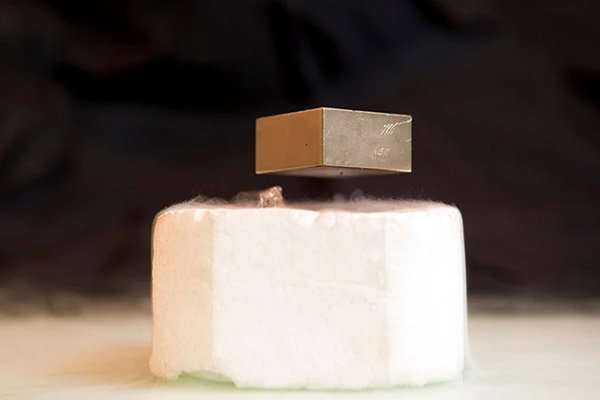
| The Meissner effect, in which a material expels magnetic fields, is one of the hallmarks of superconductivity. (Patrick Gaillardin/LookAt Sciences/SPL) | |||||
No confirmation of superconductor claimIn late July, researchers claimed they had discovered the first superconductor, called LK-99, that works at room temperature and ambient pressure. So far, all efforts to reproduce this spectacular finding have come up short. Superconductivity — the ability to transport electricity without any resistance — has so far been described only in materials cooled to ultra-low temperatures or under extreme pressures. Two replication experiments failed to observe any signs of superconductivity, and a third found near-zero electrical resistance, but only well below room temperature. Theoretical studies suggest that LK-99 might have interesting features but none found evidence that it is a superconductor in ambient conditions. Nature | 7 min readReference: arXiv preprint 1 & preprint 2 (not peer reviewed) |
|||||
DNA reveals enslaved people’s descendantsResearchers have identified nearly 42,000 living descendants of 27 people who were buried in an African American cemetery at an iron forge in the United States from the 1770s. The furnace workers’ DNA was linked to that from customers of the personal genetics company 23andMe. Previous efforts to identify the descendents of the workers, many of whom were enslaved, had failed because of scant historical records. “Each time we are able to find an enslaved ancestor, we are defeating the purpose of slavery. The purpose of slavery was to rob us of that information,” says Henry Louis Gates Jr, a scholar of African and African American studies. Ethical questions remain about whether a for-profit company should be holding data of relevance to the community of descendants. Nature | 7 min readReference: Science paper |
|||||
Mosquito-dwelling microbe stops malariaMalaria-carrying mosquitoes are less likely to pass on the parasite that causes the disease if they are infected with a naturally occurring bacterium. The microbe secretes a chemical that hobbles the malaria parasite’s development in the insects’ guts. So far, researchers trying to prevent the spread of the disease have had to rely on genetically modified bacteria — a major obstacle to regulatory and public acceptance, says malaria researcher Carolina Barillas-Mury. In experiments, one-third of mice bitten by bacterium-carrying mosquitoes became infected, compared with 100% of those bitten by regular malaria mosquitoes. And the mosquitoes don’t seem to develop resistance against the bacterium as they do to insecticides. The approach “has great potential to be implemented”, adds Barillas-Mury. Science | 5 min readReference: Science paper |
|||||
|
|||||
Let young people take the lead on climateIndigenous youth must be at the forefront of climate diplomacy, say the co-organizers of the Global Indigenous Youth Summit on Climate Change. Indigenous Peoples bring centuries of resilience and lifetimes of adaptation to extreme environmental conditions — and young people are well placed to combine Traditional Knowledge with modern technologies and practices. Events such as the 24-hour online Global Indigenous Youth Summit on 9 August are one way for Indigenous young people to take active roles in the global discourse on climate resilience. “There is no question that they should be an inherent part of the formal system of governance in their countries and on the international stage,” the group writes. Nature | 12 min read |
|||||

|
|||||
ACCESS NATURE AND 54 OTHER NATURE JOURNALS
|
|||||
How make the most of remote conferencesOnline meetings can help you to widen your scientific network and raise your profile, says microbiome researcher Svetlana Ugarcina Perovic. Here are her tips for before, during and after remote conferences:
|
|||||
Five best science books this weekAndrew Robinson’s pick of the top five science books to read this week includes a bitter-sweet history of sugar, an appealing discussion of rocks and their lessons and a poetic meditation on the Universe. Nature | 4 min read |
|||||
Quote of the day“If all I find is that the extraterrestrials know quadratic equations, I’m going to be very disappointed.”Astrobiologist Douglas Vakoch says that deciphering alien messages would be “incredibly boring and frustrating”. So he hopes that if Earth were ever to receive an extraterrestrial dispatch, it would include more than just some maths and science. (Scientific American | 10 min read) |
|||||
|
|
|||||
|
|||||
|
|
|||||
|
|||||
|
You received this newsletter because you subscribed with the email address: - Please add [email protected] to your address book. Enjoying this newsletter? You can use this form to recommend it to a friend or colleague — thank you! Want to switch to the weekly edition? Update your preferences. Had enough? Unsubscribe from the Nature Briefing. Fancy a bit of a read? View our privacy policy. Forwarded by a friend? Get the Briefing straight to your inbox: subscribe for free. Want to master time management, protect your mental health and brush up on your skills? Sign up for our free short e-mail series for working scientists, Back to the lab. Get more from Nature: Register for free on nature.com to sign up for other newsletters specific to your field and email alerts from Nature Research journals. Would you like to read the Briefing in other languages? 关注Nature Portfolio官方微信订阅号,每周二为您推送Nature Briefing精选中文内容——自然每周简报。
Nature | The Springer Nature Campus, 4 Crinan Street, London, N1 9XW, United Kingdom Nature Research, part of Springer Nature. |