Cancer staff shortages are global ‘wake-up call’
What matters in cancer research |

Is this your brand on Milled? Claim it.
|
|||||
|
|||||
|
Hello Nature readers, |
|||||

|
|||||
| Investing in the cancer workforce could prevent around 170 million cancer deaths and deliver US$120 trillion in economic benefits between 2030 and 2050, according to a report in The Lancet Oncology. (Unaihuiziphotography/Getty) | |||||
Staff shortages are global ‘wake-up call’The world is facing a major shortfall in the number of staff needed to care for people with cancer. By 2050, there will be a shortage of 100-million nursing and clinical staff as cancer rates increase around 20% to 100,000 diagnoses a day. “Make no mistake, this is a wake-up call, no matter where you are in the world,” says co-author and digital health researcher Mark Lawler. More people are living long enough to experience cancer as a disease of ageing than in the past. “This demographic shift is not a failure — it reflects remarkable progress in global health, but it demands an equally ambitious response in cancer care,” says co-author and surgical oncologist Peter Kingham. The Guardian | 4 min readReference: The Lancet Oncology commission (31 May) |
|||||
Rare case of a tumour after gene therapyA gene therapy has been linked with the development of cancer, but experts say it’s an unusual case and isn’t generalizable to others. In January, two clinical trials were paused in the United States after a 5-year-old boy developed a brain tumour. The boy, born with Hurler syndrome, was injected with a virus carrying the genetic instructions for a functioning enzyme he otherwise would have lacked. But the virus integrated some of its components into his brain cells' DNA, switching on a cancer-associated gene. The tumour was successfully removed and the boy is still cognitively advanced for his age, suggesting that the gene therapy worked. The boy’s young age at treatment and his particular clinical history might have made him more susceptible to the tumour. Science | 5 min readReference: The New England Journal of Medicine paper (13 May) |
|||||
No ‘single smoking gun’ for cancer in youthThe rise of cancers in people under the age of 50 was a key talking point at two major US cancer conferences, with obesity, ultra-processed foods, microbial toxins and changes in screening or classification all being considered as potential drivers. What’s becoming clear is that there’s no one cause, experts say. “I don’t think there’s a single smoking gun,” says gastroenterologist Andrew Chan. Nature | 6 min read |
|||||
A spotlight on lung cancer
|
|||||
|
|||||
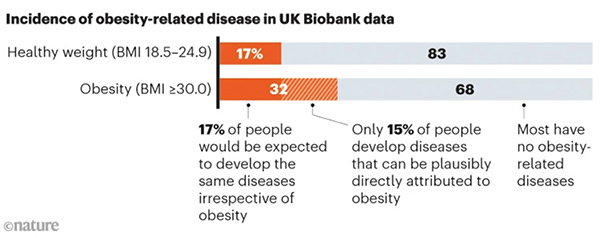
Obesity isn’t always a diseaseObesity can be described as a chronic disease, but this label shouldn’t be applied uniformly to a condition that can affect individuals’ health so differently, argues surgeon Francesco Rubino. Instead, there should be two diagnoses: clinical obesity, in which excess fat tissue directly impairs daily activities or causes demonstrable organ dysfunction, and preclinical obesity, in which it doesn’t. The former is “unequivocally disease” while the latter represents a higher risk of developing conditions such as diabetes, high blood pressure and cancer, Rubino writes. This distinction can help clinicians know who to prioritize for treatment and avoids labelling people as diseased when they might not consider themselves to be ill. Nature | 16 min read |
|||||
|
|||||
| Most people with obesity do not have obesity-related diseases, and only 15% develop diseases that could be plausibly attributed to obesity. (Source: Kivimäki, M. et al./Lancet Diabetes Endocrinol.) | |||||
|
|||||
The human genome — but smallerA synthetic ‘minimal human genome’ that contains the smallest set of genes it needs to function could be useful in biomedicine, argues synthetic biologist Sudarshan Pinglay. This abridged version of the human genome would be cheaper to synthesize and could potentially improve cellular therapies used in cancer where superfluous DNA can be a liability, writes Pinglay. Nature | 5 min read |
|||||
|
|||||
|
|||||
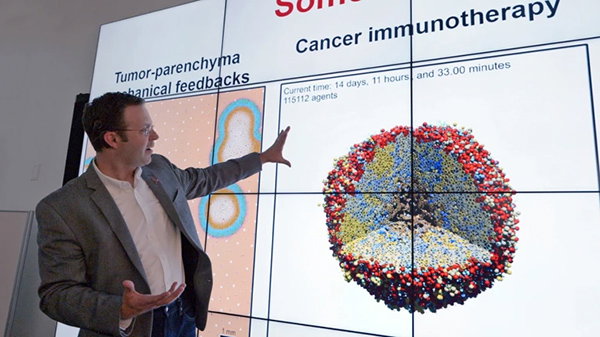
| Engineer Paul Macklin (pictured above) and his team have spent more than a decade developing open-source software called PhysiCell to simulate the interactions between tumour and immune cells. The next phase is to create ‘virtual cells’ that can respond to their environment, but it’s a complex task that will require even more data to predict dynamic changes. (Nature | 13 min read) (Photo courtesy of Indiana University) | |||||
Quote of the week“I wanted to keep contributing, even in my darkest hour.”Richard Scolyer, a pathologist and melanoma researcher, has died aged 59 after being diagnosed with glioblastoma in 2023. Scolyer was the first person to trial an experimental brain cancer treatment based on his own melanoma research. His final words have been published in an open letter. (ABC News | 8 min read) |
|||||
|
|
|||||
|
|||||
|
|
|||||
Free newsletters from NatureWant more? Update your preferences to sign up to our other Nature Briefing newsletters:
|
|||||
|
|||||
|
You received this newsletter because you subscribed with the email address: - Please add [email protected] to your address book. Enjoying this newsletter? You can use this form to recommend it to a friend or colleague — thank you! Had enough? To unsubscribe from this Briefing, but keep receiving your other Nature Briefing newsletters, please update your subscription preferences. To stop all Nature Briefing emails forever, click here to remove your personal data from our system. Fancy a bit of a read? View our privacy policy. Forwarded by a friend? Get the Briefing straight to your inbox: subscribe for free. Get more from Nature: Register for free on nature.com to sign up for other newsletters specific to your field and email alerts from Nature Portfolio journals. Nature Portfolio | The Springer Nature Campus, 4 Crinan Street, London, N1 9XW, United Kingdom Nature Portfolio, part of Springer Nature. |