Climate-friendly coffee: brewing more with less
What matters in science |

Is this your brand on Milled? Claim it.
|
|||||
|
|||||
|
Hello Nature readers, |
|||||
|
|||||
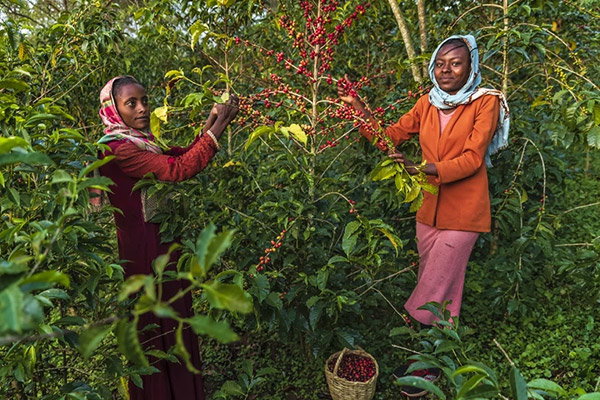
| Ethiopia is the homeland of arabica coffee (Coffea arabica). (hadynyah/Getty ) | |||||
How to brew a climate-friendly cuppaResearchers are racing to save the engine of scientific discovery — coffee — from the effects of climate change and preserve the livelihoods of farmers who grow the cash crop. Efforts vary from improving the resilience of the two main species, to experimenting with relatives in the Coffea genus, to squeezing more coffee out of current crops with clever chemistry tricks. Nature | 8 min read |
|||||
Chaos-courting pigeons break all the rulesPigeons live at “the edge of chaos” to maintain their legendary flexibility and adaptability, suggests new research. Scientists presented common pigeons (Columba livia) with five colourful buttons, and pecking any sequence of five resulted in a tasty reward. Despite cutting down the number of sequences they used, the birds never fully gave up on trying new versions, and their favourites fell in and out of favour. The findings run counter to ‘Thorndike’s Law of Effect’ — proposed by psychologist Edward Thorndike in 1905 — that rewarded behaviours become more frequent and less variable. Scientific American | 6 min readReference: Journal of Experimental Psychology: Animal Learning and Cognition paper |
|||||
|
|||||
|
|||||
|
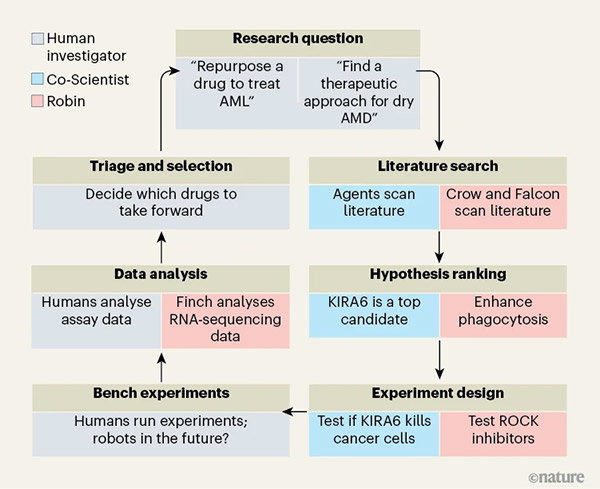
Computational biologist Olivier Elemento explores two new papers that test how scientific discovery can be aided by multi-agent AI tools — systems consisting of several autonomous AI agents that cooperate to solve complex problems. ‘Co-Scientist’ proposed that a small molecule called KIRA6 could be repurposed to treat acute myeloid leukaemia (AML) by selectively killing cancer cells. ‘Robin’, which uses three agents (Crow, Falcon and Finch), proposed that drugs called ROCK inhibitors could treat the eye disease dry age-related macular degeneration (dry AMD) by boosting a cellular process called phagocytosis, and analysed the resulting data. (Nature News & Views | 11 min read) Reference: Nature paper |
|||||
|
|||||
How ticks make people allergic to meatIn the United States, the range of lone star ticks (Amblyomma americanum) is expanding, and they carry diseases — such as alpha-gal syndrome, which makes people allergic to red meat. In Australia, the same goes for Ixodes holocyclus, known as the paralysis tick because it injects a potent neurotoxin. The scientists working with these ticks sometimes put their own bodies on the line: when allergist and immunologist Thomas Platts-Mills was investigating why a certain cancer drug was suddenly causing reactions in some patients, he tracked the progress of his own tick-induced allergy. “He came in with the ticks in a Tupperware container,” says his colleague Jake Hosen. “And he said, ‘Draw my blood! Draw my blood!’” The New Yorker | 47 min read (intermittent paywall) |
|||||
The messy, beautiful path to discoveryA new documentary called The Endless Frontier “lingers on the everyday realities” that illustrate “the iterative, often frustrating nature of fundamental research”, writes Nature reporter Max Kozlov in his review. The film was conceived as an exploration of how scientists conduct the fundamental research that underpins crucial advances, but the tumult in US science that has been unleashed by the Trump administration has given it a fresh urgency. “The striking refusal of the film to romanticize the scientific process means that viewers get a rare glimpse into the grind it takes simply to keep a laboratory afloat,” Kozlov says. Nature | 8 min read |
|||||
AI tools for neurodiverse young scientistsAccommodations for neurodivergent students often focus on aspects such as the time needed to take exams. But “in our experience, the biggest barriers to succeeding in academia and research are associated with communication, interpersonal relationships and ambiguous expectations”, write engineering dean Marisa Chrysochoou and astrophysicist Keivan Stassun, the director of the Frist Center for Autism and Innovation. The authors explore how generative AI tools can support students with those aspects of their scientific careers — and the drawbacks. Nature | 10 min read |
|||||
Living the good life, naturally“My field of ecology teaches us that human lives are not merely supported by nature: they are entangled with it, emerge from it, are enmeshed in it, nourished by it, and dependent on it in countless ways, from local to planetary,” writes Yadvinder Malhi in an exploration of how to better integrate this fundamental truth into our measures of human success. Last year, Mahli and colleagues proposed to achieve just that with the ‘Nature Relationship Index’, which the UN will report annually, starting in later this year. “We believe flourishing is possible for both us and the nonhuman natural world,” he writes. Aeon | 19 min readReference: Nature paper (from 2025) |
|||||
Quote of the day“The library is being burned … before the books can be read.”There could be as many as 20 million species of insect living on Earth, according to new estimates. But climate change threatens to drive swathes of them to extinction before they can be formally described, says entomologist Darko Cotoras. (Science | 5 min read) |
|||||
|
|
|||||
|
|||||
|
|
|||||
Free newsletters from NatureWant more? Update your preferences to sign up to our other Nature Briefing newsletters:
|
|||||
|
|||||
|
You received this newsletter because you subscribed with the email address: - Please add [email protected] to your address book. Enjoying this newsletter? You can use this form to recommend it to a friend or colleague — thank you! Had enough? To unsubscribe from this Briefing, but keep receiving your other Nature Briefing newsletters, please update your subscription preferences. To stop all Nature Briefing emails forever, click here to remove your personal data from our system. Fancy a bit of a read? View our privacy policy. Forwarded by a friend? Get the Briefing straight to your inbox: subscribe for free. Want to master time management, protect your mental health and brush up on your skills? Sign up for our free short e-mail series for working scientists, Back to the lab. Get more from Nature: Register for free on nature.com to sign up for other newsletters specific to your field and email alerts from Nature Portfolio journals. Would you like to read the Briefing in other languages? 关注Nature Portfolio官方微信订阅号,每周二为您推送Nature Briefing精选中文内容——自然每周简报。
Nature Portfolio | The Springer Nature Campus, 4 Crinan Street, London, N1 9XW, United Kingdom Nature Portfolio, part of Springer Nature. |