CRISPR enzyme kills cancer cells by shredding their DNA
What matters in science |

Is this your brand on Milled? Claim it.
|
|||||
|
|||||
|
Hello Nature readers, |
|||||
|
|||||
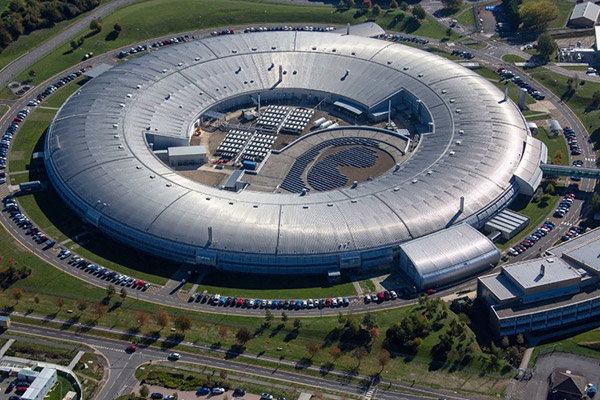
| The Diamond Light Source — the UK’s national synchrotron facility, shown here — is one of many sites funded by the UK Science and Technology Facilities Council. (David Goddard/Getty) | |||||
UK physics facilities face existential choiceAmid overhauls to UK public research funding, physics facilities run by the UK Science and Technology Facilities Council (STFC) have been told to obtain commercial funding to continue their operations, or risk closure. The UK government’s funding plan sees STFC’s core budget remain flat up to 2030, but with cuts to the funding of individual institutions within that to free up money for the rising costs, such as grants, for postdoctoral researchers. STFC has received a one-off injection of £135 million to enable facilities to stay open long enough to find extra income to cover the shortfalls. Among the sites at risk looks to be the UK’s Jodrell Bank Observatory and its iconic Lovell radio telescope. Nature | 7 min read & Research Professional News |
|||||
CRISPR enzyme acts as DNA shredderAn unusual CRISPR enzyme can cause cancer cells to self-destruct by shredding their DNA. The protein — Cas12a2, a variant of the usual Cas protein found in CRISPR systems — can be ‘trained’ to recognize a specific RNA sequence made by cancer cells. Once the enzyme finds its partner, it begins to slash the cell’s genome to pieces. Researchers hope that this seek-and-destroy approach could be used to kill tumours that express mutant proteins that have been difficult to target using conventional medicines. “This is basically a programmable chemotherapy,” says molecular biologist Yang Liu. Nature | 6 min readReference: Nature paper 1 & paper 2 |
|||||
The town heated by one big batteryThe small town of Pornainen, in Finland, is now heated by the world’s largest commercial ‘sand battery’ — in this case, a 13-metre-tall silo filled with 2,000 tonnes of crushed soapstone. The battery is warmed up with electricity that is generated by renewable sources when they are plentiful. A full charge of the battery could heat the town for a week in winter or up to a month in summer. “You don’t need rare earths, critical raw materials and the beauty is you can also charge up the battery when the electricity is cheap,” says energy-policy researcher Jan Rosenow. “And you can store it for long periods, not just two hours or four hours like lithium-ion batteries, but potentially for days and maybe even weeks.” CNBC | 9 min read |
|||||
A new blueprint for US scienceThe administration of US President Donald Trump has unveiled the first research projects that will be funded by its Genesis Mission, which aims to encourage the use of AI to accelerate discoveries in areas ranging from improving the US power grid to automating laboratories. It also unveiled a report called Science: A New Golden Age that proposes substantial, and controversial, changes to federally funded research. In the report, Michael Kratsios, chief science adviser to Trump, calls for shifting US science funding away from “legacy institutions” such as universities. Nature | 10 min read |
|||||
|
|||||
A call for ‘evolutionary thinking’In Force of Nature, biologist and legal scholar Owen Jones argues that an understanding of evolution through natural selection can inform humans’ interactions with their environment and with each other. Applying the principles of natural selection can improve medical treatments, social policies and crop yields, Jones suggests. There are cracks in some aspects of this argument, writes social scientist Jonathan Goodman in his review. But the book “makes an excellent case for the need for evolutionary thinking” in these fields, he says. Nature | 7 min read |
|||||
MAHA health claims under the microscopeUS health secretary Robert F. Kennedy Jr’s Make America Healthy Again (MAHA) programme contains some solid recommendations, mixed with a big dose of others that are based on weak or insufficient evidence, say health researchers. At worst, the MAHA platform includes policies that are harmful — for example, by reducing the slate of routine vaccines for children. Nature | 15 min read |
|||||
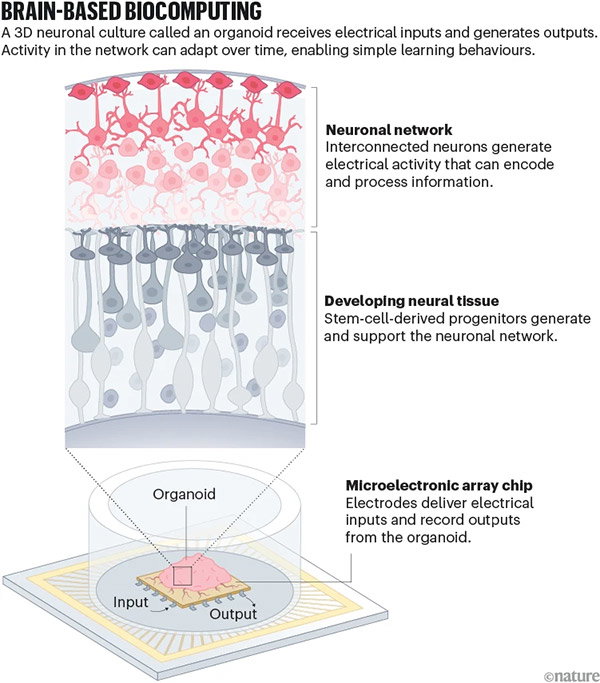
Biocomputing ignores a major ethical issueEfforts to build computers that integrate human brain tissue rely on donated cells. But donors aren’t asked what kind of research they’d like their cells to be used for, which makes using their tissue in biocomputing research ethically grey, argue a group of bioethicists, neuroscientists and engineers. Donors should be asked for their explicit consent to use their cells in biocomputers, which could have commercial uses, and cell lines for which consent was given only for biomedical uses should be excluded from such research, the group writes. Nature | 10 min read |
|||||
|
|||||
| Integrating cultures of brain cells into computers could circumvent the physical limitations of conventional silicon-based computing hardware. | |||||
Quote of the day“It starts off as a cute little white cloud.”Wildfire researcher Jean-Baptiste Filippi explains the science behind pyrocumulonimbus clouds: huge storm clouds, powered by the heat of fires, that generate wind and lightning, and exacerbate dangerous conditions. The clouds are now being seen in France and Spain, where more than 320,000 people have been evacuated as wildfires continue to spread. (France 24 | 4 min read) |
|||||
|
|
|||||
|
|||||
|
|
|||||
Free newsletters from NatureWant more? Update your preferences to sign up to our other Nature Briefing newsletters:
|
|||||
|
|||||
|
You received this newsletter because you subscribed with the email address: - Please add [email protected] to your address book. Enjoying this newsletter? You can use this form to recommend it to a friend or colleague — thank you! Had enough? To unsubscribe from this Briefing, but keep receiving your other Nature Briefing newsletters, please update your subscription preferences. To stop all Nature Briefing emails forever, click here to remove your personal data from our system. Fancy a bit of a read? View our privacy policy. Forwarded by a friend? Get the Briefing straight to your inbox: subscribe for free. Want to master time management, protect your mental health and brush up on your skills? Sign up for our free short e-mail series for working scientists, Back to the lab. Get more from Nature: Register for free on nature.com to sign up for other newsletters specific to your field and email alerts from Nature Portfolio journals. Would you like to read the Briefing in other languages? 关注Nature Portfolio官方微信订阅号,每周二为您推送Nature Briefing精选中文内容——自然每周简报。
Nature Portfolio | The Springer Nature Campus, 4 Crinan Street, London, N1 9XW, United Kingdom Nature Portfolio, part of Springer Nature. |