CRISPR used to engineer precision in vivo CAR T cells
What matters in cancer research |

Is this your brand on Milled? Claim it.
|
|||||
|
|||||
|
Hello Nature readers, |
|||||

|
|||||
| Editing DNA to create CAR T cells must be highly targeted; harmful mutations or immune resistance can develop if reproductive cells or tumour cells are accidentally edited. (Ruslanas Baranauskas/SPL) | |||||
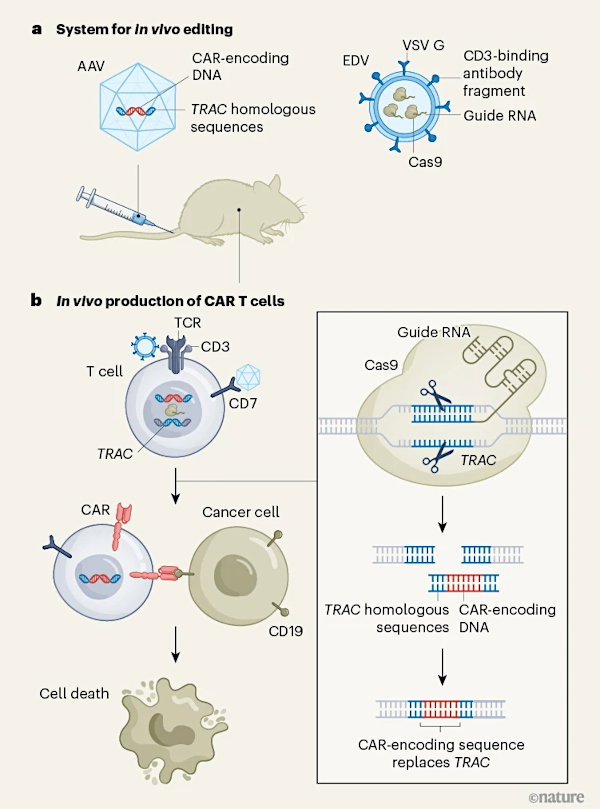
Greater precision for in vivo CAR TResearchers have invented a two-vector system that uses CRISPR–Cas9 gene editing to create in vivo cancer-fighting CAR T cells without accidentally targeting other cells. Leukaemia and multiple myeloma were eliminated in the mice treated with these precision in vivo CAR T cells, while more than half of mice with sarcoma went into remission. Biotech company Azalea Therapeutics is testing the approach in monkeys and hopes to trial the treatment in people by the end of next year. Nature | 5 min readGo into more depth with this article by cancer researchers Robert Holt and Laura Evgin (9 min read) Reference: Nature paper (18 March) |
|||||
|
|||||
| Previous efforts to create in vivo CAR T cells have involved viral vectors (that sometimes accidentally edit ‘bystander’ cells using retroviral transduction) or lipid nanoparticles (which deliver mRNA to T cells, creating transient expression of the CAR protein). To specifically target and permanently edit T cells, the team used two vectors: a CRISPR-Cas9 gene-editing system inside ‘enveloped delivery vehicles’, and viruses that transported the DNA coding for the CAR protein. (Nature News & Views | 9 min read) | |||||
|
|||||
Ageing drives metastasis in lung cancerAs mice age, their cells become stressed, and levels of a protein called ATF4 increase, helping lung cancer to spread. Targeting this pathway using genetic edits or drugs limits the spread of tumours. Lung cancer is most commonly diagnosed in older people aged 65-75 but researchers typically rely on young mice to develop therapies for the disease. “This age disconnect between experimental models and patients may explain why many cancer therapies that perform well preclinically, such as with glutaminase inhibitors, have failed to translate their efficacy in clinical trials,” write the authors. Reference: Nature paper (11 March) |
|||||
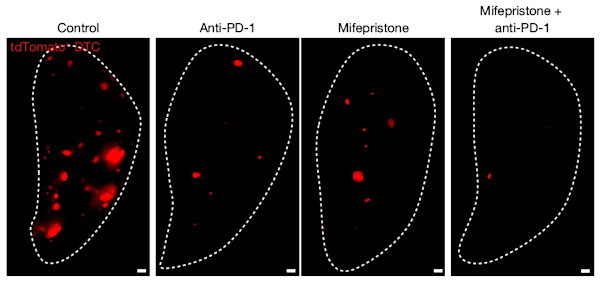
How breast cancer blocks immune cellsBreast cancer cells can spread to the lungs by resisting attack from immune cells — a process that involves a stress response that activates the glucocorticoid receptors. In mice with triple-negative breast cancer, researchers found that blocking these receptors using a drug called mifepristone in combination within immunotherapy reduced the spread of breast cancer and extended the lifespan of mice. Stress hormones can be chronically elevated in people with advanced breast cancer, either because of prolonged stress and pain associated with the diagnosis or because of use of synthetic glucocorticoids as anti-inflammatory treatments. This study suggests that both of these factors could drive cancer progression. Reference: Nature paper (4 March)Read more from the authors in their Research Briefing (6 min read) |
|||||
|
|||||
| Mice given a drug called mifepristone, which blocks glucocorticoid receptors, and the immunotherapy anti-PD-1 had fewer metastatic breast cancer cells growing in their lungs than control mice. (Cassandras, M., Sanchez, X., Hsu, L. et al./Nature) | |||||
Tumour cells in the blood guide treatmentPeople with head and neck cancer are around 40% more likely to survive without a relapse over three years if the frequency and dosage of their chemoradiotherapy is guided by their circulating tumour DNA levels than if it is not. This dynamic therapy “could be a promising strategy to improve survival, challenging the conventional fixed-course, static treatment approach,” report the authors. Reference: Nature paper (11 March)Read more in Nature Clinical Briefing (5 min read) |
|||||
Herding is hoardingThe money and time invested in clinical trials for cancer drugs called TIGIT inhibitors would be better spent investigating a broad range of drug types, argue health-policy researchers Emily Zhang and Leeza Osipenko and biologist John Hickman. More than US$3 billion has been spent by 21 competing companies on TIGIT inhibitor clinical trials, involving nearly 49,000 people. But it is unlikely that these medications will receive approval, given that 95% of oncology drugs fail in clinical trials. This race to develop TIGIT inhibitors is a case of ‘herding’, where conformity is preferred to diversification, they write. “The risks of drug toxicity in ineffective clinical trials of this magnitude have raised moral questions concerning the role of patients in such trials,” write the authors. Reference: BMJ Oncology paper (12 February) |
|||||
|
|||||
Quote of the week“Strength … is found instead in staying present within a life that no longer fits the frantic success stories we are sold.”Living with stage four lung cancer has been a “merciless reorientation from a life of ‘doing’ into a life of ‘being’”, where quiet moments of fulfilment are the goal, writes Janis Chen. (The Guardian | 14 min read) |
|||||
|
|
|||||
|
|||||
|
|
|||||
Free newsletters from NatureWant more? Update your preferences to sign up to our other Nature Briefing newsletters:
|
|||||
Access Nature and 54 other Nature journals
Nature+ is our most affordable 30-day subscription, giving you online access to a wide range of specialist Nature Portfolio journals, including Nature. |
|||||
|
|||||
|
You received this newsletter because you subscribed with the email address: - Please add [email protected] to your address book. Enjoying this newsletter? You can use this form to recommend it to a friend or colleague — thank you! Had enough? To unsubscribe from this Briefing, but keep receiving your other Nature Briefing newsletters, please update your subscription preferences. To stop all Nature Briefing emails forever, click here to remove your personal data from our system. Fancy a bit of a read? View our privacy policy. Forwarded by a friend? Get the Briefing straight to your inbox: subscribe for free. Get more from Nature: Register for free on nature.com to sign up for other newsletters specific to your field and email alerts from Nature Portfolio journals. Nature Portfolio | The Springer Nature Campus, 4 Crinan Street, London, N1 9XW, United Kingdom Nature Portfolio, part of Springer Nature. |