CRISPR’s next act: editing the epigenome to treat disease
What matters in science |

Is this your brand on Milled? Claim it.
|
|||||
|
|||||
|
Hello Nature readers, |
|||||

|
|||||
| Cologne, Germany is among the European cities grappling with intensifying heat waves. (Ina Fassbender/AFP via Getty) | |||||
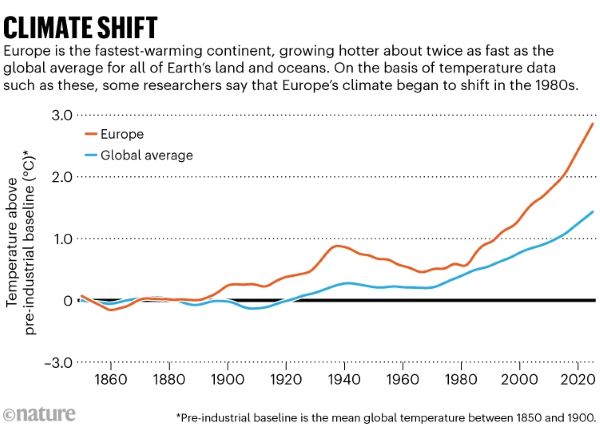
Does Europe have a new climate?A record-breaking heat wave is baking Europe, hot on the heels of unprecedented temperatures in May. “Heatwaves are here to stay, until we turn the tap off to global emissions,” says Samantha Burgess, deputy director of Europe’s Copernicus Climate Change Service. “They’re more frequent, they’re more intense and they’re lasting longer.” Europe is heating up twice as fast as the global average, and scientists are trying to understand the complex factors that will determine whether this year’s sweltering heat should be considered ‘the new normal’. Nature | 7 min read |
|||||
|
|||||
China’s LineShine is top supercomputerA Chinese supercomputer called LineShine has shot to the top of the world’s fastest computers list — the first China-based system to achieve this ranking in almost a decade. LineShine combines conventional computer processing with artificial-intelligence capabilities, but doesn’t use graphics processing units (GPUs), the chips that are usually required to handle the concurrent calculations needed for AI computation. Instead, the machine draws its computing power from 14 million processing cores, including specialized units to shoulder some of the burden of calculations that usually require GPUs. Nature | 5 min read |
|||||
Scientists in Germany raise alarm about AfDScientists are raising the alarm about proposals from the ascendent far-right political party Alternative for Germany (AfD) that they say could severely limit academic freedoms at German universities and research institutes. For example, in Saxony-Anhalt — where recent polls have seen the party’s support exceed 40% — the AfD’s manifesto proposes sweeping reforms to the state’s university system. “The AfD’s election programme explicitly proposes restrictions on, or even the prohibition of, research in certain fields,” and constrains the mobility of researchers in and out of the state, says Bettina Rockenbach, president of the German National Academy of Sciences Leopoldina, which has its headquarters in the state. Nature | 7 min read |
|||||
Political screening is stalling NIH grantsHundreds of grant applications to the US National Institutes of Health (NIH) are being held up at any given time by unprecedented scrutiny after peer review. Some have been flagged by an algorithm for using terms, such as ‘gender’ and ‘climate change’, that have been deemed not to conform with the priorities of the administration of US President Donald Trump. These new layers of review have delayed delivery of funds, and have even resulted in the outright rejection of some applications that had been approved by outside and agency scientists — a situation unheard of before 2025, officials say. Nature | 11 min read |
|||||
|
|||||
CRISPR’s next act: editing the epigenomeA handful of start-up firms are testing therapies that target specific epigenetic markers — essentially chemical groups that sit on DNA and the proteins that it is wound around — to treat everything from high cholesterol to a rare muscular disorder. Changing these chemical markers can switch genes on or off. Some existing medications influence epigenetic markers, but these drugs act broadly and lack specificity. A new cadre of scientists has found ways to precisely alter the epigenetic signals that influence specific genes. Nature | 15 min read |
|||||
DoE science chief says to keep an open mindDarío Gil is the science chief at the US Department of Energy (DoE), presiding over two of the Trump administration’s prized fields: artificial intelligence and quantum science. But he’s also got the unenviable task of convincing scientists that these fields deserve the massive investments they are receiving — at a time when researchers are worried about securing funding for basic research and losing jobs to AI. “I haven’t moved one dollar” between disciplines, Gil tells Nature. “All I am asking is that if you’re doing biology, can you please explore carefully and thoughtfully the implications of this computing revolution for biology?” Nature | 8 min read |
|||||
Zombie forest fires burn all winterIn the vast taiga forest that encircles the far north, ‘zombie’ forest fires can lie dormant all winter, even under snow, and break out when the weather warms. The fires tend to eat away at root systems and collapse large swathes of trees, making them obvious from above — allowing researchers to study them from satellite images. They found that overwintering fires are on the rise, which will mean more summer fires and tougher, zombie-scarred terrain in which to fight them. The good news is that forest areas burned by these zombies do seem to be able to bounce back, although the mix of tree species changes. Sierra | 7 min readReference: International Journal of Wildland Fire paper |
|||||
How to beat the keeper (at work)When elite football players face the do-or-die pressure of a penalty shootout, they rely on preparation, a good coach and the emotional support of their teammates, writes Geir Jordet, a researcher in sport psychology. The rest of us can learn a lesson from their coping strategies, he says. “Rely on a colleague to give you a warm introduction when you speak at an event and ensure that a buddy greets you after a tough situation, regardless of how things went.” Nature | 7 min read |
|||||
Quote of the day“The generative AI rediscovers the classic Big Mac without explicit supervision and generates novel burgers optimized for deliciousness, sustainability, or nutrition.”Nutrition researchers and engineers trained an AI model on the ingredient combinations and quantities in various burgers, and it came up with a recipe similar to a fast-food favourite. (The Big Mac was not part of the initial training data). It also invented healthier and more sustainable burgers, and two that humans judged to be tastier than the ubiquitous McDonald’s product. (Reference: npj Science of Food paper) |
|||||
|
|
|||||
|
|||||
|
|
|||||
Free newsletters from NatureWant more? Update your preferences to sign up to our other Nature Briefing newsletters:
|
|||||
|
|||||
|
You received this newsletter because you subscribed with the email address: - Please add [email protected] to your address book. Enjoying this newsletter? You can use this form to recommend it to a friend or colleague — thank you! Had enough? To unsubscribe from this Briefing, but keep receiving your other Nature Briefing newsletters, please update your subscription preferences. To stop all Nature Briefing emails forever, click here to remove your personal data from our system. Fancy a bit of a read? View our privacy policy. Forwarded by a friend? Get the Briefing straight to your inbox: subscribe for free. Want to master time management, protect your mental health and brush up on your skills? Sign up for our free short e-mail series for working scientists, Back to the lab. Get more from Nature: Register for free on nature.com to sign up for other newsletters specific to your field and email alerts from Nature Portfolio journals. Would you like to read the Briefing in other languages? 关注Nature Portfolio官方微信订阅号,每周二为您推送Nature Briefing精选中文内容——自然每周简报。
Nature Portfolio | The Springer Nature Campus, 4 Crinan Street, London, N1 9XW, United Kingdom Nature Portfolio, part of Springer Nature. |