‘Cyborg’ cockroaches breathe underwater with printed suit
What matters in science |

Is this your brand on Milled? Claim it.
|
|||||
|
|||||
|
Hello Nature readers, |
|||||
|
|||||
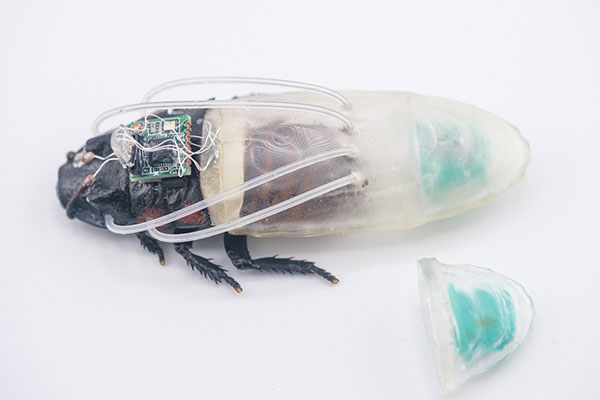
| Remote-controlled insects could be used in search and rescue missions to explore dangerous areas or rubble that humans can’t access, researchers hope. (NTU Singapore) | |||||
‘Cyborg’ cockroaches go divingResearchers have equipped ‘cyborg’ cockroaches with diving suits that enable the insects to breathe underwater. These Madagascar hissing cockroaches (Gromphadorhina portentosa) have electrodes attached to their brains and sensory organs that allow researchers to remotely control their movements. The new 3D-printed suits attach tubes to the insects’ breathing holes, called spiracles, that connect to a chemical oxygen generator. In underwater tests, the roaches could explore a variety of underwater terrain and traverse obstacles for up to three hours at speeds similar to those they could move at on land. Popular Science | 6 min readReference: Nature Communications paper |
|||||
Synthetic cell mimics some elements of lifeResearchers have created an entirely synthetic cell that can feed, grow and reproduce. Dubbed ‘SpudCells’, the tiny blobs aren’t technically alive, but can perform some of the chemical reactions seen in living cells. “It’s a cell that was built, not born. It’s constructed, but it does what cells do,” says synthetic biologist Drew Endy. Scientists hope that humanmade cells like these can reveal secrets such as how many genes a cell needs to survive, or be engineered to produce compounds that natural cells can’t make. The New York Times | 8 min readReference: biotic preprint (not peer reviewed) |
|||||
Fake cancer studies attract citationsCancer research papers that appear to have been produced by paper mills — businesses that produce and sell low-quality or fraudulent manuscripts — garner double the citations than do genuine articles in the field. The problem appears to be self-propagating: in an analysis of tens of thousands of papers, researchers found that papers that were probably produced by paper mills frequently cite, or are cited by, other potentially fraudulent articles. This distortion of citations might also inflate the impact metrics of journals in molecular oncology, says statistician and study co-author Adrian Barnett. Nature | 6 min readReference: bioRxiv preprint (not peer reviewed) |
|||||
|
|||||
Recognize bias to build trust in scienceScientists need to acknowledge their own political biases to avoid eroding public trust in science, argues Mark Henderson, director of corporate affairs at the charitable foundation Wellcome. The scientific community can’t assume public support for their positions and should take care to ensure that science isn’t equated with membership in a wider liberal or progressive project. “If respect for science is bundled with wider political identity, people with more conservative values might feel pushed to reject science along with the politics,” Henderson writes. Nature | 6 min read |
|||||
The coral that defies the oddsIn the waters of the Port of Miami, Florida, a community of coral is thriving — seemingly against all odds. Growing on hard materials such as concrete blocks and dumped shopping trolleys, the coral have stood strong in the face of disease, drastic swings in temperature and pollution that have caused bleaching in other Florida coral populations. The coral in the busy waters of the port are only a few decades old, and scientists think that human activity in the area could be what’s equipping these species with their unusual survival mechanisms. Now researchers are trying to work out how. bioGraphic | 9 min read |
|||||
Can Rwanda sustain its scientific rise?In The Political Economy of Rwanda’s Rise, economist Pritish Behuria details Rwanda’s bold attempt to transform its economy after the 1994 genocide. The nation has made impressive gains in health systems, technology and governance, but that has yet to translate into an industrial economy, Behuria writes. The book “is about much more than Rwanda”, says science writer Abdullahi Tsanni in his review. It “offers an important lesson: growth is not the same as transformation, and technological capability remains extremely difficult for nations to build”. Nature | 7 min read |
|||||
Quote of the day“I don’t know what the point of the comment period was if you’re just going to ignore the comments.”The US Department of Agriculture is moving ahead with plans to close the Beltsville Agricultural Research Center, one of its largest scientific campuses. The decision comes despite overwhelming opposition to the idea from scientists during a two-month public comment period, says retired cow geneticist Paul VanRaden. (Science | 5 min read) |
|||||
|
|
|||||
|
|||||
|
|
|||||
Free newsletters from NatureWant more? Update your preferences to sign up to our other Nature Briefing newsletters:
|
|||||
|
|||||
|
You received this newsletter because you subscribed with the email address: - Please add [email protected] to your address book. Enjoying this newsletter? You can use this form to recommend it to a friend or colleague — thank you! Had enough? To unsubscribe from this Briefing, but keep receiving your other Nature Briefing newsletters, please update your subscription preferences. To stop all Nature Briefing emails forever, click here to remove your personal data from our system. Fancy a bit of a read? View our privacy policy. Forwarded by a friend? Get the Briefing straight to your inbox: subscribe for free. Want to master time management, protect your mental health and brush up on your skills? Sign up for our free short e-mail series for working scientists, Back to the lab. Get more from Nature: Register for free on nature.com to sign up for other newsletters specific to your field and email alerts from Nature Portfolio journals. Would you like to read the Briefing in other languages? 关注Nature Portfolio官方微信订阅号,每周二为您推送Nature Briefing精选中文内容——自然每周简报。
Nature Portfolio | The Springer Nature Campus, 4 Crinan Street, London, N1 9XW, United Kingdom Nature Portfolio, part of Springer Nature. |