Fake cancer papers get more citations
What matters in cancer research |

Is this your brand on Milled? Claim it.
|
|||||
|
|||||
|
Hello Nature readers, |
|||||

|
|||||
| Short bouts of physical activity could prevent chronic inflammation and other metabolic responses associated with prolonged sitting. (Phynart Studio/Getty) | |||||
Get up every 30 mins to lower cancer riskPeople who sit for long periods of time without short breaks might be at greater risk of cancer death. In a 12-year follow up of more than 90,000 people who wore a movement tracker for a week, each additional hour per day of uninterrupted sedentary behaviour increased the risk of cancer death by 10%. However, every additional hour that included a few minutes of physical activity every 30 minutes decreased the risk of cancer death by 19%. “Breaking up your sitting time with something as simple as a short walk could be protective,” says public health researcher and co-author Frederick Ho. The Guardian | 3 min readReference: PLOS Medicine paper (2 July) |
|||||
Fake cancer studies attract citationsCancer research papers that appear to have been produced by paper mills — businesses that produce and sell low-quality or fraudulent manuscripts — garner double the citations than do genuine articles in the field. The problem appears to be self-propagating: in an analysis of tens of thousands of papers, researchers found that papers that were probably produced by paper mills frequently cite, or are cited by, other potentially fraudulent articles. This distortion of citations might also inflate the impact metrics of journals in molecular oncology, says statistician and study co-author Adrian Barnett. Nature | 6 min readReference: bioRxiv preprint (26 May, not peer reviewed) |
|||||
|
|||||
Liver fat makes bowel cancer spread worsePeople with excess fat in their liver, such as those with a history of alcohol-use disorder or metabolic disease, are more likely to develop an aggressive, treatment-resistant form of metastatic colorectal cancer than people with normal levels of liver fat. In people with colorectal cancer without fatty liver disease, metastases tend to remain ‘encapsulated’ and separate from healthy liver tissue. But in people with fatty liver disease, ‘replacement’ metastases infiltrate liver tissue, dropping their five-year survival rate from 73% to 44%. There are no approved drugs that target ‘replacement’ metastases but, in mice, these cancer cells responded to an MYC inhibitor that is currently in a clinical trial. Reference: Nature paper (1 July)Go deeper with this Research Briefing by the authors (6 min read) |
|||||
Early results for kidney cancer drugCasdatifan, a drug that inhibits the transcription factor HIF-2a, has been safely tested in people with pre-treated metastatic kidney cancer. People whose blood showed signs of greater HIF-2α inhibition after treatment were more likely to benefit, with higher response rates and longer progression-free survival. Reference: Nature paper (1 July) |
|||||
TROP2 drives the spread of cancerColorectal cancer is more likely to spread if tumour cells express large amounts of a surface protein called TROP2. In an analysis of more than 1,300 people with advanced colorectal cancer, those with high TROP2 expression had shorter disease-free survival than those with low TROP2 expression. Chemotherapy promoted the growth of TROP2-expressing cancer cells but combining chemotherapy with a TROP2-directed antibody–drug conjugate helped keep colorectal cancer under control in mice. Reference: Nature paper (1 July) |
|||||
|
|||||
Behind-the-scenes of the BRCA1 discoveryGeneticist Andrew Futreal worked “with literally few to no breaks for four years” in the lead up to the discovery of the breast cancer gene BRCA1 in 1994. “There was shouting, bits of subterfuge, heated discussions, and, at all times, very passionate and talented people in teams all working non-stop to find this gene,” he recalls. His team wrote two manuscripts in a matter of days and were then whisked to Washington D.C. to announce the discovery. “There were incendiary faxes, rancor, and, soon, scientific credit disputes driven by patent lawyers,” says Futreal. “But the BRCA1 gene was identified, and it was a beast of a gene in its size and complexity.” Nature Genetics | 10 min read |
|||||
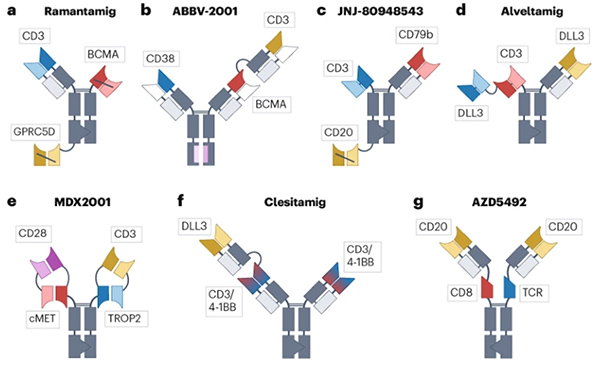
Many-armed cancer drugsSince 2014, the US Food and Drug Administration has approved nine ‘bispecific’ drugs that bind to two targets: a cancer antigen and an immune cell. Now, pharmaceutical giants Johnson & Johnson, AbbVie, Amgen and AstraZeneca are investing billions of dollars into drugs called multispecific T-cell engagers that interact with three or more targets. “It’s an exciting time,” says Gary Nabel, the CEO at ModeX Therapeutics, a company that develops multispecific-antibodies. Nature Reviews Drug Discovery | 14 min read |
|||||
|
|||||
| Multispecific T-cell engagers can attack cancers that have two or more types of antigens, potentially making them more effective at killing heterogeneous or drug-resistant tumours. | |||||
Legal decisions aren’t scientific findingsThe US Supreme Court recently ruled that Roundup lawsuits can’t be won under state failure-to-warn laws because federal regulators haven’t labelled the weedkiller as carcinogenic. But legal decisions like this one cannot settle the scientific question of whether Roundup causes cancer and shouldn’t be represented as having done so by the media, writes epidemiologist Alex Smolak. “Public confusion arises when those situations are collapsed into one category,” Smolak writes. “Public trust will keep eroding if every legal outcome is treated as though it were a scientific finding.” STAT | 7 min read |
|||||
|
|||||
|
|||||
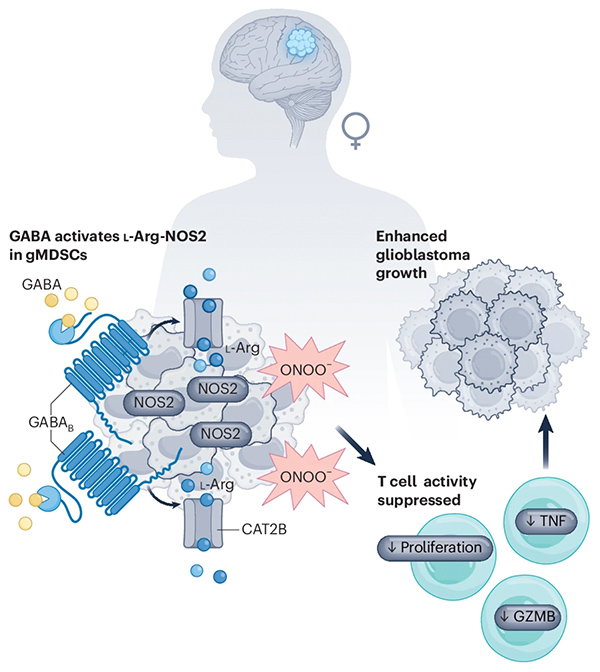
| A neurotransmitter called GABA enhances the growth of glioblastoma in female mice by activating monocyte-derived suppressor cells (MDSCs), which then suppress the activity of T cells. A similar pathway exists in women with glioblastoma, suggesting that blocking GABA signalling could be a treatment option. (Nature News & Views | 6 min read) Reference: Nature Cancer paper (23 June) (McDonald, M.F. & Deneen, B./Nat. Cancer) | |||||
Quote of the week“Even a simple heart emoji if they thought of me was enough to make my day.”When Poppy Bilderbeck lost her mother to pancreatic cancer in her mid-20s, her friends deserted her. Some people don’t know what to say and others have busy lives, but even small gestures can make a big difference, she says. (The Times | 9 min read, paywall) |
|||||
|
|
|||||
|
|||||
|
|
|||||
Free newsletters from NatureWant more? Update your preferences to sign up to our other Nature Briefing newsletters:
|
|||||
|
|||||
|
You received this newsletter because you subscribed with the email address: - Please add [email protected] to your address book. Enjoying this newsletter? You can use this form to recommend it to a friend or colleague — thank you! Had enough? To unsubscribe from this Briefing, but keep receiving your other Nature Briefing newsletters, please update your subscription preferences. To stop all Nature Briefing emails forever, click here to remove your personal data from our system. Fancy a bit of a read? View our privacy policy. Forwarded by a friend? Get the Briefing straight to your inbox: subscribe for free. Get more from Nature: Register for free on nature.com to sign up for other newsletters specific to your field and email alerts from Nature Portfolio journals. Nature Portfolio | The Springer Nature Campus, 4 Crinan Street, London, N1 9XW, United Kingdom Nature Portfolio, part of Springer Nature. |