Faster ageing might be driving early-onset cancers
What matters in cancer research |

Is this your brand on Milled? Claim it.
|
|||||
|
|||||
|
Hello Nature readers, |
|||||

|
|||||
| Cancer diagnoses are climbing globally, but there have also been some improvements in prevention efforts: tobacco use has declined 27% since 2010, and almost a third of girls have received the first dose of the HPV vaccine. (gorodenkoff/Getty) | |||||
Global cancers to rise in the coming decadesThe World Health Organization (WHO) has predicted that up to 35 million people could be diagnosed with cancer each year by 2050, up from around 21 million diagnosed in 2024. Factors such as an ageing population, alcohol consumption, obesity and screening improvements will likely drive cancer rates up 67% over the next two decades. Lower-income countries will be disproportionately affected because of poorer access to healthcare. “Far too many people are still being left behind,” says André Ilbawi, who leads the cancer control team at the WHO. The Washington Post | 5 min readReference: WHO report (8 July) |
|||||
Young people might be ageing fasterEarly-onset cancers might be increasing worldwide because younger people are ageing faster than older generations. Using data from more than 150,000 people in the UK Biobank, researchers found that the gaps between biological and chronological ages were larger in people born between 1965 and 1974 than those born between 1950 and 1954. This result was mirrored in a US cohort of more than 10,000 people. Over 15 years, people who biologically aged faster were more likely to be diagnosed with lung, gastrointestinal and uterine cancers at a younger age. “It is possible that [young people] are being exposed to new cancer-causing risks or that [our] defences to them are somehow altered,” says haematologist Jyoti Nangalia. LiveScience | 8 min readReference: Nature Medicine paper (22 June) Go into more depth with this Research Briefing by the authors (6 min read) |
|||||
Trained T cells help kids with deadly cancerFour children with terminal brain cancer are alive years after receiving an experimental therapy that boosts the number of immune cells that can recognize cancer proteins. Three of these kids have no evidence of disease. The treatment, called tumour-associated antigen T-cell therapy, was given to 33 children and young adults with newly diagnosed diffuse intrinsic pontine glioma (DIPG) or other treatment-resistant brain tumours. Kids with DIPG usually survive for less than a year after diagnosis but one child with this type of cancer survived for more than two years after treatment. Three further participants with other types of brain tumours were alive two, three and four years after receiving the T-cell therapy. New Scientist | 4 min readReference: Nature Medicine paper (30 June) |
|||||
Painless test accurately detects oral cancerA swab-based test that produces results within the hour could screen for oral cancer without people having to undergo a painful biopsy. The test “gives clinicians a rapid, accurate, and non-invasive way to triage patients, and crucially, it can be repeated,” says oral oncologist Muy-Teck Teh. Across 545 people given ‘brush biopsies’, the test was 95.5% accurate. ScienceAlert | 4 min readReference: Biomarker Research paper (23 June) |
|||||
Transplants for advanced lung cancerA study has challenged the idea that people with advanced lung cancer don’t benefit from lung transplants. All 17 people with lung-confined advanced cancer given a lung transplant were alive a year later, compared with half of the 81 people given other treatments. “This work changes what we can imagine for a highly selected group of patients who were previously considered beyond the reach of curative-intent intervention,” says thoracic surgeon and co-author Ankit Bharat. Reuters | 6 min readReference: JAMA paper (8 July) |
|||||
|
|||||
WHO publishes global breast cancer statsFor the first time, the World Health Organization has released breast cancer survival estimates across all 194 member states. The five-year survival was 42% in low-income countries and 88% in high-income countries. The authors call for “sustained initiatives to narrow gaps in access to diagnosis and treatment for breast cancer” to address these “profound global inequities”. Reference: Nature Medicine paper (8 July) |
|||||
Cancer worse for three years postpartumPregnancy is known to change breast tissue and make cancers more aggressive. But whether the effect lasts a few years or a decade has been debated. A study of 385 people with early breast cancer has now gone some way towards settling that debate, finding that people one to three years postpartum have a higher risk of recurrence than do people who gave birth more than three years before their cancer diagnosis. Reference: npj Breast Cancer paper (1 July) |
|||||
|
|||||
|
|||||
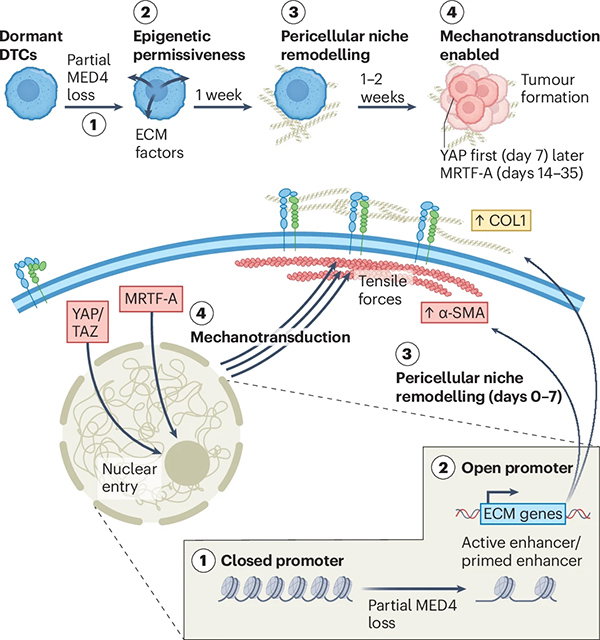
| The partial loss of a protein called MED4 inside dormant breast tumour cells triggers a cascade of changes that drive metastatic growth. Having only one functioning MED4 gene was common in people with metastatic breast cancer and was linked with poorer outcomes. (Nature Cell Biology | 6 min read) Reference: Nature Cell Biology paper (22 June) | |||||
Quote of the week“Lung cancer screening is so easy, a two-minute scan. You don’t even have to put on a gown.”Only around one quarter of people who are eligible for lung cancer screening have annual scans done in the United States, which is “abysmally low”, given how deadly the disease is, and how straightforward the scan is, says thoracic surgeon Chi-Fu Jeffrey Yang. (The New York Times | 9 min read) |
|||||
|
|
|||||
|
|||||
|
|
|||||
Free newsletters from NatureWant more? Update your preferences to sign up to our other Nature Briefing newsletters:
|
|||||
|
|||||
|
You received this newsletter because you subscribed with the email address: - Please add [email protected] to your address book. Enjoying this newsletter? You can use this form to recommend it to a friend or colleague — thank you! Had enough? To unsubscribe from this Briefing, but keep receiving your other Nature Briefing newsletters, please update your subscription preferences. To stop all Nature Briefing emails forever, click here to remove your personal data from our system. Fancy a bit of a read? View our privacy policy. Forwarded by a friend? Get the Briefing straight to your inbox: subscribe for free. Get more from Nature: Register for free on nature.com to sign up for other newsletters specific to your field and email alerts from Nature Portfolio journals. Nature Portfolio | The Springer Nature Campus, 4 Crinan Street, London, N1 9XW, United Kingdom Nature Portfolio, part of Springer Nature. |