First-ever ‘nuclear’ clocks put atomic clocks in the shade
What matters in science |

Is this your brand on Milled? Claim it.
|
|||||
|
|||||
|
Hello Nature readers, |
|||||
|
|||||
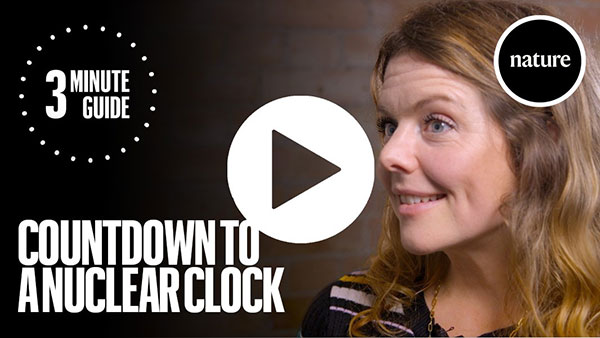
| Researchers have been chasing the concept of a nuclear clock for more than 20 years. Last year, Nature reporter Elizabeth Gibney explained how the imminent discovery could improve on state-of-the-art atomic clocks. (Nature | 4 min watch) | |||||
A whole new kind of clock starts tickingTwo research teams, one in Europe and one in China, have made the world’s first ‘nuclear’ clocks. These clocks derive their ‘tick’ from the energy that makes protons and neutrons inside the nucleus of thorium-229 shift to a higher energy level. The groups used similar approaches to solve the problem that’s hindered nuclear-clock development in the past: how to keep the clock’s tick speed from drifting over time. Creating a nuclear clock is “a dream come true”, says atomic physicist Thorsten Schumm, a member of the European team. “Now we have a fierce but friendly global competition.” Nature | 5 min readReference: arXiv preprint 1 & preprint 2 (not peer reviewed) |
|||||
Bird flu has reached every continentThe H5N1 strain of avian influenza has been detected in two wild birds in Australia — the first cases of the disease on the continent. There’s no evidence that the virus has killed large groups of birds or mammals, but at least 58 sick or dead birds have been reported on an emergency hotline. Mainland Australia had previously been a stronghold against the virus, but “we all knew we couldn't be bird flu-free forever”, says Julie Collins, the country’s agricultural minister. BBC | 4 min read & ABC News | 6 min read |
|||||
Backlash saves US ocean observatoryThe US National Science Foundation (NSF) announced last week that it will no longer proceed with Trump administration plans to dismantle much of the Ocean Observatories Initiative — a network of hundreds of instruments used to monitor ocean science and climate change. Some devices had already been removed, and the NSF said that it is “developing plans to redeploy the equipment after servicing”. The change came after a bipartisan effort by some lawmakers to stop the system from being taken apart. The New York Times | 8 min read |
|||||
|
|||||
A changing climate threatens our heritageIn The Future of the Past, art historian Thijs Weststeijn looks at heritage sites threatened by climate change to explore how the idea of heritage has developed over time. He argues that concepts such as ‘world heritage’ — a term used to designate places on Earth of outstanding universal value to humanity — are rooted in Eurocentric frameworks, which can limit how people respond to cultural loss in other parts of the world. The book “is a valuable contribution to an increasingly necessary debate”, writes archaeologist William Megarry in his review. Nature | 6 min read |
|||||
Ukraine toils to save museum specimens“This skull is basically one of the most important Chilotherium specimens currently existing in Europe,” says palaeontologist Panagiotis Kampouridis, referring to a fossil of a hornless rhino that resides in Ukraine’s National Museum of Natural History. The Chilotherium sarmaticum is just one of thousands of specimens and artifacts that museum staff are digitizing so that researchers worldwide can still study them — and before they are potentially destroyed by Russian bombardment. At the same time, some curators struggle to define the value of their work in a time of war. bioGraphic | 6 min read |
|||||
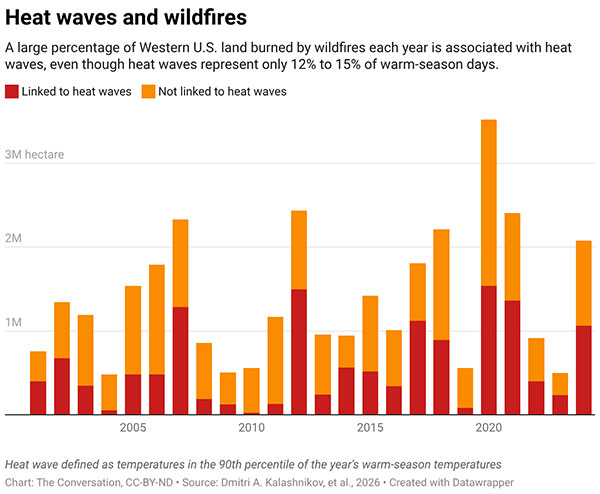
Heat waves mean fire: here’s why“We expected a big impact, but the numbers still surprised us,” write wildfire and climate researchers Dmitri Kalashnikov, Cong Yin, Madhulika Gurazada and Mukesh Kumar. Their research found that only a small fraction of ‘warm-season’ days in the western United States count as heat waves, which the team define as three or more consecutive days with temperatures in the top tenth of hottest days. But a huge chunk of the area burned by fires was affected during or immediately after a heat wave. It turns out that heat waves not only create tinder-dry fuel sources, they also limit fire-suppressing humidity at night and promote lightning that can ignite vegetation. High Country News | 6 min readReference: ScienceAdvances paper |
|||||
|
|||||
| (The Conversation (CC-BY-ND)) | |||||
The Walmart way to boost generalizabilityAs chief economist at the retail chain Walmart, John List and his team are running natural field experiments with more than 6,000 suppliers to test which factors will most effectively incentivize reductions in carbon emissions. List argues that such tests, in which researchers vary a feature of the environment and watch how it affects people’s everyday activities, can help tackle the challenge of generalizability: where interventions that worked in one place fail to work in another or when scaled up. Nature | 14 min read |
|||||
Quote of the day“A better AI-assisted research workflow would use the technology not simply to produce a paper faster, but to move ideas across fields sooner.”Artificial intelligence’s ability to enrich science will depend on whether researchers, reviewers and funders reward originality over speed, argues Xizhe Zhang, who does work which spans algorithm design, biological-data analysis and clinical studies. (Nature | 7 min read) |
|||||
|
|
|||||
|
|||||
|
|
|||||
Free newsletters from NatureWant more? Update your preferences to sign up to our other Nature Briefing newsletters:
|
|||||
|
|||||
|
You received this newsletter because you subscribed with the email address: - Please add [email protected] to your address book. Enjoying this newsletter? You can use this form to recommend it to a friend or colleague — thank you! Had enough? To unsubscribe from this Briefing, but keep receiving your other Nature Briefing newsletters, please update your subscription preferences. To stop all Nature Briefing emails forever, click here to remove your personal data from our system. Fancy a bit of a read? View our privacy policy. Forwarded by a friend? Get the Briefing straight to your inbox: subscribe for free. Want to master time management, protect your mental health and brush up on your skills? Sign up for our free short e-mail series for working scientists, Back to the lab. Get more from Nature: Register for free on nature.com to sign up for other newsletters specific to your field and email alerts from Nature Portfolio journals. Would you like to read the Briefing in other languages? 关注Nature Portfolio官方微信订阅号,每周二为您推送Nature Briefing精选中文内容——自然每周简报。
Nature Portfolio | The Springer Nature Campus, 4 Crinan Street, London, N1 9XW, United Kingdom Nature Portfolio, part of Springer Nature. |