How to bounce back from a PhD-project failure
What matters in science |

Is this your brand on Milled? Claim it.
|
|||||
|
|||||
|
Hello Nature readers, |
|||||
|
|||||
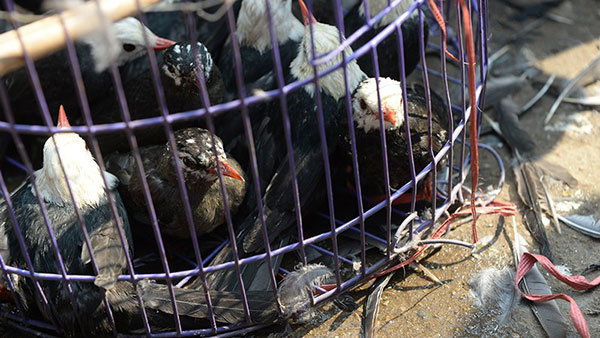
| Wild birds are sold for food at a market in Vietnam. (Hoang Dinh Nam/AFP/Getty) | |||||
Where livelihoods depend on wild speciesBillions of people worldwide rely on at least 50,000 species of wild plants and animals for food, medicine and income. Dozens of authors, including individuals with Indigenous and local knowledge, were involved in a major attempt by the Intergovernmental Science-Policy Platform on Biodiversity and Ecosystem Services (IPBES) to quantify how much humanity relies on nature. The report highlights many examples of wild species being used sustainably, and recommends ways to support and replicate those methods. Critics say there are significant gaps in the evidence and question whether some cases are as sustainable as they seem. The report’s authors acknowledge those gaps but say they shouldn’t slow efforts to introduce better practices. Nature | 5 min readReference: IPBES Sustainable Use Assessment |
|||||
DeepMind AI learns physics like a babyResearchers at Google-owned company DeepMind have created an artificial intelligence (AI) that knows about as much physics as a 3-month-old baby. The team trained the system on simple videos until it could predict patterns such as solidity (two objects do not pass through one another) and continuity (objects do not blink in and out of existence). The research makes an interesting contribution to the nature–nurture debate about how infants learn to see the world, say psychologists Susan Hespos and Apoorva Shivaram in the accompanying News & Views article. The results suggest that experience “is an important contribution to the learning process, but it is not the whole story. The complete story requires some built-in knowledge.” Nature | 4 min read & Nature Human Behaviour | 5 min readReference: Nature Human Behaviour paper |
|||||
|
|||||
|
|||||
|
|||||
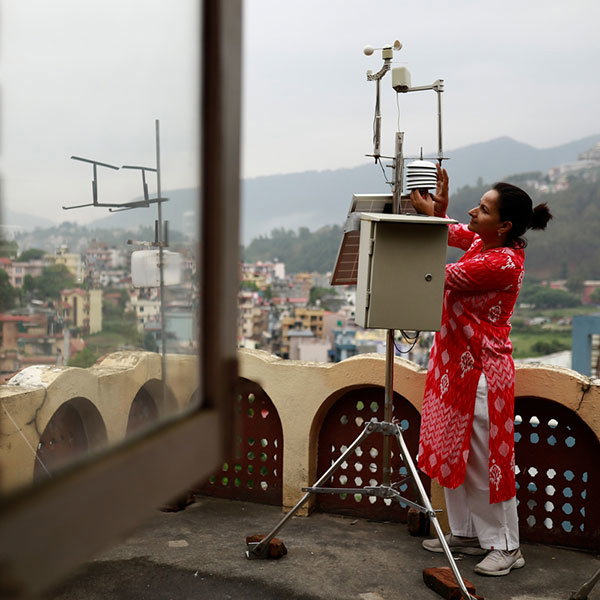
| With no research institute in Nepal equipped to support her drought research, environmental scientist Hemu Kafle helped to establish a new one. She is pictured here with one of the low-cost meteorological stations that she and her colleagues designed and developed at the Kathmandu Institute of Applied Sciences. (Nature | 3 min read) (Monika Deupala for Nature) | |||||
|
|||||
Bounce back from a PhD-project failureScience is riddled with stories of getting scooped, data glitches and funding crises — which can feel particularly acute for PhD candidates who are racing against time to earn their degrees. Five researchers talk about the hurdles they faced and how they overcame them. Nature | 11 min read |
|||||
‘Why I advocate for abortion access for all’“I know in my heart that I would never have become a scientist had I not had my abortion,” writes palaeoecologist Jacquelyn Gill. She never regretted her decision, she says, but she has carried a lifetime of grief because of unnecessary barriers that made the experience more invasive, expensive and traumatic than it had to be. She shares her deeply personal story to illustrate that “reproductive justice matters to science not only because scientists get abortions, but also because so many scientists are well-positioned to use our privilege and roles as trusted experts to de-stigmatize and support abortion rights for everyone”. Nature | 5 min read |
|||||
How BA.5 is reshaping the pandemicThe rise and rise of the BA.5 variant of SARS-CoV-2 — a sub-variant of Omicron — raises questions about how we will deal with a pandemic in which many more people get COVID-19 or experience repeated reinfections. Focusing on the United States, where the variant is spreading quickly, science writer Ed Yong debunks some false assumptions. He also urges US leaders to tighten up the country’s slackening health-protection policies against COVID-19. “This is what ‘living with COVID” means’,” writes Yong. “A continual cat-and-mouse game that we can choose to play seriously or repeatedly forfeit.” The Atlantic | 10 min read |
|||||
|
|||||
|
|||||
|
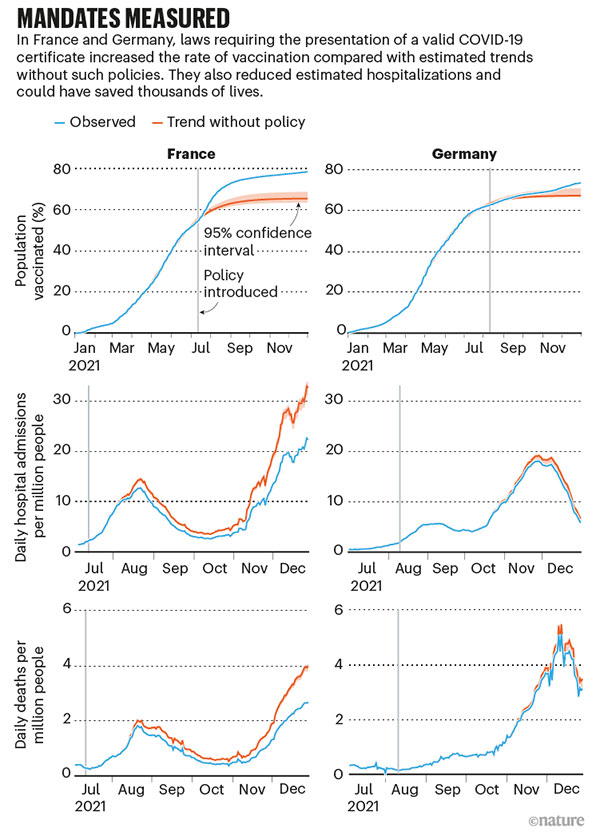
Public-health researchers have found that the ‘measure of last resort’ for increasing vaccination rates — legal interventions such as vaccine mandates and passes — increased vaccine uptake and reduced hospitalizations and deaths. But scientists say it is hard to accurately quantify how obligatory vaccination policies affected social exclusion, loss of public trust or inequitable outcomes. (Nature | 13 min read ) See more of the week’s key infographics, selected by Nature’s news and art teams. (Source: M. Oliu-Barton et al. Preprint at Research Square https://doi.org/h4s5 (2022).) |
|||||
Quote of the day“We have a climate crisis going on that we’re trying to respond to, but then we also have a moral crisis that we can’t ignore.”Marine biologist Brendan Kelly is among the climate researchers facing a loss of crucial climate data as the war in Ukraine severs partnerships between researchers inside and outside Russia. (Nature | 7 min read) |
|||||
|
|
|||||
|
|||||
|
|
|||||
|
|||||
|
You received this newsletter because you subscribed with the email address: - Please add [email protected] to your address book. Enjoying this newsletter? You can use this form to recommend it to a friend or colleague — thank you! Want to switch to the weekly edition or change your email address? Update your preferences. Had enough? Unsubscribe from the Nature Briefing. Fancy a bit of a read? View our privacy policy. Forwarded by a friend? Get the Briefing straight to your inbox: subscribe for free. Want to master time management, protect your mental health and brush up on your skills? Sign up for our free short e-mail series for working scientists, Back to the lab. Get more from Nature: Register for free on nature.com to sign up for other newsletters specific to your field and email alerts from Nature Research journals. Would you like to read the Briefing in other languages? 关注Nature Portfolio官方微信订阅号,每周二为您推送Nature Briefing精选中文内容——自然每周简报。
Nature | The Springer Nature Campus, 4 Crinan Street, London, N1 9XW, United Kingdom Nature Research, part of Springer Nature. |