Huge DNA Borg structures perplex scientists
What matters in science |

Is this your brand on Milled? Claim it.
|
|||||
|
|||||
|
Hello Nature readers, |
|||||
|
|||||
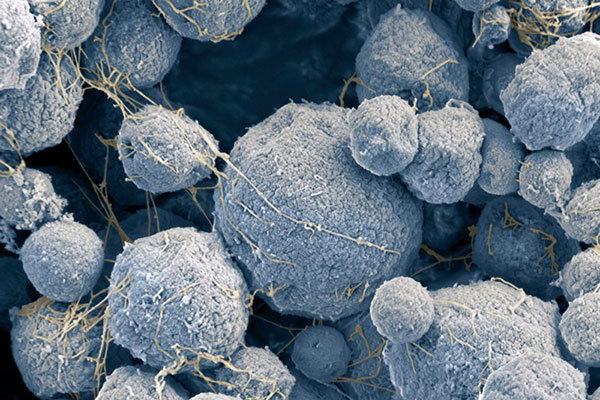
| Borgs seem to be associated with single-celled microorganisms known as archaea, shown in this scanning-electron microscopy image. (Eye of Science/SPL) | |||||
Huge DNA ‘Borg’ structures discoveredThe Borg have landed — or, at least, researchers have discovered their counterparts here on Earth. Scientists analysed samples from muddy sites in the western United States and found DNA structures that seem to scavenge and ‘assimilate’ genes from microorganisms in their environment, much like the fictional Star Trek ‘Borg’ aliens who assimilate the knowledge and technology of other species. These extra-long DNA strands, which the scientists named in honour of the aliens, join a diverse collection of genetic structures — circular plasmids, for example — known as extrachromosomal elements. Nature | 8 min read |
|||||
|
|
|||||
New chief for US Climate AssessmentThe US government has appointed a new director to lead the nation’s next major climate assessment: Allison Crimmins, who has worked on climate issues for the past decade at the US Environmental Protection Agency. She will work with environmental toxicologist Mike Kuperberg, who in May was restored as head of the US Global Change Research Program, which coordinates climate activities across 13 federal agencies. By law, the United States must produce its influential assessment of the latest climate science every four years. The finalized roster marks the end of a turbulent period for the government’s climate team. “We’re behind, and we need to get to work,” says climate scientist Donald Wuebbles. Nature | 5 min read |
|||||
|
|
|||||
Astronomers push for debate on satellitesAstronomers are working to see whether the UN Committee on the Peaceful Uses of Outer Space might take up the topic of satellite ‘megaconstellations’ at its next meeting, which begins on 25 August. They say the goal is not to pit astronomers — who are worried about how satellites will interfere with their observations of the sky — against satellite companies, but to develop a vision of how to fairly use the shared realm of outer space. Aerospace companies have launched about 2,000 Internet satellites into orbit around Earth over the past 2 years, with tens of thousands more expected. Nature | 6 min read |
|||||
|
|
|||||
Podcast: England’s risky COVID strategyToday, England is facing what has been dubbed ‘freedom day’ — the end of nearly all measures for mitigating the spread of COVID–19. Around 68% of the adult population is fully vaccinated, and that progress has weakened the link between infections and hospitalizations or deaths. But the United Kingdom’s infection rate, driven by the rise of the Delta variant, is among the highest in the world — almost 40,000 new cases per day. Nature’s Coronapod explores an unprecedented public-health experiment that could provide the perfect breeding ground for vaccine-resistant variants. Nature Coronapod Podcast | 21 min listenSubscribe to the Nature Podcast on Apple Podcasts, Google Podcasts or Spotify. |
|||||
|
|||||
|
|||||
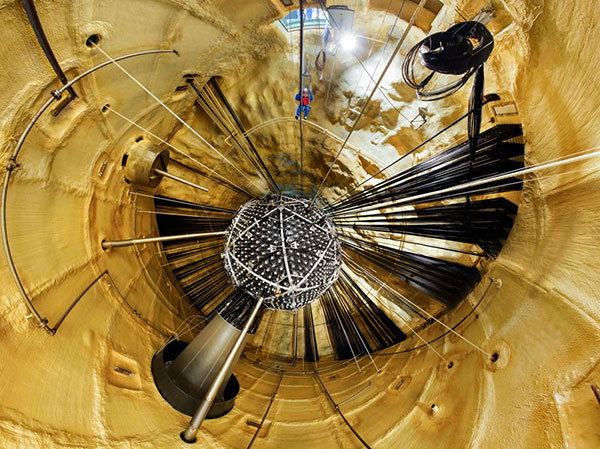
| The SNO+ detector under construction in Sudbury, Canada. (Volker Steger/SPL) | |||||
Search for vanishing neutrinos ramps upPhysicist Ettore Majorana notoriously disappeared in 1938 without a trace. His favourite elementary particles, neutrinos, might be capable of a similar vanishing act. Several new or upgraded experiments around the world are racing to show that an extremely rare kind of nuclear decay that normally produces two neutrinos might occasionally yield none. Physicists have looked for these disappearing ‘Majorana neutrinos’ for decades, but they now “have a really good shot” at detecting them with the next generation of devices, says experimental physicist Michelle Dolinski. Experiments that are now online or are being built in Japan, South Korea, Italy, Canada and the United States are an order of magnitude more sensitive than the previous generation, and planned future detectors would improve on that by another two orders of magnitude. Nature | 12 min read |
|||||
|
|
|||||
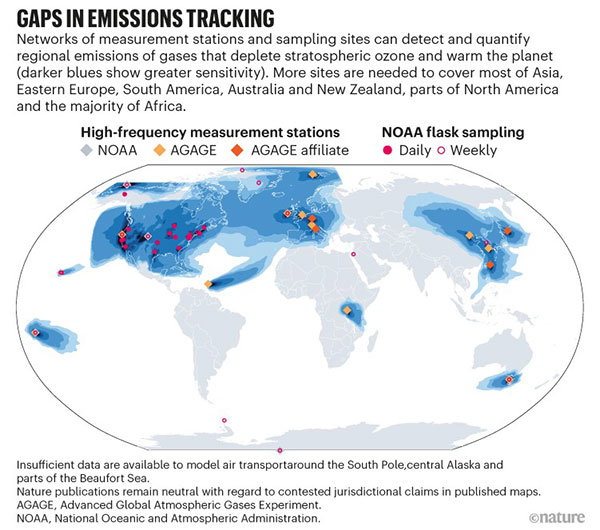
Fix blind spots in emissions monitoringIn 2018, the detection of rogue emissions of banned ozone-depleting chemicals shocked scientists. The discovery relied on a lucky coincidence, write atmospheric chemists Ray Weiss, A. R. Ravishankara and Paul Newman. “The emissions came from regions upwind of monitoring stations that collect data frequently,” they note. “It is unlikely that this will be the case next time.” They outline how the world can take a systematic, coordinated approach to monitoring gases that destroy the ozone layer and cause climate change. Nature | 8 min read |
|||||
|
|||||
|
|
|||||
Science in sign languageDeaf scientists are developing conceptually accurate American Sign Language (ASL) signs for scientific terms. So, for example, one ASL sign for ‘electron’ — a single finger wiggling in the air — is updated to represent an electron orbiting the nucleus of an atom: a finger encircling a closed fist. There can even be multiple signs for the same concept: three signs for ‘molecule’ are based on large biomolecules such as proteins, another symbolizes an atomic grouping as analysed in physics, and a fifth suggests molecules undergoing a chemical reaction. As with any language, ultimately the ASL-speaking community will decide the signs that become established in regular use. Chemistry & Engineering News | 16 min read |
|||||
Quote of the day“The degree of support that a researcher receives — when they receive it at all — needs to be more nuanced than simple blanket extensions to everyone.”Science needs a new reward and recognition system to cope with the unequal impact of the pandemic, argue researchers and Young Academy leaders Edyta Swider-Cios, Katalin Solymosi and Mangala Srinivas. (Nature | 7 min read) |
|||||
|
|
|||||
|
|||||
|
|
|||||
|
|||||
|
You received this newsletter because you subscribed with the email address: - Please add [email protected] to your address book. Enjoying this newsletter? You can use this form to recommend it to a friend or colleague — thank you! Want to switch to the weekly edition or change your email address? Update your preferences. Had enough? Unsubscribe from the Nature Briefing. Fancy a bit of a read? View our privacy policy. Forwarded by a friend? Get the Briefing straight to your inbox: subscribe for free. Want to master time management, protect your mental health and brush up on your skills? Sign up for our free short e-mail series for working scientists, Back to the lab. Would you like to read the Briefing in Arabic? Sign up for the weekly round-up e-mail, curated and translated by the editors of Nature Arabic Edition. Nature | The Springer Nature Campus, 4 Crinan Street, London, N1 9XW, United Kingdom Nature Research, part of Springer Nature. |