Orcas smash sunfish to smithereens — possibly for fun
What matters in science |

Is this your brand on Milled? Claim it.
|
|||||
|
|||||
|
Hello Nature readers, |
|||||
|
|||||
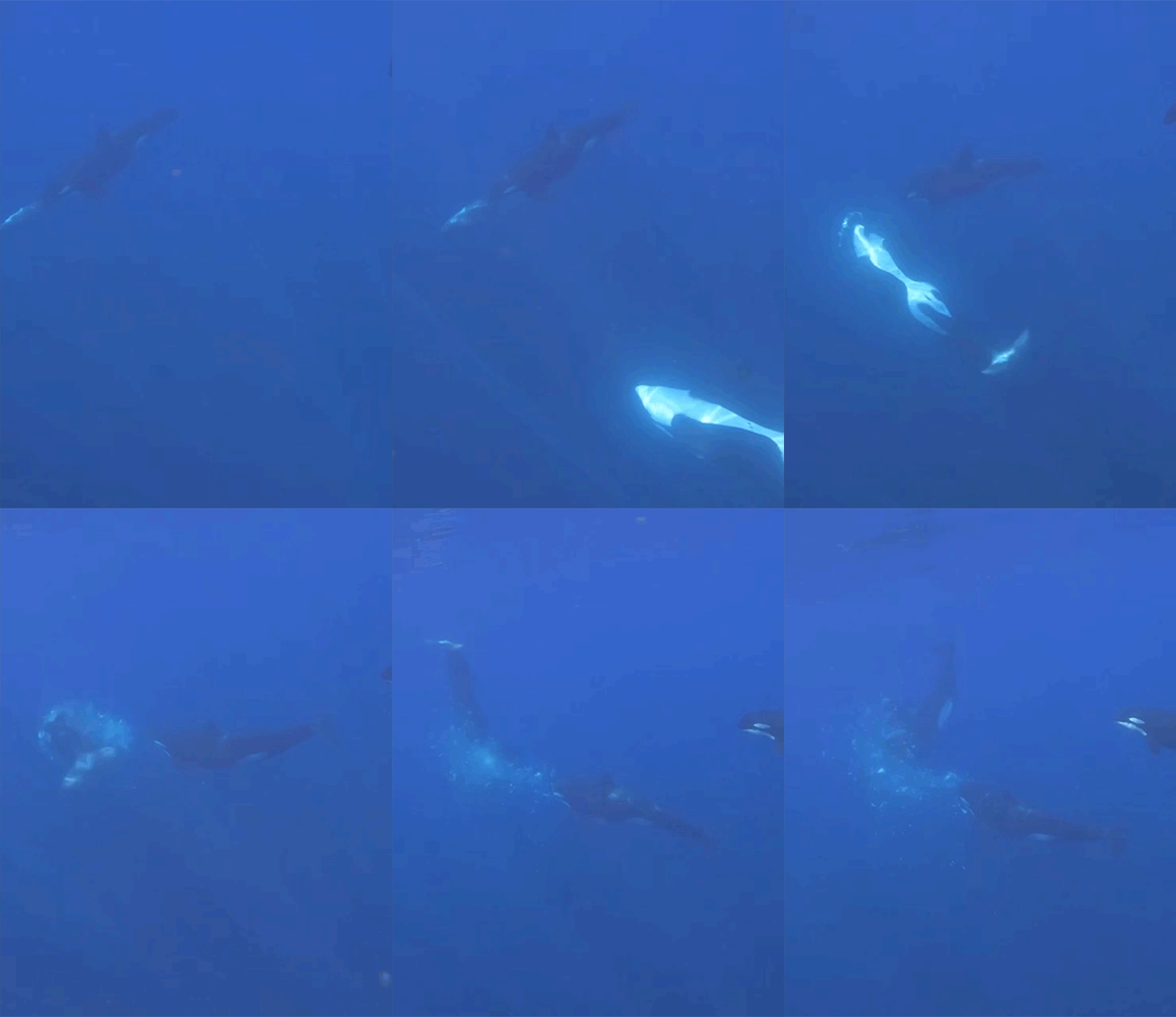
| Whatever its purpose, the set up for this body-slamming behaviour requires impressive cognitive sophistication, the study authors write. (Kathryn Ayres) | |||||
Orcas smash sunfish to smithereensOrcas (Orcinus orca) have been spotted ramming sharp-tail sunfish (Masturus lanceolatus) so hard that they explode. The gory display involved a female orca holding a dead sunfish in place for a male to speed into. In the aftermath, a juvenile orca ate some of the fleshy pieces of the fish, while the adult pair snacked on the carcass. “We think this may help younger orcas feed more easily,” says marine ecologist and study co-author Kathryn Ayres. “Or it could also just be for fun. Orcas are known for playing with their food.” The Guardian | 3 min read or Nature | 2 min videoReference: Frontiers in Ethology paper |
|||||
Inside the heart’s ‘mini brain’Scientists have begun to unpick the inner workings of the heart’s ‘mini brain’ — a network of neurons embedded in the fat pad surrounding the heart. In mice, researchers identified two subtypes of these neurons. One type, Npy+, puts the brakes on a racing heart, but is necessary to keep it beating. The other, Ddah1+, appears to help the mice’s hearts cope with stress. The findings demonstrate that these neurons do more than just passively relay signals from the brain, says chemical physiologist Beth Habecker. Nature | 5 min readReference: Cell paper |
|||||
Fields Medal winners announcedThe 2026 Fields Medal — one of maths’ most coveted prizes — has been awarded to mathematicians Yu Deng, John Pardon, Jacob Tsimerman and Hong Wang. The group represents a range of subfields of maths, from number theory to mathematical physics, and had all been rumoured as favourites to win the award. Deng and Wang are only the second and third Chinese nationals to have earned a Fields Medal, and Wang is only the third woman to win in the award’s 90-year history. Nature | 6 min read |
|||||
The alternatives to air conditioningAir conditioners are one option to keep people cool during increasingly frequent and intense heatwaves, but the technology has too many drawbacks to be the sole solution, say scientists. Instead, materials that are designed to passively cool buildings could be the way forward, they suggest. Materials that are layered, contain bubbles and air pockets or combine radiative cooling with evaporation could achieve the same effect as air conditioning without using energy, says architecture researcher Matthaios Santamouris. But many of these materials are still in prototype stages, and would require policies to encourage their use. Nature | 5 min readReference: Nature Reviews Clean Technology paper |
|||||
Doctored data sets could trick AI agentsResearchers have demonstrated how easy it is for fraudsters to ‘poison’ online datasets and thereby muddle the work of AI agents, which are increasingly used to analyse such data. “Attacks of this nature are almost inevitable, because they enable people to launder false information through an authoritative-sounding filter,” says computer scientist Vitaly Shmatikov. The team recommends ways to prevent AI agents from basing conclusions on manipulated data, such as including a SKILL.md file — an example of which they posted online for free reuse — that prompts AI agents to carry out detailed provenance checks. Nature | 6 min readReference: arXiv preprint 1 & preprint 2 (not peer reviewed) |
|||||
|
|||||
|
|||||
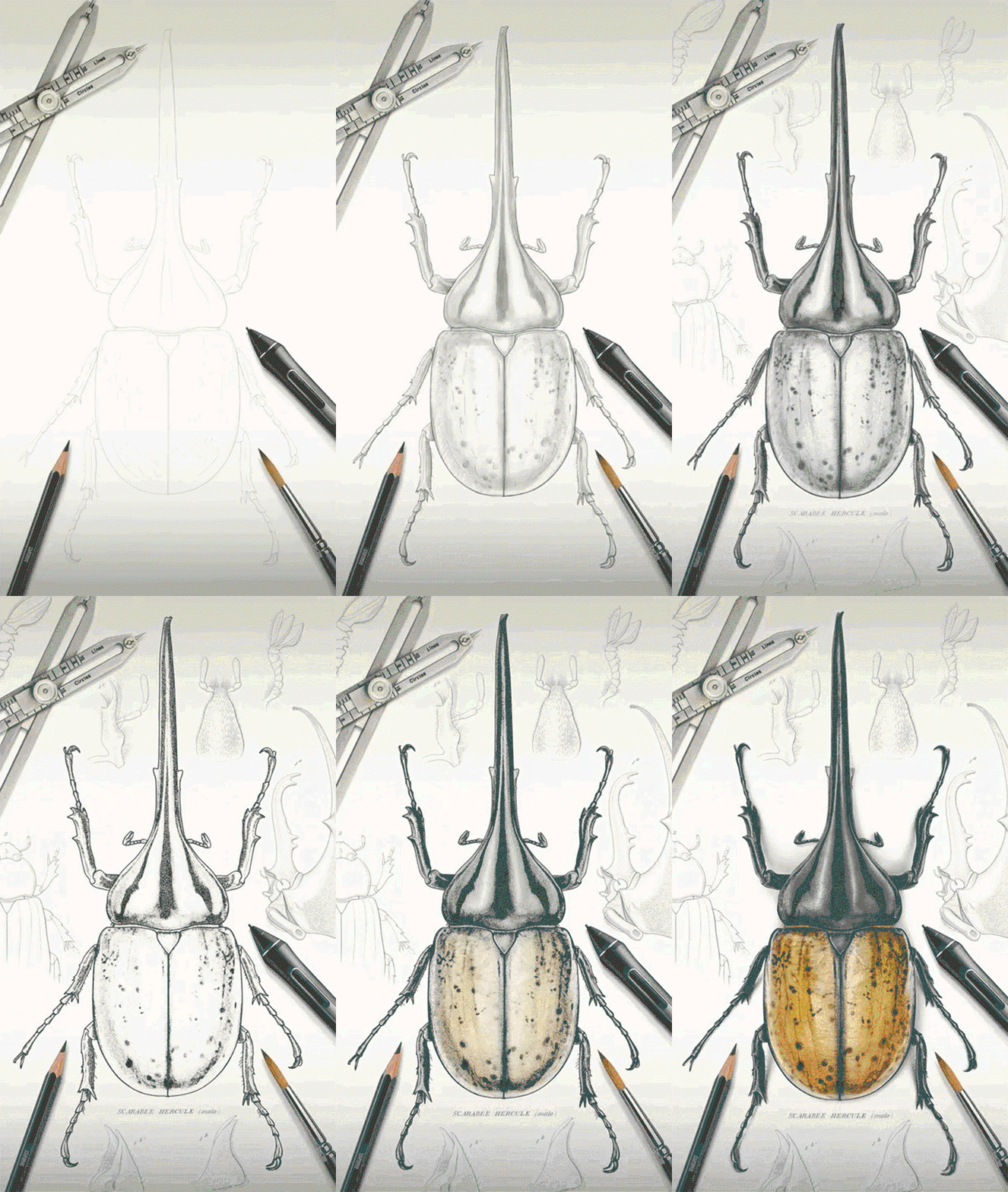
| (Richard Tibbitts/Nature) | |||||
The human art of illustrationFive artists explain what it takes to create an accurate, engaging image that conveys a scientific concept, and their vision of the future of scientific illustration in the age of artificial intelligence. “Good design takes mastery, not merely of tools and techniques, but also of judgement,” says illustrator Shehryar Saharan. “Sometimes that process means confronting questions that research has not yet resolved. In those moments, illustration can become a way of generating knowledge rather than simply communicating it.” Nature | Visual-packed scroll |
|||||
What’s next for Artemis II’s astronauts?The Artemis II flight in April captured the world’s attention as four astronauts whizzed around the far side of the Moon. Now back on Earth, what will they do once the ‘Moon joy’ wears off? While many astronauts forge thriving post-space careers, others struggle to find their next pursuit, says former astronaut Susan Kilrain. “The ones that are really successful in a post-flight career are the ones where being an astronaut didn’t define them,” says Kilrain, one of the only women, and the youngest person ever, to fly a Space Shuttle. Nature | 8 min read |
|||||
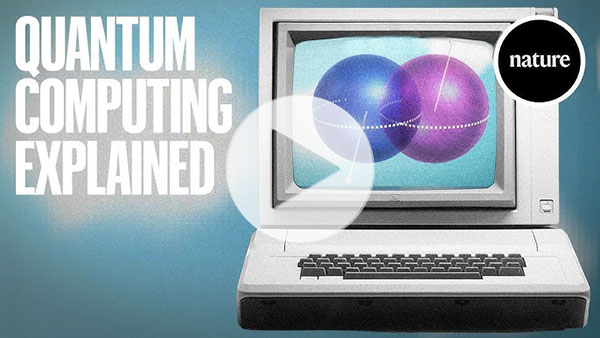
Video: quantum computers 101Researchers are developing ever-more advanced quantum computers at a breakneck pace. Some scientists predict that usable quantum devices capable of solving currently intractable problems will hit the market within the next decade. But how can quantum devices solve problems that conventional machines can’t? And what even is a quantum computer? Nature reporter Davide Castelvecchi is on hand to answer these questions, and more, in this handy explainer video. Nature | 5 min video |
|||||
|
|||||
Quote of the day“If you look at Watson and Crick’s 1953 Nature publication, it’s less than a page, and reads more like the start of a research proposal than a paper … There’s no way that that would be published in the same form with two authors today.”Nature Index data show that the number of papers authored by small teams has been declining over the past decade. The shift reflects the complexity that’s expected in modern-day publications, which can require extensive experimentation and data collection, says chemist David Leigh. (Nature Index | 8 min read) |
|||||
|
|
|||||
|
|||||
|
|
|||||
Free newsletters from NatureWant more? Update your preferences to sign up to our other Nature Briefing newsletters:
|
|||||
|
|||||
|
You received this newsletter because you subscribed with the email address: - Please add [email protected] to your address book. Enjoying this newsletter? You can use this form to recommend it to a friend or colleague — thank you! Had enough? To unsubscribe from this Briefing, but keep receiving your other Nature Briefing newsletters, please update your subscription preferences. To stop all Nature Briefing emails forever, click here to remove your personal data from our system. Fancy a bit of a read? View our privacy policy. Forwarded by a friend? Get the Briefing straight to your inbox: subscribe for free. Want to master time management, protect your mental health and brush up on your skills? Sign up for our free short e-mail series for working scientists, Back to the lab. Get more from Nature: Register for free on nature.com to sign up for other newsletters specific to your field and email alerts from Nature Portfolio journals. Would you like to read the Briefing in other languages? 关注Nature Portfolio官方微信订阅号,每周二为您推送Nature Briefing精选中文内容——自然每周简报。
Nature Portfolio | The Springer Nature Campus, 4 Crinan Street, London, N1 9XW, United Kingdom Nature Portfolio, part of Springer Nature. |