‘Raygun’ AI can shrink or supersize proteins
What matters in science |

Is this your brand on Milled? Claim it.
|
||
|
||
|
Hello Nature readers, |
||
|
||
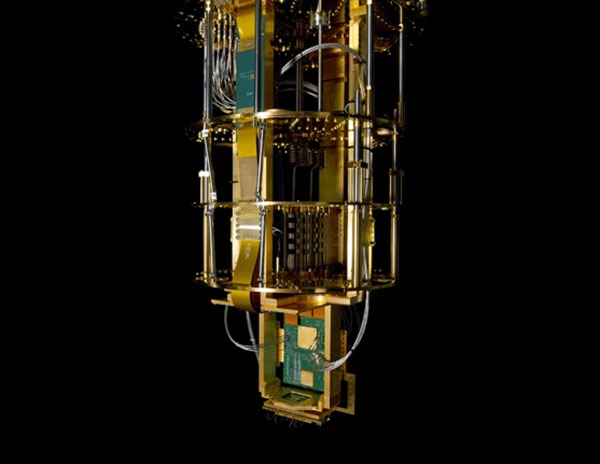
| Systems considered front-runners in the race to build a useful quantum computer encode information in the electrons of superconducting circuits or in ions and atoms confined by light. (HRL Laboratories) | ||
Spin qubits catch up in quantum raceFour independent research teams have reported big advances in the design of quantum devices that rely on ‘spin qubits’ to encode information. Spin qubits are made by carving precise patterns into semiconductor wafers, forming wells that can hold a single electron. In the race to create a useful quantum computer, this design had previously not been considered a front-runner, because systems that used spin qubits were small and had high error rates. The new systems range from 5 to 18 qubits, and one has slashed the error rate to less than 0.01%. Nature | 6 min readReference: Nature paper 1 & paper 2 and arXiv preprint 1 & preprint 2 (not peer reviewed) |
||
Honey, I shrunk the proteinsAn artificial-intelligence tool dubbed ‘Raygun’ can miniaturize or supersize a natural protein without disrupting the protein’s shape or ability to function. Raygun can modify existing proteins, using some of the same steps as natural evolution: adding or deleting single protein subunits or substituting one protein subunit for another. Raygun can make “exactly what researchers want — not a completely new protein, but a better, smaller, larger or more adaptable version of one they already trust,” says computational biologist Fajie Yuan. Nature | 4 min readReference: Nature paper |
||
Drugs show promise to prevent long COVIDThe results of rigorous clinical trials suggest that two drugs can prevent an infection with COVID-19 from developing into long COVID, a chronic condition characterized by fatigue and cognitive impairment. The first trial reported that paxlovid, an antiviral COVID-19 treatment, reduced the risk of long COVID developing after three months by 40%. Another reports that the diabetes drug metformin reduces the risk of long COVID at six months after infection by around half. The trial results have divided physicians — some think the results are promising enough to start prescribing the drugs for this purpose; others disagree. Nature | 6 min readReference: The Lancet Infectious Diseases paper & Clinical Infectious Diseases paper |
||
|
||
|
||
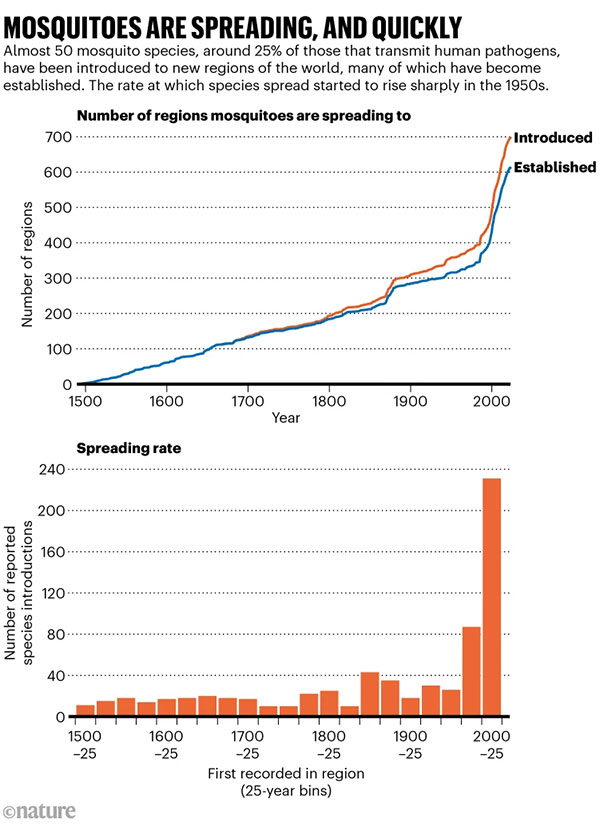
| Disease-carrying mosquitoes have now spread to previously unaffected regions in Europe, Asia, the Americas and Australia. Climate change has made some regions more suitable for mosquitoes than they were, with warm temperatures and rain extending over longer periods of the year giving the insects more time to get established and spread disease. Live mosquitoes can also travel on cars, trains and planes, covering long distances in just a few hours, so the expansion of global trade routes has also enabled the spread of mosquito-borne diseases. (Nature | 6 min read) | ||
|
||
We can’t stop Ebola without trustWithout an available vaccine or treatments for the Bundibugyo species of Ebola spreading in the Democratic Republic of the Congo (DRC), controlling the outbreak relies on identifying and isolating cases. These measures can’t succeed without public trust, but efforts to build it aren’t considered a core public health intervention, argue a group of public-health researchers. The DRC, and other countries affected by Ebola, must plan and finance social and behavioural change programs “as a core pillar of outbreak preparedness and response, not as a communications add-on”, the group writes. Nature Africa | 5 min read |
||
The dangerous return of the leopardSince the 1990s, communities across Nepal have successfully led efforts to restore large areas of forest land in the country — and with it, habitats for predators such as leopards (Panthera pardus). The reintroduction of these carnivores is a conservation success, but their proximity to villages has led to attacks on people and livestock. Protections such as spiked collars for farm animals and strong fences could lessen the frequency of such encounters, researchers suggest. But programs that provide financial compensation are key to diffuse tension between residents and their new neighbours, they say. Knowable | 7 min read |
||
Using stats to fight human-rights violationsSocial-justice campaigner Mary Gray uses her background as a statistician to fight human-rights abuses. Her pursuit of law in the 1970s, after obtaining a PhD in mathematics, was fuelled by the inequitable retirement benefits for men and women. Since then, she’s worked to combat workplace discrimination in the United States, and led projects to combat human-rights violations in the wake of the genocide in Rwanda. “If you think something is important, stick with it yourself, work hard and try to enlist others,” she says. Nature | 9 min read |
||
Quote of the day“The aliens would turn tail and head back to Mars.”Tech firm Lonestar Data Holdings plans to beam the sound of bagpipes playing onto the Moon. Cancer researcher David Kerr, who plays in the pipe band whose music Lonestar hopes to use, jokes that the sound could be used to deter extraterrestrials planning to invade Earth. (BBC | 5 min read) |
||
|
|
||
|
||
|
|
||
Free newsletters from NatureWant more? Update your preferences to sign up to our other Nature Briefing newsletters:
|
||
|
||
|
You received this newsletter because you subscribed with the email address: - Please add [email protected] to your address book. Had enough? To unsubscribe from this Briefing, but keep receiving your other Nature Briefing newsletters, please update your subscription preferences. To stop all Nature Briefing e-mails forever, click here to remove your personal data from our system. Fancy a bit of a read? View our privacy policy. Forwarded by a friend? Get the Briefing straight to your inbox: subscribe for free. Get more from Nature: Register for free on nature.com to sign up for other newsletters specific to your field and e-mail alerts from Nature Portfolio journals. Would you like to read the Briefing in other languages? 关注Nature Portfolio官方微信订阅号,每周二为您推送Nature Briefing精选中文内容——自然每周简报。
Nature Portfolio | The Springer Nature Campus, 4 Crinan Street, London, N1 9XW, United Kingdom Nature Portfolio, part of Springer Nature. |