See the ice-age art that hints at how humans flourished
What matters in science |

Is this your brand on Milled? Claim it.
|
||
|
||
|
Hello Nature readers, |
||
|
||
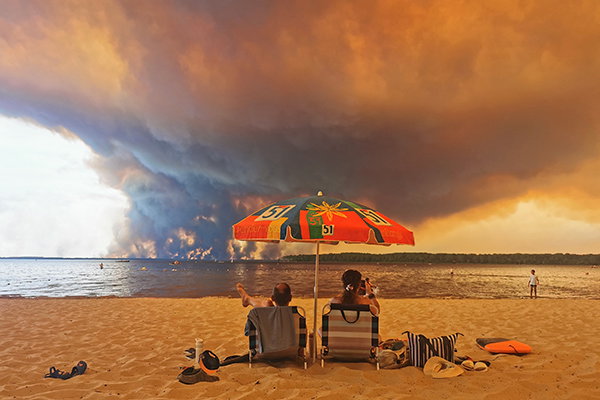
| Wildfires in Gironde, France are among those that have caused mass evacuations in the country, and brought dangerous pyroCb clouds. (Maximilien Lamy/AFP via Getty) | ||
Fire-chasers take to the skyFirefighters in Oregon and now France are battling wildfires big enough to generate spectacular, dangerous pyrocumulonimbus clouds (pyroCbs) — huge storm clouds that form in the hot updraft of big fires, generate wind and lightning, and exacerbate dangerous conditions. These fire storms also loft smoke into the stratosphere, where it can spread more readily around the globe, eat away at Earth’s protective ozone layer and influence weather and climate. That’s why scientists have just launched an airborne mission to observe these rare storms like never before, using a specially modified jet and a high-altitude NASA plane. Nature | 6 min read |
||
Inside the first Bundibugyo vaccine trialThe first trial to test an experimental vaccine for the Bundibugyo species of Ebola is underway, two months after the current outbreak in the Democratic Republic of the Congo and Uganda was declared an international public-health emergency. The trial aims to assess the safety of the vaccine and the immune response it generates before larger trials are rolled out in Uganda later this year. “We actually had in the freezer the right type of genetic sequence to let us make the Bundibugyo virus-specific vaccine really quickly,” immunologist Teresa Lambe, who’s leading the trial, tells Nature. “It looks like we’re going to need as many different tools as we have to combat this outbreak.” Nature | 5 min read |
||
Gene variant helps lizards get a gripA gene variant in some silver key anoles (Anolis scriptus) that improves the lizards’ grip might have helped them withstand the winds of two hurricanes that swept over their native Turks and Caicos Islands in 2017. Researchers found that lizards with a variant in a gene called hs6st1 had shortened fourth toes on their hind legs. The team investigated this variant’s effect in embryonic brown anoles (Anolis sagrei) — a similar but more lab-friendly species to silver key anoles. In the face of winds from powerful fans, brown anoles with this variant were better able to grip onto their perch than were those without it. Science | 5 min read |
||
Fewer retractions with open peer-reviewPapers with open peer-review reports are less likely to be retracted, says a preprint study. Researchers analysed more than 116,000 papers in Public Library of Science (PLOS) journals and found that among the 40% that opted for publicly available peer-review reports, there were around 100 retractions. There were more than 300 in the closed-review group. It might be that researchers who are confident in their work and who broadly embrace open-science practices are more likely to choose open peer review, says research-integrity specialist and study co-author Matt Spick. In that case, the choice itself could serve as an indicator of article quality. Nature Index | 7 min readReference: MetaArXiv preprint (not peer reviewed) |
||
|
||
|
||
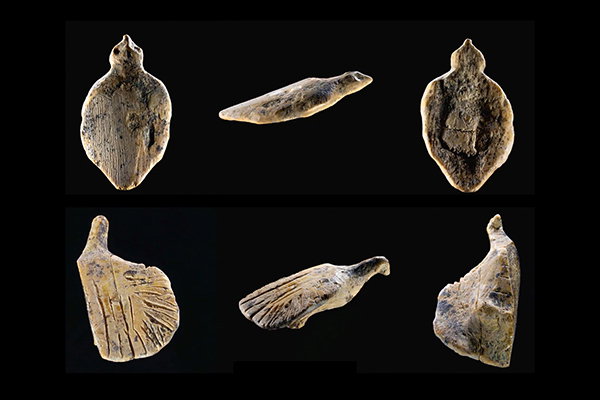
| These and other artifacts recovered from the Hohle Fels cave were made by Homo sapiens in a period called the Aurignacian, who were among the first humans known to leave behind depictions of their world. (R. Ehmann, University of Tübingen) | ||
Ice-age art hints at how humans flourishedThe newest finds from the Hohle Fels cave — a site in Germany that archaeologists have been exploring for decades — include a pair of tiny bird figurines carved from mammoth ivory, and fragments of a vulture-bone flute. These and other artworks found in the cave provide a window into the minds of some of Europe’s earliest Homo sapiens. Archaeologist Nicholas Conard, who leads the excavation, argues that the artistic capabilities of these early humans mark a shift in cognitive and cultural sophistication that might have helped them to flourish in ice-age Europe, when other groups vanished. Nature | 9 min read & 11 min video |
||
Cholera is not a solved problemWorldwide cases of cholera rose around 175% from 2021 to 2025. And the official figures are probably much lower than the true number, because the countries with the highest burden of the disease — those where access to clean water is unreliable — lack the resources to track its spread. These countries are also affected by armed conflicts or climate-driven floods, which further restrict access to clean water. The tools to prevent cholera deaths “are proven and inexpensive”, says epidemiologist Katrin Wallace. “What is missing is the investment to put them where they are needed.” The Conversation | 6 min read |
||
Quote of the day“AI is an accelerant, not the kindling. The kindling is publish or perish.”To stop the rise of AI-generated slop in the scientific literature, treat the illness and not the symptom, suggests Ivan Oransky, a specialist in academic publishing and co-founder of the media organization Retraction Watch. (Chemical & Engineering News | 11 min read) |
||
|
|
||
|
||
|
|
||
Free newsletters from NatureWant more? Update your preferences to sign up to our other Nature Briefing newsletters:
|
||
|
||
|
You received this newsletter because you subscribed with the email address: - Please add [email protected] to your address book. Had enough? To unsubscribe from this Briefing, but keep receiving your other Nature Briefing newsletters, please update your subscription preferences. To stop all Nature Briefing e-mails forever, click here to remove your personal data from our system. Fancy a bit of a read? View our privacy policy. Forwarded by a friend? Get the Briefing straight to your inbox: subscribe for free. Get more from Nature: Register for free on nature.com to sign up for other newsletters specific to your field and e-mail alerts from Nature Portfolio journals. Would you like to read the Briefing in other languages? 关注Nature Portfolio官方微信订阅号,每周二为您推送Nature Briefing精选中文内容——自然每周简报。
Nature Portfolio | The Springer Nature Campus, 4 Crinan Street, London, N1 9XW, United Kingdom Nature Portfolio, part of Springer Nature. |